By Boma West
Every July 30, the world marks the World Day Against Trafficking in Persons, a day set aside to remember millions of people whose lives have been destroyed by one of the world’s most profitable organised crimes. This year’s theme ; Trapped Behind the Scam, is a reminder that the fight against human trafficking must not stop at arresting traffickers. It must also put victims and survivors at the centre of every action.
At Blue North Initiative (BNI), this message is more than a campaign slogan. It is a commitment. BNI believes that every victim deserves protection, every survivor deserves a second chance, and every vulnerable person deserves the opportunity to live free from exploitation. While awareness remains an important tool, it cannot be the final destination. Victims need rescue, rehabilitation, justice, economic empowerment and successful reintegration into society.
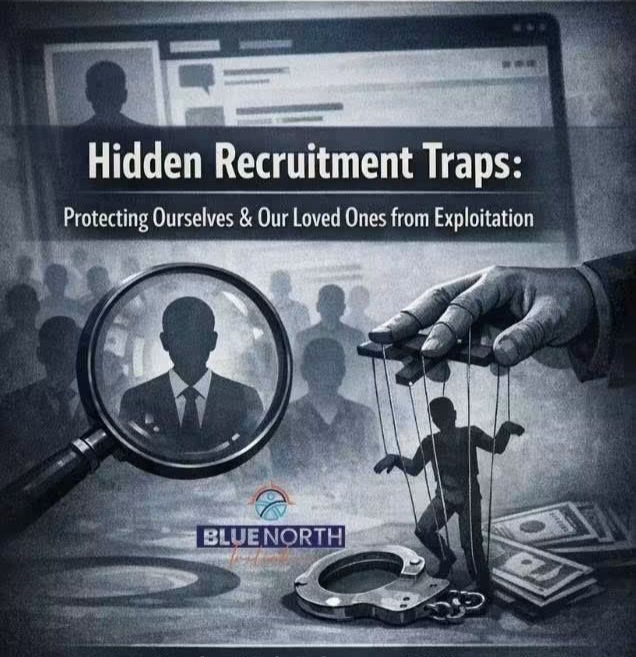
Nigeria continues to face an alarming human trafficking crisis. The crime has spread beyond border communities into every region of the country. Children are trafficked into domestic servitude, forced street hawking and begging. Young women are deceived with promises of decent jobs abroad only to become victims of sexual exploitation. Young men are recruited through fake employment offers and forced into labour, online scam operations and other forms of exploitation.
According to the National Agency for the Prohibition of Trafficking in Persons, more than 1,900 victims were rescued in 2024, while over 200 traffickers were convicted. The United Nations Office on Drugs and Crime also continues to identify Nigeria as one of the major source countries for trafficking victims within Africa and beyond. Behind every statistic is a human story. Many victims never return home. Many survivors continue to battle trauma long after their rescue.
Edo, Delta and Lagos remain among the states with the highest burden of trafficking because of irregular migration and their role as major transit points. Cases have also been recorded across Kano, Kaduna, Benue, Ogun and the Federal Capital Territory, proving that no part of Nigeria is immune.
Human trafficking survives because it feeds on poverty, unemployment, insecurity, poor education and hopelessness. Traffickers exploit these conditions by offering false hope to desperate families and unemployed youths. This is why awareness alone cannot end the crime. A hungry parent may still believe a trafficker’s promise. An unemployed graduate may still accept an unverified overseas job offer because survival comes before caution.
Blue North Initiative recognises the importance of community awareness and has continued to educate vulnerable communities through advocacy, public engagement and strategic partnerships. However, BNI believes that awareness must be matched with practical solutions. Communities need economic opportunities that reduce vulnerability. Young people need skills, employment and entrepreneurship support. Families need stronger social protection. Schools, faith-based organisations, traditional institutions, transport operators, financial institutions and technology companies must work together to prevent traffickers from recruiting and moving victims.
BNI also believes that the journey does not end when victims are rescued. Survivors should never be abandoned after leaving a shelter. They deserve trauma counselling, healthcare, education, vocational training, legal support and sustainable livelihoods that restore their dignity. They deserve acceptance instead of stigma, opportunity instead of rejection and hope instead of fear. Putting victims first means helping them rebuild their lives with confidence and purpose.
As Nigeria joins the rest of the world to commemorate the 2026 World Day Against Trafficking in Persons, Blue North Initiative calls on government, development partners, the private sector, community leaders and every Nigerian to move beyond awareness and embrace action. Ending human trafficking requires dismantling criminal networks, addressing the poverty and inequality that fuel exploitation and ensuring that every survivor receives the support needed to recover and thrive.
The fight against human trafficking will only be won when vulnerable families no longer see traffickers as a pathway out of poverty, when survivors can rebuild their lives with dignity and independence, and when every Nigerian understands that putting victims first is the surest path to ending human trafficking.