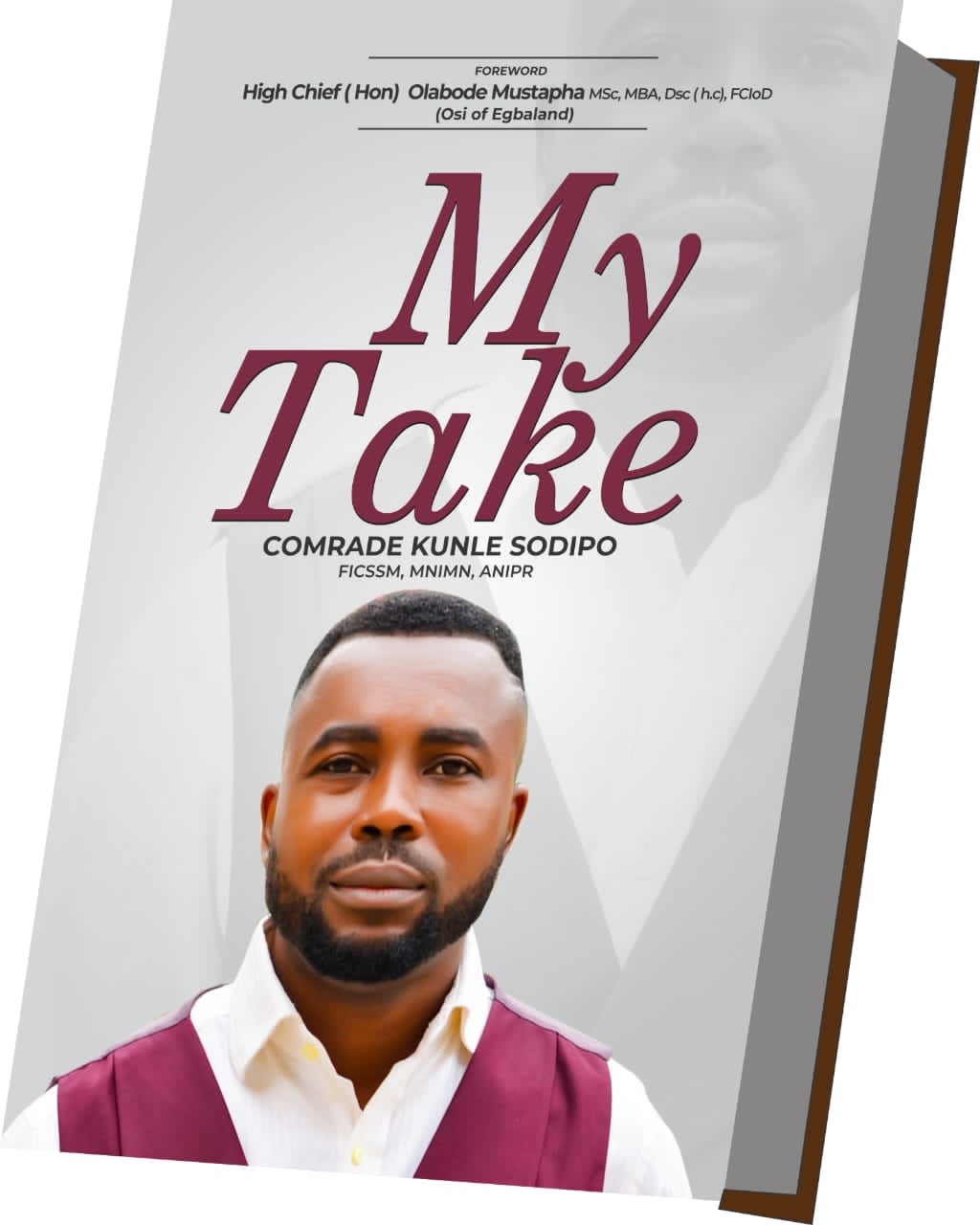
An Academic Review of Comrade Kunle Sodipo’sBook: My Take
(A Critique of Citizen-Led Development Discourse in Nigeria)
Book Title: My Take
Author: Comrade Kunle Sodipo
Publisher: Madesco Global Synergy Ltd. (Lagos)
ISBN: 978-978-68-4943-3
Reviewer Perspective: Critical Media, Conflict, and Development Studies
The question is put: Is the title My Take appropriate?
Yes, the title My Take is highly appropriate, but its appropriateness depends on how you frame it. From an academic and literary perspective, the title operates on two distinct levels: it is a methodological strength for the type of book it is, even if it presents a disciplinary limitation for rigid academic circles.
Here is an analysis of why the title works, along with its subtle nuances:
1. Why the Title is Appropriate (The Strengths)
A. Democratic Accessibility and Humility
The author explicitly states in the Foreword and Introductionthat this book is not a formal academic treatise or a dense policy manual. By choosing the phrase “My Take,” Comrade Sodipoestablishes an immediate, unpretentious contract with the reader. In the field of Development Communication, this is highly effective. It signals that the public sphere is not exclusive to elite theorists; rather, it invites ordinary citizens to pull up a chair and join the conversation.
B. Ownership of Perspective
In a socio-political climate where commentary can often be defensive or hidden behind institutional jargon, My Take is a refreshing exercise in personal accountability. The author is saying, “These are my observations, shaped by my lived experiences from Abeokuta to Lagos. I own these viewpoints.” This perfectly mirrors the book’s call for citizens to take responsibility for nation-building instead of waiting around for institutional saviours.
C. Framing the Book as a Dialogue Catalyst
The title implies that this volume is an opening gambit, not the final word. It matches the author’s stated objective in the preface: “to spark conversations, inspire new ideas, and contribute to the ongoing dialogue.” By labeling it a “take,” it naturally invites the reader to formulate their take, transforming the reading experience from passive consumption into an active debate.
D. The Academic Nuance (The Structural Limitation)
While the title is excellent for a civic manifesto or a collection of op-eds, an academic critique must note where it falls short for formal scholarly classification:
E. My Recommendation
The title is completely appropriate because it matches the book’s identity as an honest, citizen-led critique. However, to maximiseits visibility and academic framing, the subtitle is what saves it.“My Take: Perspectives on National Development, Culture, and Governance in Nigeria”
This pairing balances the approachable, conversational warmth of My Take with the analytical weight of the subjects covered in Sections 3 and 4. It tells the reader that while the voice is deeply personal, the scope of the assignment is profoundly national.
2. Contextual and Epistemological Framework
My Take sits at the intersection of popular political commentary and grassroots advocacy. Epistemologically, the text operates within the framework of Habermasian public sphere theory, where the citizen enters a conceptual space to critique state institutional failures.
The author’s preface utilises a compelling narrative anchor, the phrase “Nigeria go better”, to construct dialectic between structural skepticism and subaltern hope. By invoking his father’s dualistic interpretation of this maxim, Comrade Sodipoframes the entire book around a crucial sociological inquiry: How do structural deficits transform a population’s optimism into passive coping mechanisms, and how can this be re-engineered into active civic engagement?
While Sections 1 and 2 lay a foundational diagnostic framework, identifying systemic anomalies in politics, security, the economy, and the cultural fabric, it is in Sections 3 and 4 that the text shifts from diagnosis to prescriptive development communication.
3. Comprehensive Analysis of Section 3: Development and Progress
. Section 3 forms the empirical and structural spine of the book’s progressive arguments. Across five key chapters, Education, Technology, Agriculture, Production, and Transportation, Sodipo engages with the core tenets of Modernisation Theoryand Structural Dependency
Chapter 10: Education as Human Capital Architecture
Sodipo approaches education not merely as an instructional routine, but as the foundational engine of human capital. From an academic standpoint, his arguments align with Human Capital Theory (Schultz/Becker), which posits that sustainable development is directly proportional to qualitative investments in cognitive infrastructure.
The text correctly identifies that the disarray in the educational ecosystem is a primary driver of the national development logjam. Critically, the author’s position suggests that without rewriting pedagogical paradigms to match contemporary global realities, the nation will continue to reproduce systemic underdevelopment.
Chapter 11: Technology and Digital Leapfrogging
In this chapter, the author moves into the domain of Technological Determinism and digital inclusion. Sodipoargues that technology is an indispensable catalyst for structural optimisation. Viewed through a critical lens, this chapter addresses the “digital divide” within the global south. The author positions broadband, data analytics, and modern software architectures as tools that can help Nigeria bypass archaic developmental stages, a process known in developmental economics as technological leapfrogging.
However, the academic caveat to Sodipo’s optimism is the necessity of an underlying epistemic justice; technology must be localised and made accessible, rather than remaining an elitist tool that exacerbates existing class cleavages.
Chapters 12 & 13: Agriculture and Production (The Real Sector Imperative)
These chapters confront the Resource Curse Thesis and the structural distortions of an oil-dependent resource-based economy. Sodipo’s call for diversification into agriculture and domestic manufacturing is an implicit critique of Nigeria’s dependency status in the global capitalist economy.
Chapter 14: Transportation and Spatial Linkages
Sodipo recognises transportation as the physical circulatory system of the political economy. From the perspective of spatial sociology and economic geography, the movement of goods, services, and human capital is what creates integrated markets. The breakdown of transport infrastructure directly increases transaction costs, undermines agricultural supply chains, and weakens national cohesion. Sodipo’s perspective emphasises that physical connectivity is a prerequisite for economic democratization.
4. Comprehensive Analysis of Section 4: Creative and Recreational Sectors
In Section 4, consisting of Chapters 15 (Creative Industry), 16 (Sports), and 17 (Tourism), My Take undergoes a significant paradigm shift. The author moves away from traditional, hard developmental metrics to explore the potent, under-researched domains of Soft Power, the Cultural Economy, and identity politics.
|
Chapter |
Analytical Focus |
Dominant Academic Framework |
|
15. Creative Industry |
Nollywood, Afrobeats, and digital content as economic drivers. |
Political Economy of Culture / Critical Media Studies |
|
16. Sports |
Athletic engagement as a tool for de-escalating ethnic polarisations. |
Functionalist Sociology / Peace & Conflict Studies |
|
17. Tourism |
Commodification of rich cultural heritage for global capital extraction. |
Sustainable Development Paradigms |
Chapter 15: The Creative Industry as an Alternative Economy
Sodipo’s inclusion of the creative sector demonstrates an astute understanding of contemporary economic shifts. Academically, this chapter opens up discussions on the Political Economy of Culture. The author observes that sectors like Nollywood, Afrobeats, and contemporary digital arts have emerged organically, often in spite of state negligence rather than because of state support.
From a critical media perspective, Sodipo frames the creative industry as a dual-force engine:
Chapter 16: Sports, Peacebuilding, and Organic Integration
In this chapter, the text transitions into Functionalist Sociologyand Conflict Resolution Theory. In a fractured polity characterised by the “ethnic and regional tensions” diagnosed in Section 1, sports are identified by Sodipo as one of the few remaining instruments of organic national integration.
The author views athletic platforms as spaces where competitive regional and ethnic identities collapse into a unified civic project. Academically, this chapter argues that sports should not be treated merely as recreation, but should be integrated into strategic peacebuilding frameworks and youth development policies.
Chapter 17: Tourism and the Political Economy of Heritage
Sodipo closes his thematic exploration by looking at tourism through the lens of preservation and economic regeneration. He argues that Nigeria’s vast ethno-cultural diversity (over 250 ethnic groups) is a major economic asset.
The academic value of this chapter lies in its focus on sustainability. Sodipo does not advocate for a superficial, commercialised tourism that degrades local communities. Instead, his text implies a model of Eco-Tourism and Cultural Heritage Management that yields economic returns while preserving historical memory and environmental integrity.
5. Methodological and Structural Critique
As an academic text, My Take displays distinct methodological strengths alongside clear analytical limitations that are characteristic of populist civic manifestos.
Strengths
Limitations
6. Conclusion: The Text as a Pedagogical Tool
Comrade Kunle Sodipo’s My Take is a commendable contribution to the literature of civic responsibility and national introspection in Nigeria. Its supreme value lies in its refusal to succumb to absolute cynicism. By systematically laying out paths forward in education, technology, manufacturing, and the creative arts, the book serves as an introductory roadmap for policy alternative formulation.
For students and scholars of Development Communication, Civic Engagement, and Contemporary Nigerian Socio-Political History, this book serves as an excellent primary case study showing how the contemporary Nigerian intelligentsia and civil society engage with, diagnose, and prescribe solutions for the post-colonial state.
Peter Olusade Adebimpe, PhD
Department of Mass Communication,
Crescent University, Abeokuta.
The Reviewer