By Okoi Obono-Obla
Justice, Bail, and Public Perception
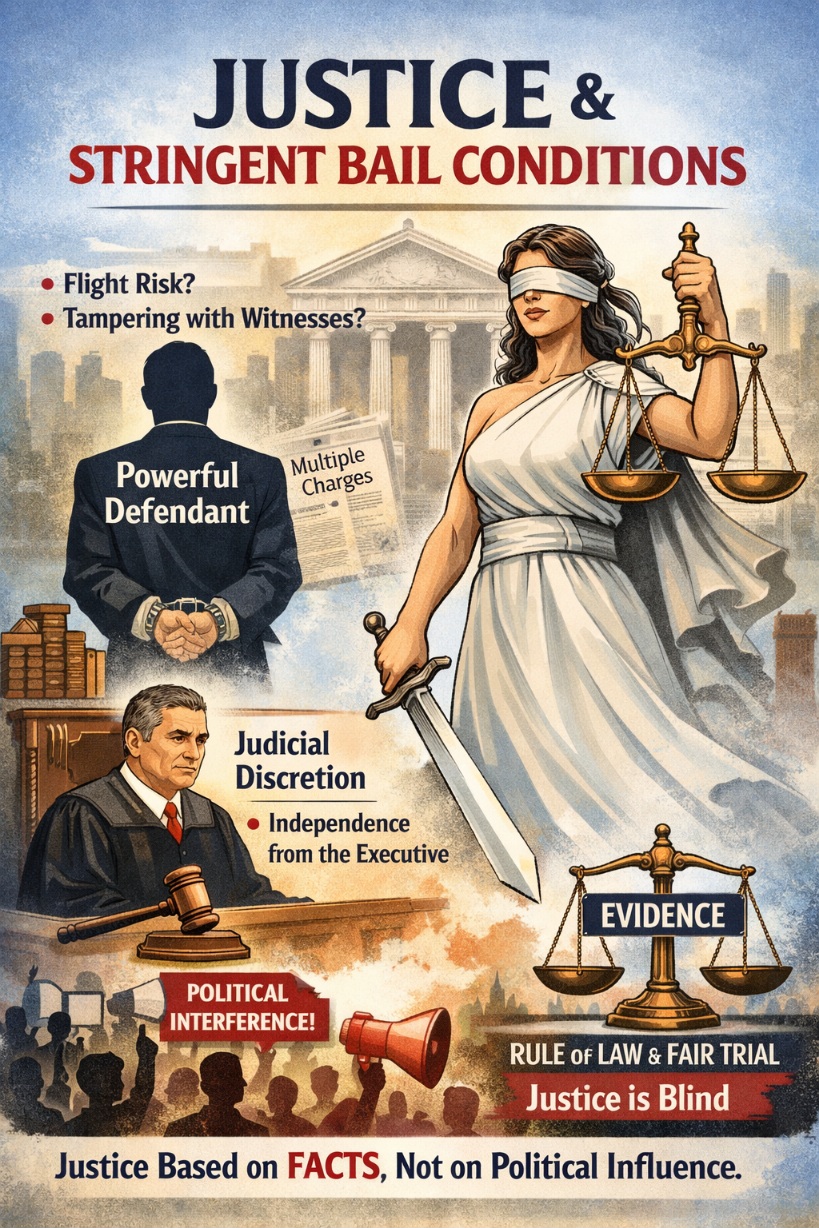
What is wrong with a trial court or judge, in determining a bail application brought by a defendant or accused person, exercising discretion to grant such an application with stringent bail conditions that the defendant must fulfil before release? One of the key considerations for the judge is the behaviour of the defendant. Has the defendant demonstrated a propensity to jump bail, flee, or fail to appear for trial? Is the defendant such an influential or powerful individual who, if left unchecked, might attempt to influence or tamper with witnesses the prosecution relies upon to prove its case?
Therefore, when a powerful Politically Exposed Person (PEP) is on trial and the court, in the exercise of its unfettered discretion, imposes stringent bail conditions, it is misplaced for some to orchestrate political campaigns through the media, pointing fingers at the executive branch of government as if it pressured the court. These narratives are false. The judiciary and the executive are separate arms of government, and the judiciary does not take instructions from the executive in such matters.
Judges are men and women of strong convictions. They do not pander to pressure. Many live like hermits or monks in monasteries—unapproachable, inaccessible, and deliberately insulated from public glare. They avoid socialising, even distancing themselves from relatives, to preserve independence. Yet, they are easily accused of bias. Because of their work, they maintain stoic silence: they cannot grant press interviews or defend themselves publicly. When their judgments favour one side, they are praised; when they uphold justice in politically sensitive matters, they are condemned.
Justice, however, is blind. This is symbolised by Lady Justice holding a sword and scales. She weighs the evidence presented before her, and if the scales tilt against one party, she is ready to cut down that party with the sword of justice. In criminal trials, if the prosecution fails to prove guilt beyond reasonable doubt, Lady Justice must acquit, regardless of public sentiment. She dispenses justice based on the law as written in the statute books—not on how it ought to be, nor swayed by emotional tantrums or mob opinion.
Conclusion
The imposition of stringent bail conditions is not evidence of executive interference but a reflection of judicial prudence. Judges act within the law, guided by evidence and the need to protect the integrity of the trial process. Public perception may be clouded by politics, but justice remains blind, impartial, and rooted in the rule of law.