
- By Okoi Obono-Obla
Nigeria’s Rising Foreign Reserves: Strengthening the Economy, Easing the People’s Burden?
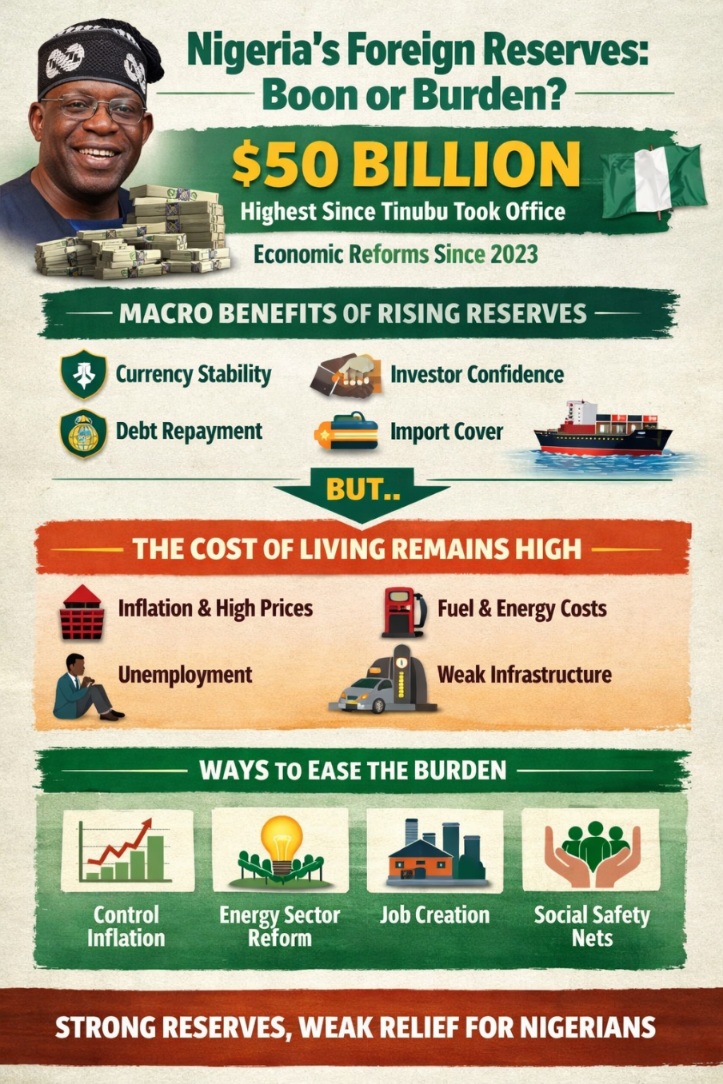
Nigeria’s foreign reserves have surged to $50 billion, the highest level since President Bola Ahmed Tinubu assumed office. Analysts widely attribute this milestone to the economic reforms introduced since 2023, ranging from exchange‑rate unification to subsidy removal. While this achievement signals resilience at the macroeconomic level, debates continue about whether it has meaningfully reduced the cost of living for ordinary Nigerians.
The Benefits of Higher Foreign Reserves
Foreign reserves serve as a backbone for national economic stability. Nigeria’s recent increase carries several advantages:
– Currency stability: A stronger reserve position empowers the Central Bank to defend the naira against volatility.
– Investor confidence: Rising reserves signal resilience, attracting foreign direct investment.
– Debt servicing: Nigeria can meet external debt obligations more comfortably, reducing default risks.
– Import cover: Reserves provide a buffer to finance imports of essential goods like fuel, machinery, and food.
– Crisis management: In times of global shocks, reserves act as insurance for the economy.
The Disconnect: Strong Reserves, Weak Household Relief
Despite these gains, many Nigerians argue that the increase has not translated into lower living costs. The reasons are clear:
– Inflation persistence: Food and energy prices remain high, eroding household purchasing power.
– Exchange‑rate reforms: Liberalizing the naira attracted foreign inflows but raised import costs.
– Structural bottlenecks: Poor infrastructure, insecurity in farming regions, and high transport costs keep expenses elevated.
– Time lag: Reforms often take time before benefits trickle down to the average citizen.
Pathways to Reduce Cost of Living
For reforms to truly ease household burdens, Nigeria must complement macroeconomic stability with microeconomic relief:
1. Inflation control: Tight monetary policy and improved food supply chains.
2. Energy sector reform: Expanding electricity generation and local refining to cut costs.
3. Job creation: Investing in manufacturing, agriculture, and infrastructure to raise incomes.
4. Social safety nets: Cash transfers and welfare programs to cushion vulnerable households.
5. Tax and fiscal reforms: Simplified tax laws and reduced corruption to lower business costs.
Macro vs. Micro Impact
| Reform Impact | Macro Benefits | Micro ( Household ) Reality |
|——————–|——————–|——————————–|
| Foreign reserves rise | Boosts investor confidence, stabilizes naira | No direct effect on food or rent prices |
| Fuel subsidy removal | Frees up government revenue | Sharp rise in transport & energy costs |
| Exchange‑rate unification | Improves transparency, attracts investment | Higher import costs, inflationary pressure |
| Fiscal discipline | Reduces deficit, strengthens economy | Limited relief for household budgets |
Conclusion:
Nigeria’s rising foreign reserves are a significant achievement, reflecting the strength of Tinubu’s reforms. Yet, the ordinary Nigerian still grapples with high inflation, energy costs, and stagnant wages. For reforms to resonate beyond the macroeconomic headlines, they must be paired with policies that directly lower living costs—from food affordability to energy access and job creation. Only then will the promise of economic stability translate into everyday relief