
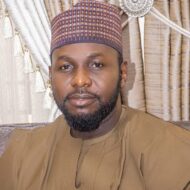

by Abdullahi Haruna
In every generation, the Igbo political imagination seems to search for a voice—one capable of translating enterprise into influence, and grievance into strategy. The past offered many registers: defiance, negotiation, reinvention. Today, amid the persistent hum of separatist rhetoric and regional discontent, a quieter but potentially more consequential voice is emerging in Mark Chukwuemeka Okoye II.
But who, precisely, is this figure now being cast as a potential alternative voice?
Okoye is not a product of traditional political apprenticeship. Born in the mid-1980s in Ifitedunu, Anambra State, he is trained as an investment banker and shaped by the disciplines of finance, markets, and public policy. His early career traversed the private sector, where exposure to capital flows and institutional structuring appears to have informed his later approach to governance. His transition into public office came with unusual speed: at just 30, he became one of Nigeria’s youngest commissioners, serving in Anambra State’s executive council—an early indication of both trust and capacity.
From there, his trajectory has been defined less by noise and more by positioning. Now as Managing Director and Chief Executive Officer of the Southeast Development Commission, Okoye occupies a role that is as strategic as it is symbolic: coordinating development priorities across a region long characterised by economic vitality but institutional fragmentation.
The question, however, is not merely whether he is different. It is whether that difference is beginning to matter.
For years, the Southeast has oscillated between two poles: extraordinary private-sector ingenuity and a public-sector deficit that has struggled to keep pace. Into that vacuum, discordant narratives have found fertile ground—voices that frame marginalisation as destiny, and separation as remedy. What has been missing is a countervailing proposition: a credible, structured pathway that repositions the region not as an outlier, but as a national reference point.
Okoye’s intervention, through the Southeast Development Commission, appears to be an attempt at precisely that recalibration.
Unlike the politics of agitation, which thrives on immediacy and emotion, his approach is incremental, almost methodical. It is rooted in the belief that regional relevance in modern Nigeria will be earned less through rhetoric and more through demonstrable economic coordination—roads that connect markets, policies that unlock capital, and institutions that reduce fragmentation.
This is where his voice begins to diverge from the familiar chorus.
Rather than amplifying grievance, Okoye is advancing a framework of productive inclusion—one that seeks to integrate the Southeast more firmly into Nigeria’s economic architecture. The logic is disarmingly simple: a region that becomes indispensable to the national economy acquires influence that no volume of protest can secure. Development, in this sense, becomes both shield and leverage.
It is a philosophy that, in its essence, carries the distant imprint of Nnamdi Azikiwe. Zik understood that the assertion of Igbo identity was most effective when paired with national utility—when regional ambition aligned with a broader Nigerian project. Okoye’s strategy appears to echo that insight, albeit in a more technocratic register.
His emphasis on coordinated infrastructure, investment facilitation, and institutional coherence suggests an attempt to reposition the Southeast as a hub of structured productivity rather than fragmented brilliance. If successful, such a repositioning could gradually dwarf the appeal of separatist narratives—not through suppression, but through obsolescence.
After all, narratives lose power when reality begins to contradict them.
Yet, to frame Okoye as a definitive alternative voice is to venture into territory that demands caution. Nigeria has seen many reformist figures whose early clarity was diluted by systemic inertia. The Southeast Development Commission itself operates within a federal ecosystem that is often resistant to efficiency, and where ambition must constantly negotiate with constraint.
The durability of Okoye’s voice will therefore depend on translation—on whether plans become projects, and projects become visible transformation. Without that conversion, even the most elegant frameworks risk becoming another layer of unrealised intent.
Still, there is a discernible shift in tone.
Where others have spoken in absolutes, Okoye speaks in structures. Where the prevailing discourse has leaned toward rupture, his leans toward reconstruction. It is not a louder voice, but it may prove to be a more sustainable one—precisely because it seeks to change outcomes rather than merely describe them.
In this, he offers something the region has long needed: not a repudiation of its frustrations, but a redirection of its energies.
Whether he becomes the defining voice of this moment remains uncertain. Leadership, particularly in Nigeria, is rarely secured by intent alone. It must be earned through persistence, resilience, and results that outlast scepticism.
But if the measure of an alternative voice is its ability to reshape the terms of conversation, then Okoye has at least begun to do so.
Not by shouting over the noise, but by attempting to make it irrelevant.
My name is Abdullahi O Haruna fondly called Haruspice, this piece was motivated by the brilliance of Mark Okoye II during the City Boys Tour of the East Region in Imo state at the Protea Hotel where I listened to this young pulsating Nigerian reeled out what I tag the new Igbo Renaissance.
Impressively musing