by Ademola Rabiu
On the day he presented his credentials, Nigeria’s envoy showed why a continent may invest its hopes in him
A Promise With a Face and a Voice
There is a quiet philosophy in every arrival, and a deeper one in every letter of credence. It is a promise that one nation’s trust now has a face and a voice. An envoy who lands in a foreign capital with a letter of appointment carries more than luggage. He carries the expectations of those who sent him and the hopes of those who wait.
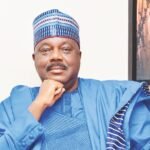
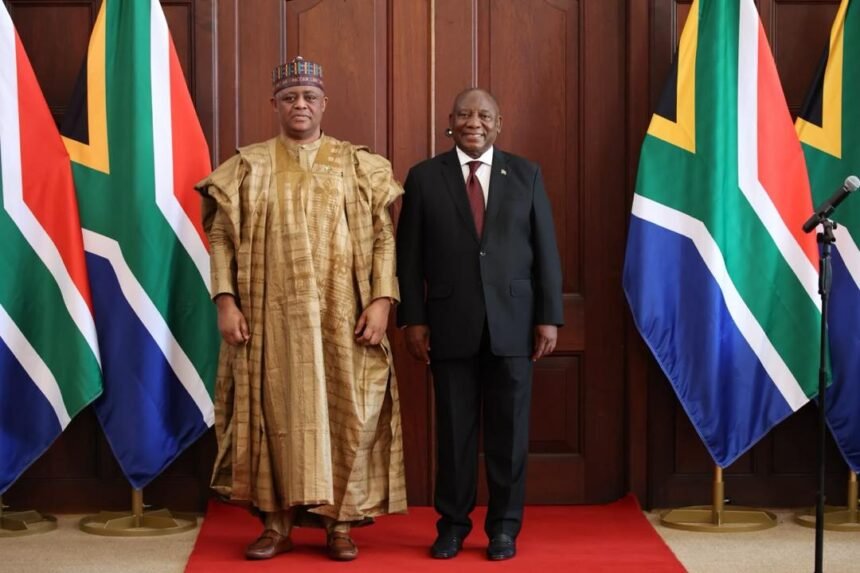
On Friday, 13 November 2026, at the Sefako Makgatho Presidential Guest House in Pretoria, His Excellency Chief Olufemi Adewumi Fani-Kayode presented his letter of credence to President Cyril Ramaphosa, alongside envoys of 14 other countries and the EU.

He is Nigeria’s High Commissioner to South Africa, with concurrent accreditation to the Kingdoms of Lesotho and Eswatini. The work, which began when he assumed duties on 30 October, now carries the full weight of two nations’ trust.
His speech was worthy of the occasion. He told the President he came standing tall and proud, sent by President Bola Ahmed Tinubu to present his letter to a brother and friend. He reminded Ramaphosa that Nigeria and South Africa fought together during apartheid, and that Nigeria gave its blood and treasure in the dark days.
He recalled this with pride rather than grievance, as one old comrade to another. He said part of his task was to reset the relationship, build a bridge, and work out whatever concerns the two countries have, together. He also praised South Africa’s role in BRICS and the Global South, and Nigeria’s inclusion in the G20.
Three Questions That Will Not Die
He did not come with diplomacy alone. He came with an idea of Africa, and in his address, he invoked the spirit of Madiba, Patrice Lumumba, and Muammar Gaddafi. In calling those names, he summoned three questions that every African statesman must still answer.
From Madiba comes the question of reconciliation. Can a people wronged be freed without being embittered, and can justice and forgiveness share one house? Madiba’s answer was that the oppressed are fully liberated only when they refuse to become oppressors in turn. That is the deepest teaching of Ubuntu, and an Africa wounded by Afrophobia must learn it again.
From Lumumba comes the question of dignity. What is political independence if the mind and the mineral wealth of a nation remain mortgaged elsewhere? Lumumba paid with his life for the conviction that sovereignty is incomplete until a people hold their destiny in their own hands.
From Gaddafi comes the question of unity. Can a continent of many nations ever speak with one voice, and can the dream of a united Africa survive the quarrels of its own sons? In the dark years of apartheid, he stood among those who backed the liberation struggle, and he kept alive the audacious idea that Africa’s borders, drawn in distant boardrooms, need not be the borders of its imagination.
No People Should Suffer Alone
He also paid tribute to South Africa, to President Ramaphosa, and to the ANC for standing with Gaza and the Palestinian cause, and for lending the country’s voice to the Global South and a just world. He commended South Africa’s role in BRICS and the Global South, and it was fitting homage from the envoy of a nation that knows what it is to be told that justice must wait.
People who have walked through the long night of apartheid carry a moral memory that others lack: that oppression is never a distant abstraction, and that silence in its presence is a form of consent. Madiba said that South Africa’s own freedom was incomplete without the freedom of the Palestinians, and the ANC has kept faith with that insight.
At the root of these is Ubuntu: that no people may be left to suffer alone, and a freed nation owes a debt of conscience to those still in chains. A just world is built by nations that refuse to look away, and in honouring South Africa for that refusal, our envoy affirmed what Africa’s best traditions have always taught: that liberation is indivisible.
Reconciliation, dignity, and unity are not three slogans but one philosophy. Pan-Africanism is the refusal to let our humanity be divided by borders strangers drew.
A High Commissioner who carries these ideas into a room is more than a functionary. He is a custodian of an unfinished revolution.
Refuse to Be Erased, Refuse to Be Bitter
Even the small drama of the day revealed him. When his address was missing from the live broadcast, he raised the matter with President Ramaphosa directly, and the President took him to the relevant officials, who acted with despatch. He thanked the President publicly for his timely intervention, and the Presidency then published the full recording of the ceremony. That is diplomacy in miniature: refuse to be erased, and refuse to be bitter.
When Africa Wounds Africa
The hour in which he speaks is heavy. Africa once dreamed aloud through Nkrumah, Oliver Thambo, Patrice Lumumba and a generation of giants who taught the continent that its liberation was indivisible. In South Africa, that dream found its fiercest proof, for apartheid fell because Africa refused to look away.
Today, Afrophobic attacks and anti-migrant sentiment wound the memory of that solidarity. The sorrow is sharpest because the blow falls mainly on fellow Black Africans, sparing non-Black undocumented migrants.
Such an hour needs a man whose character is larger than his commission, and I believe Nigeria has sent one.
The River That Chose the Plain
Chief Fani-Kayode is a builder of men and a hunter of talents. As Minister, he placed capable young professionals into directorships, and many of them stand high in public and private life today. That is the signature of a natural giver, who plants for harvests he will share. He was born noble, yet he chose to live for the masses.
Like a river born on a mountain that chooses to run down to the plain, he gives his height away to the thirsty valleys.
Nobility is inherited, but humility is chosen, and he has chosen it repeatedly.
He also carries a pride that cannot be bargained away. His admirers, and I am one, read his well-known clash with the UK’s High Commissioner to Nigeria as an act of pride in his Black and Nigerian heritage. A man who will not be diminished abroad will not allow his people to be diminished either.
One Fabric, One People
So it is with his plain speech on Afrophobia. In his columns, he asked how it could be denied when Nigerians had fled to camp at the gates of the High Commission in Pretoria for safety.
He drew on the MTN Group chief executive’s figures showing how much of the company’s revenue comes from the rest of Africa, a pan-African economic argument that South Africa’s own prosperity depends on the continent. In the same writing, he urged respectful dialogue and cultivating a core of leaders from both sides committed to the bond between the two nations.
This is the voice of one who stands with conscious South Africans such as Thabo Mbeki, Julius Malema, Dr Mbuyiseni Ndlozi and Prof PLO Lumumba, who insist that African solidarity is a duty and not a slogan.
In Pretoria, he carried the same spirit in a gentler register, with concerns to be worked out between friends. Candour is not combativeness, and diplomacy without candour is only etiquette. His Pan-Africanism is a conviction he has voiced.
When he sought this posting instead of Berlin, he said he wanted a country closer to Nigeria and nearer to his political thinking on foreign affairs and a pan-African vision. That is the creed of a man who understands that Africa’s dignity is one fabric, and that a thread pulled in Pretoria is felt in Lagos, Accra, and Maseru.
These convictions rest on rare gifts: a keen intellect, a courage that does not flinch before hard truths, the experience of a long public life, and the discipline of a noble upbringing. Those gifts are matched by a character just as rare, a remarkable tolerance of every faith and a freedom from tribal sentiment. He sees one people where others see divisions.
Let the Continent Watch Pretoria
The measure of any man worthy of larger trust is how he conducts himself in the hardest places. Nations do not find their leaders in comfort. They find them where difficulty is greatest, and the stakes are most human.
If Nigerians seek leaders in whom to invest their hopes for the greater tasks ahead, and if Pan-Africanists everywhere seek a voice who will turn solidarity from a slogan into a practice, let them watch what is being built in Pretoria.
Chief Fani-Kayode we can all rest assured he went there to build a partnership between South Africa and Nigeria, the apostles of African renaissance.
Godspeed, Ẹ̀gbọ́n
I write as one who has been benefiting from His Excellency’s mentorship. I do not pretend to be neutral, but I believe in what I have seen. History does not remember those who merely arrived. It remembers those who stayed and built.
Godspeed, Your Excellency. The work is waiting, and the continent is watching with hope.
✍ Ademola Rabiu, CEng, writes from Cape Town. A consultant/academic with degrees in engineering, law and project management, he works at the intersection of energy engineering, international trade, project financing and sustainable development. He owns Novus Integrated Solutions Limited and has lived in South Africa since 2003.