By Stephen Onuh Uwodi
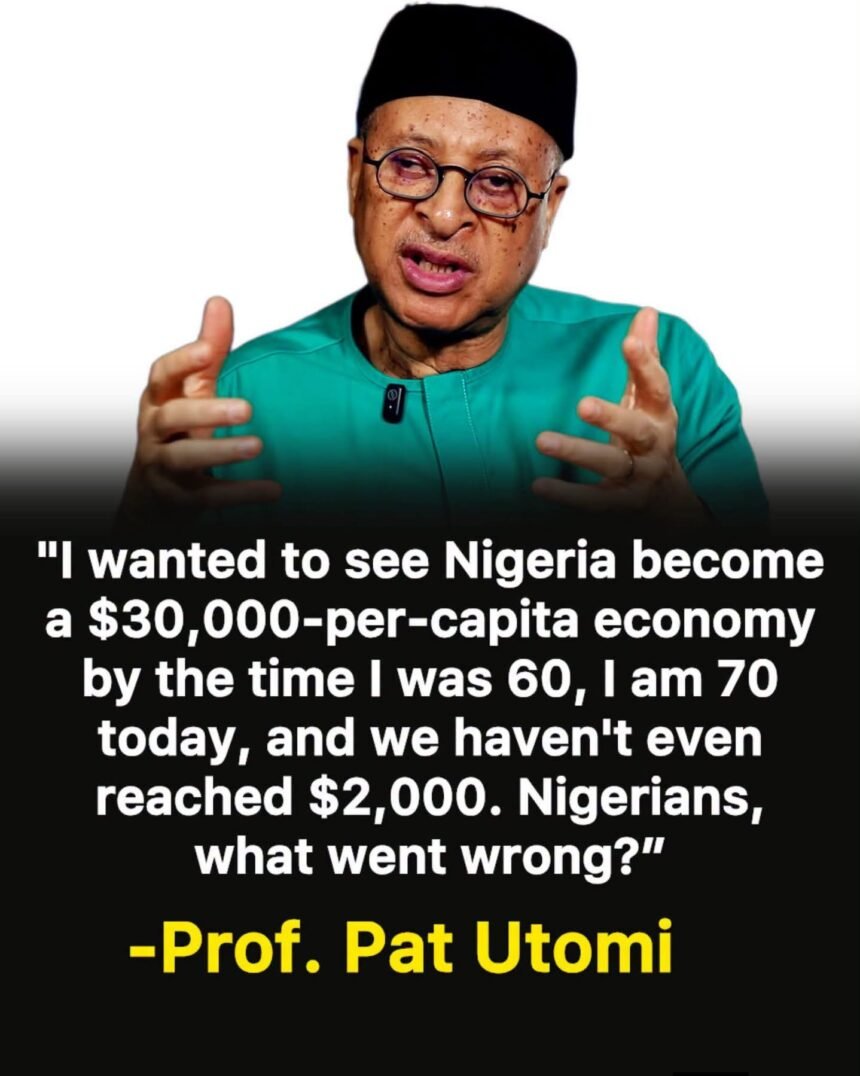
He wanted Nigeria to become a $30,000-per-capita economy by the time he turned 60. He is now 70. Nigeria’s nominal GDP per capita stands at roughly $1,200–$1,225 in 2025 according to World Bank figures (and even lower in some IMF estimates after successive naira devaluations). At its recent peak around 2014–2019 it briefly touched the $3,000 range before collapsing. The dream did not merely fall short; it was systematically dismantled.
What went wrong in the course of our nation-building is not mysterious. It is a documented sequence of choices, structural pathologies, and institutional betrayals that turned extraordinary potential into mediocrity.
The Original Promise and the Fatal Pivot
At independence in 1960, Nigeria was an agricultural economy with real regional dynamism. Cocoa in the West, groundnuts and cotton in the North, palm produce in the East financed schools, roads, universities and early industrialisation. Per capita income was low, but the trajectory was upward and diversified. The discovery and subsequent dominance of oil changed everything.
Oil revenues created the classic Dutch disease on a grand scale. Agriculture was abandoned. Manufacturing never matured into a competitive base. Easy petrodollars removed the discipline that forces nations to build productive capacity. Instead of using temporary resource wealth to create permanent national wealth—human capital, infrastructure, institutions, and a broad tax base—successive governments treated the treasury as a feeding bottle. Professor Utomi has repeatedly called this what it is: a rent-seeking, “feeding bottle” economy in which connection to power, not value creation, determines who prospers.
The Core Failures of Nation-Building
1. Institutional weakness and elite capture.
Nigeria never completed the hard work of building a capable, impersonal state. Military rule normalised arbitrariness and impunity. Civilian rule often merely democratised the same predatory instincts. Public office became the fastest route to private enrichment rather than public service. Policy inconsistency became the norm: every new administration discarded or diluted the previous one’s programmes. Long-term national projects require continuity; Nigeria specialised in discontinuity.
2. The refusal to convert resources into productivity.
Oil paid the bills without forcing the hard choices that build competitive economies. Power generation remained chronically inadequate. Logistics costs stayed high. Education and health systems produced neither the skills nor the healthy workforce required for high-productivity growth. Population grew rapidly while the productive base stagnated. The result is an economy that expands in absolute size yet delivers falling or stagnant living standards for the majority.
3. The moral and cultural dimension.
A critical mass of the elite chose extraction over creation. Contracts replaced enterprise. Political primaries became auctions. University professors earn a fraction of what politicians spend on campaigns. Talent either emigrates or is underutilised. Innovation and “creative destruction” are stifled because those who control access to resources prefer the status quo. A society that rewards rent-seeking more than risk-taking and competence will never reach $30,000 per capita.
4. Insecurity and the collapse of the social contract.
No serious industrial or agricultural transformation can occur when large parts of the country are unsafe for farming, investment or ordinary movement. Banditry, insurgency and communal violence are not merely security problems; they are the visible symptoms of a state that has failed to establish a legitimate monopoly on force and deliver basic order.
The Arithmetic of Failure
A $30,000 per capita economy would require sustained high growth, massive productivity gains, and a fundamental shift from consumption of resource rents to production of tradable goods and services. Nigeria achieved none of these consistently. Even when oil prices were high, the surplus was largely consumed or stolen rather than invested in the foundations of future prosperity. Currency crises, inflation, and repeated devaluations then wiped out much of the nominal progress that did occur.
Other resource-rich nations—Norway, Botswana, Malaysia in earlier decades, more recently parts of the Gulf—demonstrated that oil and minerals can be transformed into broad-based development when institutions, policy discipline and elite consensus exist. Nigeria possessed the resources and the human talent. It lacked the institutional and moral architecture.
The Uncomfortable Truth
Utomi’s question—“Nigerians, what went wrong?”—is simple only in appearance. The answer is that we repeatedly chose the path of least resistance and greatest private gain for those in control of the state. We preferred the appearance of sovereignty and the reality of elite consumption over the hard, unglamorous work of building productive capacity, competent institutions, and a genuine national project.
The dream of a $30,000-per-capita Nigeria was never impossible. It was simply incompatible with the political economy we constructed and defended. Until that political economy is dismantled—until wealth creation is rewarded more than wealth extraction, until institutions become stronger than individuals, and until the state exists primarily to enlarge the pie rather than to allocate rents—the gap between potential and reality will remain a national scandal.
Professor Utomi is not asking an innocent question. He is holding up a mirror. The reflection is one we can no longer afford to ignore.