Otunba (Dr.) Abdulfalil Abayomi Odunowo
When Nigerians talk about the economy, the conversation almost always circles back to hardship: higher food and transport costs, a naira that no longer carries quite the purchasing power it once did, steeper energy bills, and the broad feeling that public finances are under real strain. Those realities are real, and they shouldn’t be brushed aside. Still, any serious analysis also has to ask a counterfactual question: what would Nigeria have looked like if the economic path inherited in May 2023 had simply rolled on? That question matters. It helps frame the trade-offs behind subsidy removal and exchange-rate reform, and it gives us a way to judge whether the reforms were a necessary risk with wider benefits, or a misstep that left households carrying the burden without returns to match.
The problems before May 2023 did not appear out of thin air. By the time President Bola Ahmed Tinubu assumed office, Nigeria was already grappling with deep structural imbalances that tested growth, stability, and resilience. Inflation was uncomfortably high, government revenue was strikingly weak, and petrol subsidies were swallowing an ever-bigger share of the public purse. Foreign exchange was rationed through a messy multi-window system that spun a web of arbitrage, one more favourable to some players than others. The Central Bank financed sizeable fiscal deficits, and growth barely stayed ahead of population growth. Put simply, the country was at a crossroads: keep postponing adjustment or face up to accumulated imbalances that could no longer be managed with smoke and mirrors.
One of the clearest pressure points was the petrol subsidy. Before reform, Nigerians effectively paid a price that was administratively fixed and kept below cost. The gap between that artificial pump price and the true cost did not vanish; the state absorbed it. The World Bank estimated that petrol subsidies alone cost more than ₦8.6 trillion between 2019 and 2022, resources that could have gone into roads, power, hospitals, schools, security, or social protection. Keeping the subsidy would not have guaranteed cheap petrol indefinitely. It would simply have preserved a cheaper pump price while the public balance sheet picked up the tab. And as that tab grew, the pressure to borrow more, raise taxes, or finance deficits through money creation would have intensified. The pain might have entered through another door, yes, but it would’ve come all the same.

The foreign-exchange regime was another major fault line. One dollar bought different things depending on where it was traded, inviting arbitrage and skewing incentives. Official channels became the least dependable route for many businesses, which then turned to the parallel market. Importers ran into liquidity frictions, investors worried about repatriating capital, and the Central Bank carried large unmet obligations. The basic choice before policymakers was stark: continue rationing scarce dollars at an official rate that was growing more unrealistic by the day, or let the currency move closer to a market-clearing level. The evidence points one way: the official rate could not have held forever in the face of persistent demand.
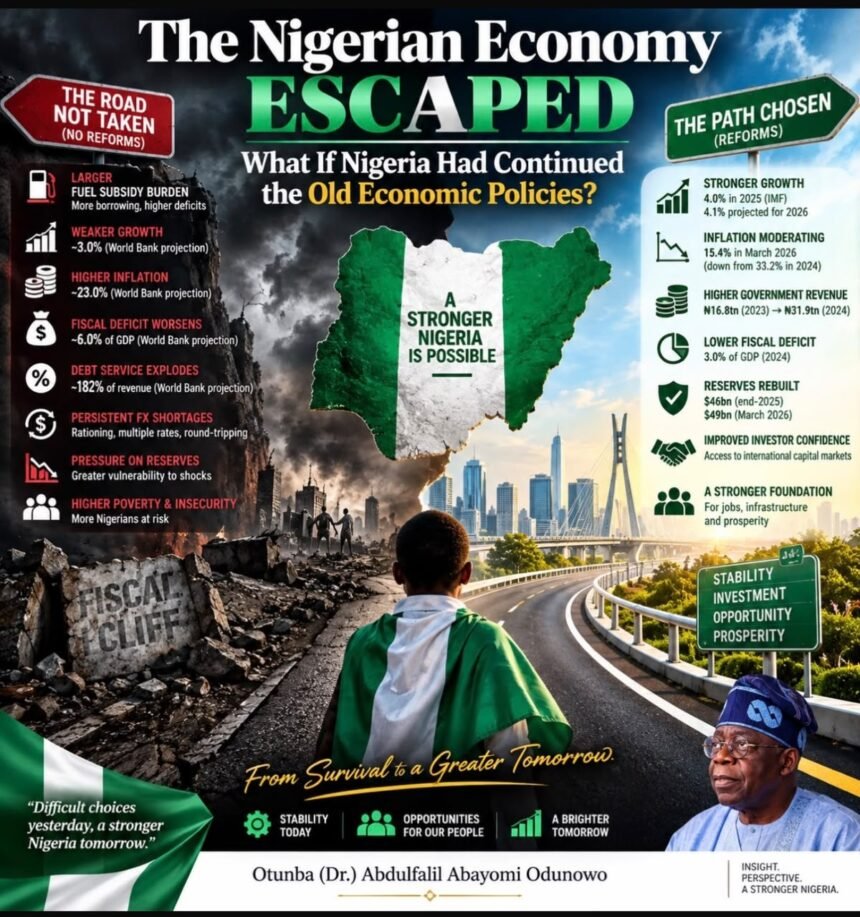
In December 2023, the World Bank set out explicit reform and no-reform scenarios. Its early modelling for 2025 drew a sharp contrast: real GDP growth of 3.7% under reform versus 3.0% under no reform; inflation at 19.6% versus 23.0%; a fiscal deficit of 3.7% of GDP versus 6.0%; and public debt service as a share of revenue at 51% versus 182%. These were projections, not final outcomes, but they captured the worry among international economists. Without reform, the economy could drift toward a far heavier burden on future budgets and households. The same analysis also suggested that sustained reforms could lift average annual growth in 2023–2026 by roughly half a percentage point relative to the no-reform path.
What actually happened by 2026 was different, though still very much within the frame of that reform decision. The IMF reported real GDP growth near 4.0% in 2025 and projected about 4.1% for 2026. Nigeria’s gross international reserves climbed from roughly $40 billion at end-2024 to about $46 billion at end-2025, and then around $49 billion by March 2026; net international reserves rose from about $23 billion to roughly $35 billion in 2025. The current account swung into a surplus of around 4.8% of GDP in 2025. Portfolio investment returned, and Nigeria regained access to international capital markets. Inflation did jump in the short term during the transition, but then it eased for more than a year, hovering around the mid-teens, about 15.1% year on year in February 2026 and 15.4% in March 2026 as global fuel and food prices rose. Disinflation did not wipe away earlier price increases, of course, but it did slow the pace of further rises, and that matters for households trying to manage everyday budgets.
Even with those macro gains, the question remains: what would the old path have delivered? Counterfactuals are inherently uncertain. Even so, the pressures visible in 2023, subsidy burdens, tighter fiscal space, persistent foreign-exchange constraints, continuing arbitrage, and fragile investor confidence, all point toward a broader and more punishing subsidy bill, heavier reliance on monetary financing of deficits, and perhaps a more abrupt correction later, with even greater disruption for households and businesses. Delaying adjustment doesn’t make the need disappear. If anything, it tends to raise the eventual cost.
Stabilisation is not prosperity. That’s the key point. International institutions have repeatedly reminded us that macroeconomic stabilisation does not automatically translate into better living standards. The IMF’s June 2026 assessment put poverty at around 63% using the national poverty line, with roughly 27 million Nigerians food insecure in late 2025. The World Bank’s Nigeria Development Update of April 2026 struck a similar note: meaningful macroeconomic stability had been achieved, but household incomes had not fully recovered, and poverty remained stubbornly high. Reserves and growth matter enormously, but they don’t put food on the table by themselves, and GDP growth alone does not guarantee gainful employment, dependable power, functioning streets, or safer neighbourhoods. A country’s prosperity is measured not only by macro aggregates, but by the tangible improvements people actually feel in daily life: steady power supply, decent roads, accessible healthcare, good schools, secure neighbourhoods, and real job openings for graduates.
Even in a more stabilised macro environment, warning signs remain and can’t be ignored. The IMF estimated that the consolidated government deficit widened to about 4.4% of GDP in 2025 from 2.4% in 2024. Interest payments absorbed an estimated 53% of Federal Government revenue in 2025, up from roughly 41% the previous year. The Fund also pointed to the difficulty of tracking how savings from subsidy removal flowed into the budget. These are not abstract, technocratic complaints; they are valid reasons to demand greater transparency and visible accountability. Citizens who bore the cost of reform deserve clear proof of its benefits and a credible plan showing how those savings are being used to improve living standards.
Two overly neat narratives should now be put to rest in public debate. The first claims everything was fine until subsidy removal and exchange-rate reform. The historical record says otherwise: the pre-2023 trajectory was already unsustainable, and that was in exchange for a relatively modest domestic payoff. The second insists that because reforms were necessary, every outcome that followed must automatically count as success. That, too, doesn’t hold up. Nigeria entered May 2023 carrying deep fiscal, monetary, and foreign-exchange imbalances that successive governments had delayed confronting. The reforms changed that trajectory, at substantial cost to households, and by 2026 several significant macro indicators had improved. The unfinished, and ultimately decisive, task is to convert that stability into tangible prosperity: more jobs, higher and more predictable incomes, reliable electricity, safer neighbourhoods, and a government that actually delivers on promises.
So the central question is no longer whether subsidy removal or exchange-rate reform was inherently right or wrong. The real issue now is what Nigeria is doing with the economic space those sacrifices created. How are we converting macro stability into everyday opportunity? How are we strengthening the channels through which government revenue becomes roads, power, schools, hospitals, security, and jobs? Accountability, at this point, has to focus on implementation: clarity about how savings from subsidy reform are tracked, how they are directed into targeted social protection, and how performance is measured not only in fiscal metrics but in welfare outcomes too.
Policy implications follow quite naturally from that. First, transparency is non-negotiable. Reforms this costly require a clear accounting of where savings go and how they improve lives. Second, social protection must be credible, targeted, and scalable, so the most vulnerable do not carry the full brunt of short-term adjustment while the medium-term payoff slowly materialises in visible, real improvements. Third, macro stability has to be matched by structural reforms that lift productivity and invest in the foundations of growth: reliable power, efficient logistics, a workforce educated for market needs, and a safe, predictable business environment. Fourth, the state must speak plainly with citizens about what success actually looks like in concrete terms, jobs created, power reliability improved, and measurable progress in health and education, so the public can hold policymakers to account.
In the end, stabilisation is a prerequisite for prosperity, not a substitute for it. Nigeria’s experience since May 2023 shows that pursuing reforms can recalibrate a damaged fiscal and monetary path and, if executed carefully, improve key macro indicators. It also makes one thing plain: macro gains have to be translated into everyday wins for households. If the country can pair transparent governance with targeted social protection and high-return investments in infrastructure and human capital, those improvements can move beyond statistics and into the streets, schools, clinics, and markets where Nigerians live and work each day.
The question is not simply about subsidy removal or exchange-rate reform in isolation. It’s about what Nigeria chooses to do with the fiscal space those reforms have opened up: how to turn stability into opportunity, how to ensure that every naira saved from reform helps a family pay for electricity, a student’s tuition, a nurse’s wage, or a farmer’s inputs. That’s where accountability must turn next, and that’s where the courage to act, joined with clarity and candour, will determine how quickly prosperity follows stabilisation.
Signed
Otunba (Dr) Abdulfalil Abayomi Odunowo
National Chairman AATSG
ASIWAJU AHMED TINUBU SUPPORT GROUP
September 2026.