By Okoi Obono-Obla
1. The ICC Award of 17 September 2026
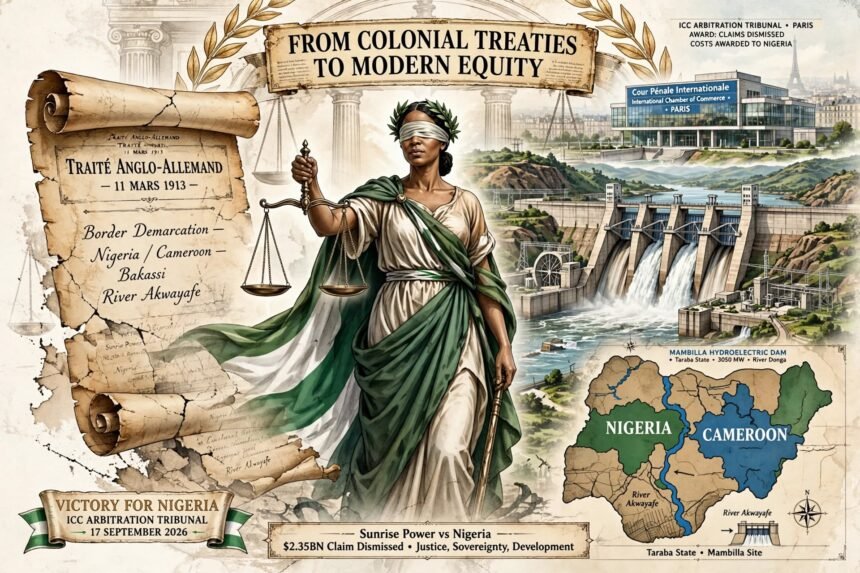
On 17 September 2026, an International Arbitration Tribunal constituted under the auspices of the International Chamber of Commerce (ICC) in Paris delivered its Final Award in favour of Nigeria in the long-running dispute with Sunrise Power and Transmission Company Ltd over the Mambilla Hydroelectric Power Project.
The panel, chaired by Ms. Melaine van Leeuwen with Prof. Stavros Brekoulakis and Mr. Simon Nesbitt, rejected Sunrise’s claims in their entirety. The company had sought $680 million as a settlement sum and interest, in connection with a separate arbitration in which it was claiming more than $2.7 billion over the 3,050MW Mambilla project – a combined exposure of over $3.38 billion for Nigeria.

The Tribunal dismissed Sunrise’s claim that Nigeria breached the 2020 Settlement Agreement and its Addendum, rejected its claim for $400 million comprising $200 million settlement and $200 million default payment, declared that promoter Leno Adesanya is bound by the arbitration agreement, affirmed jurisdiction over Nigeria’s counterclaim, and ordered Sunrise and Adesanya to reimburse 75% of Nigeria’s legal costs – $9,319,506.51 out of $11,819,506.51 plus 10% compound interest, with $2.5 million to be paid from ICC escrow funds.
2. A Critique of Classical International Law
This case has established a new frontier in international law and international arbitration, whose judgments are often perceived to be skewed against developing countries like Nigeria in favour of Western countries, the United States of America and other developed economies, pandering to their interests.
This alignment reflects principles concerning international economic law, international arbitration and international law itself that evolved at the height of Western colonialism, imperialism and hegemony in the 18th and 19th centuries, when the countries we have today in Africa, South America and Asia were not involved in their formulation, but which today still form the foundation of international legalism.
3. Colonialism and the ICJ Precedent: Nigeria v. Cameroon
Colonialism has shaped and influenced international law to such an extent that in recent times, the International Court of Justice (ICJ) at The Hague relied heavily on the Anglo-German Treaty entered into in 1913, which defines the thalweg of the River Akpakorum or Akpa Yafe, to delineate the land and maritime boundary between Nigeria and Cameroon in its judgment dated 10 October 2002, even though the Africans who know the cartography and history of the region were not involved in the drafting of the treaty, as it was strictly a United Kingdom and Germany affair.
4. Conclusion: A Gratifying Vista
Therefore, the decision of the ICC is gratifying and would definitely be an open vista for the evolution of new principles and rules concerning international trade law, international economic law and international arbitration and, generally, international law as the world seeks equity and justice, especially for developing countries.
It demonstrates that the foundations of international law, though rooted in colonial-era instruments, can be reinterpreted and applied to protect the interests of developing nations when those nations mount a rigorous, fact-based defence.