
By Okoi Obono-Obla
Tinubu’s Consistency Versus the Political Nomadism of Obi, Atiku and Kwankwaso: Setting the Record Straight
I could not help but blush and laugh when I read the article by my brilliant young friend from Katsina State, Khaleed Yazeedu, who has been writing blistering and hard-hitting essays insinuating that the Hausa majority has been dominated by the Fulani – to the extent that a supposedly tiny Fulani ethnic nationality has totally subdued and subjugated the majority Hausa under the guise of a religious jihad launched in the 19th century.
But in his attempt to excoriate Bayo Onanuga for suggesting that President Bola Ahmed Tinubu has been consistent in his political trajectory and career – unlike the likes of Peter Obi, Atiku Abubakar and Kwankwaso, who are studies in political nomadism and peripateticism – Khaleed Yazeedu missed the point big time. Basking in political prejudice and partisanship under the guise of an objective political commentator, he completely twisted the political trajectory of Mr. President, especially when he tried in vain to create the impression that President Tinubu jumped opportunistically into the APC to ride on President Buhari’s cult-like followership. I think he misfired, or he knows next to nothing about how the APC was founded.

The truth of the matter is that President Bola Tinubu founded the Action Congress [AC] when he realized that his party, the Alliance for Democracy [AD], under which he was elected Governor of Lagos State in 1999, had been infiltrated and compromised by moles planted by the PDP. After some time, the AC merged with the defunct Justice Party and the Advanced Congress of Democrats to form the Action Congress of Nigeria [ACN].
President Bola Tinubu and President Buhari later formed the National Democratic Movement to explore the possibility of like-minded politicians collaborating to form a broad-based national political party to challenge the PDP, which did not materialize at the time. In 2011, there was another attempt for the ACN and the newly formed Congress for Progressive Change [CPC] to forge an alliance to contest against the PDP in the presidential election. That effort failed over the choice of a vice-presidential running mate, as President Buhari had already settled for Pastor Tunde Bakare.
That failure, however, precipitated the realization by both Bola Ahmed Tinubu and Muhammadu Buhari that the way forward was a merger of political parties that share the same values, principles and philosophy. This came into being in 2013 when the ACN, ANPP, CPC and factions of APGA and DPP merged, culminating in the registration of the All Progressives Congress [APC] by the Independent National Electoral Commission on 31st July, 2013.
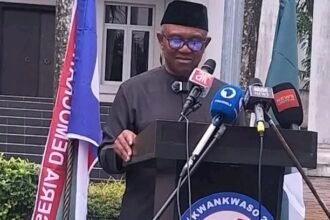
This trajectory is fundamentally different from that of Peter Obi. He started with the PDP, moved to APGA under which he contested the Anambra State gubernatorial election in 2003, lost to Dr. Chris Ngige of the PDP, but was later awarded victory by the Election Petitions Tribunal. He served two terms which expired in 2014. After that, he defected from APGA to the PDP and was appointed Chairman of the Board of the Securities and Exchange Commission, and subsequently served as an adviser to President Goodluck Jonathan. He became the vice-presidential running mate to the PDP presidential candidate, Atiku Abubakar, in the 2019 election, which they lost. In 2022, he defected from the PDP to the Labour Party after losing its presidential primaries to Atiku Abubakar, even after the Labour Party had submitted its membership register to the Independent National Electoral Commission. In 2025, he defected from the Labour Party to the ADC, and in March 2026, he yet again left the ADC for the NDC.
Atiku Abubakar was a founding member of the PDP in 1999 and was elected Governor of Adamawa State under its platform, but before he could be sworn in, he was nominated by President Olusegun Obasanjo to be his vice-presidential running mate for the 1999 and 2003 presidential elections. He fell out with President Obasanjo and jumped ship from the PDP to seek political sanctuary in the Action Congress of President Bola Ahmed Tinubu, who graciously offered him a soft landing to secure the presidential ticket of the AC for the 2007 presidential election, which he lost to President Umaru Musa Yar’Adua. Dramatically, President Yar’Adua died on 5th May, 2010 and was succeeded by Vice President Goodluck Jonathan. Soon after, Atiku Abubakar, lurking around the corner to see if there was any chance of getting the presidential nomination of the PDP on the pretext that it was the turn of Northern Nigeria under the zoning policy of the party, defected from the AC to the PDP to contest its presidential ticket for the 2011 election against President Jonathan, which he lost. In 2014, after the APC had been formed, Atiku Abubakar defected from the PDP to the APC. In 2018, he defected from the APC back to the PDP. In 2025, he defected from the PDP to the ADC.
I will not go into so much detail concerning the case of Dr. Rabiu Musa Kwankwaso, who has shared an almost identical trajectory of political nomadism with Peter Obi and Atiku Abubakar.
In conclusion, for the sake of posterity, especially for Nigerians who came of age between 2008 and 2015 and beyond, the records must be set straight. While President Bola Ahmed Tinubu stands out as a consistent party builder and ideologue who invested years in building a national platform from the AD to AC, ACN and ultimately the APC, his contemporaries – Peter Obi, Atiku Abubakar and Rabiu Kwankwaso – represent the classic case of political nomadism, moving from one party to another in search of personal electoral advantage rather than ideological conviction.