
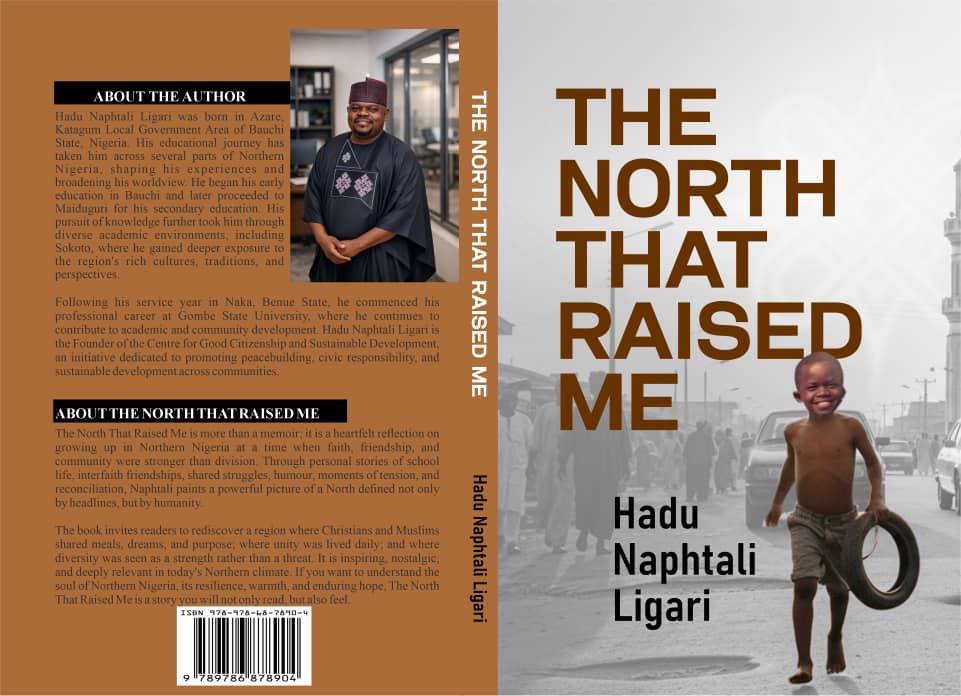

The North That Raised Me
By Hadu Naphtali Ligari
Overview
The North That Raised Me is more than an autobiography; it is a reflection on the social history of Northern Nigeria through the lens of the author’s personal experiences. The book argues that Northern Nigeria was once defined by deep communal bonds where Muslims and Christians lived as neighbours first and adherents of different faiths second.
Rather than presenting an idealized North without problems, the author contrasts the spirit of the past with the increasing religious suspicion, ethnic polarization, and political manipulation that characterize many contemporary relationships.
The Author’s Central Message
The author’s principal argument is straightforward:
Northern Nigeria did not become great because everyone shared the same religion or ethnicity. It became strong because people valued humanity above differences.
Throughout the opening chapters, he demonstrates this through real-life stories of Muslims risking everything for Christians, Christians protecting Muslim beliefs, and communities resolving disagreements privately without allowing them to become religious conflicts. THE NORTH THAT RAISED ME ALL BOOK_125757.pdf
Major Themes
1. Humanity Before Religion
The strongest theme is that compassion should never be limited by religious identity.
The dramatic account of his birth illustrates how an imam assumed responsibility for the life of his Christian neighbour’s wife despite religious differences, showing that genuine faith can inspire acts of extraordinary humanity. THE NORTH THAT RAISED ME ALL BOOK_125757.pdf
2. The Lost Northern Spirit
The author repeatedly mourns what he considers the disappearance of an earlier Northern culture characterized by:
* neighbourliness
* trust
* hospitality
* respect for elders
* communal parenting
* peaceful coexistence
He argues that this culture has steadily weakened.
3. Religion Was Once a Bridge
Instead of portraying Islam and Christianity as enemies, the author argues that many ordinary Northerners historically respected one another’s beliefs and lived peacefully while remaining committed to their own faiths. THE NORTH THAT RAISED ME ALL BOOK_125757.pdf
4. Children Learned Unity Naturally
The stories from his childhood illustrate that children naturally crossed religious boundaries through friendship, imitation, and shared experiences. Adults corrected and guided them without turning these interactions into hostility. THE NORTH THAT RAISED ME ALL BOOK_125757.pdf
5. Memory as Social Critique
The author uses memories not simply for nostalgia but to critique present-day society. He suggests that many current divisions result from losing values that once held communities together.
The Book’s Strengths
The review identifies several notable strengths:
* Rich storytelling that makes complex social issues accessible.
* Use of personal experiences to discuss broader societal questions.
* Balanced criticism directed at attitudes rather than entire religious communities.
* Strong emotional appeal without abandoning its central message.
* Clear call for reconciliation and mutual respect.
Possible Limitations
Readers may also observe that:
* The work relies heavily on personal experience rather than systematic historical analysis.
* Some conclusions are interpretive and may not reflect every community’s experience.
* Those seeking a purely academic history may find the memoir style less comprehensive.
These observations do not diminish the value of the work but help frame it appropriately as a reflective memoir with broader social commentary.
Lessons for Nigeria
The book encourages readers to:
* rebuild trust across religious divides;
* reject stereotypes;
* judge individuals by their character rather than their identity;
* preserve communal values;
* remember that peaceful coexistence requires deliberate effort.
Overall Assessment
The North That Raised Me is best understood as both a memoir and a social commentary. It invites readers to reflect on how ordinary acts of kindness, neighbourliness, and mutual respect shaped communities in the author’s experience and asks whether those values can be renewed today.
Its greatest contribution lies not in claiming that the past was perfect, but in challenging readers to consider whether society has lost forms of everyday solidarity that once helped people live together despite profound differences.








Leave a comment