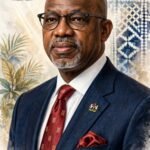


By Chief Akinwumi Akinfenwa
2027 AND THE FUTURE OF NIGERIA:
WHAT MUST CHANGE?
*Recap of the Series*

Over the past six weeks, this series has undertaken a comprehensive examination of the record of the All Progressives Congress (APC) since assuming power in 2015.
In Part One, we revisited the promises that brought the APC to power under the banner of Change and the commitments made in 2023 under the slogan of Renewed Hope.
In Part Two, we examined the economy, highlighting rising inflation, worsening poverty, declining purchasing power and the growing cost-of-living crisis confronting millions of Nigerians.
In Part Three, we analyzed the collapse of the naira, the shrinking middle class, the foreign exchange crisis and the growing exodus of skilled professionals from the country.
In Part Four, we assessed the security situation and compared campaign promises with the realities of terrorism, banditry, kidnapping and widespread insecurity.
In Part Five, we examined public debt, transparency, accountability and the burden that growing indebtedness places on future generations.
In Part Six, we evaluated the state of education and healthcare and considered what these sectors reveal about the nation’s broader human development challenges.
Taken together, these six installments sought to answer one fundamental question:
Has the APC fulfilled the promises upon which it secured the trust and mandate of the Nigerian people?
Today, in this concluding installment, we look forward rather than backward.
For while accountability requires us to examine the past, nation-building requires us to prepare for the future.
*Beyond APC: The Bigger Question*
This series has focused on the APC because it has governed Nigeria for more than a decade.
However, the lessons discussed here extend beyond any single political party.
The future of Nigeria cannot be reduced to APC versus PDP.
It cannot be reduced to APC versus ADC.
It cannot be reduced to APC versus any other political platform.
The larger issue is governance.
The larger issue is leadership.
The larger issue is accountability.
Nigerians must move beyond political branding and begin demanding measurable performance from everyone who seeks public office.
Political parties matter.
But results matter more.
*The Danger of Political Amnesia*
One of the greatest threats to democracy is political amnesia.
As elections approach, new slogans emerge.
New alliances are formed.
New promises are made.
New campaign songs are composed.
Old failures are forgotten.
Citizens are encouraged to focus on future promises while ignoring past performance.
This cycle has repeated itself throughout Nigeria’s democratic journey.
Yet democracy becomes stronger when citizens remember.
Democracy becomes stronger when leaders understand that promises will be measured against outcomes.
Democracy becomes stronger when elections become exercises in accountability rather than exercises in manipulation.
The Nigerian voter must therefore become more demanding, more informed and more vigilant.
*What Nigerians Should Demand in 2027*
As political activities intensify ahead of 2027, Nigerians should insist upon specific standards.
*1. Economic Competence*
Citizens should ask every candidate:
How will you reduce inflation?
How will you stabilize the currency?
How will you create jobs?
How will you attract investment?
How will you reduce poverty?
Vague promises should no longer be sufficient.
Detailed plans should be demanded.
*2. Security Reform*
Every candidate should explain clearly:
How will insecurity be tackled?
How will intelligence gathering improve?
How will communities be protected?
How will farmers return safely to their farms?
How will kidnapping be reduced?
Security promises must be supported by credible strategies.
*3. Institutional Strengthening*
Strong nations are built on strong institutions.
Nigerians should support leaders committed to:
– Judicial independence.
– Electoral integrity.
– Professional public service.
– Legislative effectiveness.
– Local government autonomy.
– Anti-corruption reforms.
Strong institutions outlive individual leaders.
Weak institutions produce recurring crises.
*4. Human Capital Development*
Education and healthcare should occupy a central place in national discourse.
Citizens should demand:
– Better-funded schools.
– Better-funded hospitals.
– Improved teacher welfare.
– Improved healthcare delivery.
– Expanded opportunities for young people.
No country develops sustainably while neglecting its human capital.
*5. Fiscal Responsibility*
Future governments must manage public resources prudently.
Borrowing should be transparent.
Public spending should be accountable.
Citizens should be able to trace how public resources are utilized.
The era of borrowing without sufficient public accountability must end.
*The Nigeria We Must Build*
Nigeria possesses extraordinary advantages.
A large and energetic population.
Abundant natural resources.
Entrepreneurial citizens.
Strategic geographic location.
Rich cultural diversity.
Immense agricultural potential.
Vast mineral resources.
The challenge has never been the absence of potential.
The challenge has always been converting potential into progress.
That requires leadership.
It requires vision.
It requires discipline.
It requires competence.
Above all, it requires accountability.
*Lessons from Twelve Years of APC Governance*
Whether one supports the APC or opposes it, several lessons emerge from the past decade.
First, slogans are not policies.
Second, promises are not achievements.
Third, intentions are not outcomes.
Fourth, political loyalty should never replace objective evaluation.
Fifth, democracy works best when citizens demand results.
The experience of the APC years should encourage Nigerians to become more rigorous in assessing political claims.
Every promise should be scrutinized.
Every policy should be evaluated.
Every government should be held accountable.
That is how democratic societies mature.
*A New Standard for Leadership*
The future of Nigeria requires a new political culture.
A culture in which:
– Performance matters more than propaganda.
– Competence matters more than connections.
– Results matter more than rhetoric.
– Accountability matters more than excuses.
Citizens must reject attempts to distract them with ethnicity.
Citizens must reject attempts to divide them by religion.
Citizens must reject attempts to manipulate them through fear.
The issues that affect Nigerians are remarkably similar regardless of tribe or faith:
– Economic hardship.
– Insecurity.
– Unemployment.
– Poor healthcare.
– Educational challenges.
– Weak infrastructure.
The solutions must therefore be national rather than sectional.
*The Verdict Belongs to the People*
Ultimately, this series does not deliver a verdict.
The Nigerian people do.
The ballot box remains the most powerful instrument of democratic accountability.
It enables citizens to reward success.
It enables citizens to reject failure.
It enables nations to correct mistakes peacefully.
As 2027 approaches, every Nigerian voter should ask a simple but profound question:
Am I better off today than I was before?
Has security improved?
Has my standard of living improved?
Have opportunities expanded?
Has governance improved?
Have public institutions become stronger?
The answers to these questions should guide electoral decisions.
Not propaganda.
Not sentiment.
Not personality cults.
Not political patronage.
But evidence.
*Conclusion: The Future Is Still Ours to Shape*
The story of Nigeria is not yet finished.
The challenges are real.
The frustrations are understandable.
The disappointments are undeniable.
Yet the possibilities remain enormous.
Nations rise and fall on the quality of choices made by both leaders and citizens.
The responsibility of leadership is to govern effectively.
The responsibility of citizens is to hold leaders accountable.
Over the course of this series, we have examined twelve years of APC governance through the lenses of economic performance, currency stability, security, public debt, corruption, education and healthcare.
The evidence has been presented.
The arguments have been made.
The questions have been asked.
The final judgment now rests with the Nigerian people.
As the nation approaches 2027, may voters choose wisely.
May leaders govern responsibly.
May institutions grow stronger.
And may Nigeria finally realize the promise that has for too long remained just beyond reach.
END OF SERIES
*©️ Chief Akinwumi Akinfenwa*
*09091700203 – WhatsApp*
*07062986613 – Calls*