By Eneojo Herbert Idakwo
As the Federal Government champions the revival of Nigeria’s Cotton, Textile and Garment sector, stakeholders are asking whether conflicting institutional actions are placing that ambition at risk.
Industrial revival is not measured by policy pronouncements alone. It is measured by whether factories reopen, investors expand production, workers return to the factory floor and confidence gradually returns to an industry that has spent decades in decline.
That is why Nigeria’s renewed commitment to rebuilding its cotton, textile and garment (CTG) industry has been welcomed across the value chain. Farmers see renewed hope for stable markets. Ginners anticipate increased processing volumes. Textile manufacturers envision dormant machines returning to life. Garment producers see opportunities to source more fabrics locally, while investors are once again beginning to pay attention to a sector that once stood among the country’s largest employers.

The Federal Ministry of Industry, Trade and Investment has repeatedly affirmed the Federal Government’s determination to restore the CTG industry as a strategic pillar of Nigeria’s industrialisation agenda. Recent engagements with stakeholders, financing initiatives and renewed policy conversations have reinforced the impression that the sector is once again receiving the attention it deserves.
Yet, beneath this optimism lies an uncomfortable question.
Can an industry be revived with one hand while its surviving indigenous operators are weakened with the other?
It is a question that is increasingly being asked within Nigeria’s textile community as the Bank of Industry, the government’s foremost development finance institution, pursues receivership and debt recovery actions against some indigenous textile companies.
The concern extends beyond individual businesses.
It raises fundamental questions about policy coherence, institutional coordination and the future of indigenous manufacturing in Nigeria.
Development finance or debt recovery?
Development finance institutions occupy a unique position in every economy.
Unlike commercial banks, they are established not merely to lend money but to promote industrial development, preserve productive capacity and stimulate sectors considered strategic to national economic growth.
This distinction becomes particularly important during periods of industrial distress.
Across the world, governments often ask development finance institutions to restructure loans, support business recovery and preserve productive assets where the long-term economic benefits outweigh immediate loan recovery.
The objective is straightforward.
A functioning factory that continues to employ workers, purchase raw materials and pay taxes often contributes more to the economy than a closed factory whose assets have been disposed of through receivership.
This is especially true in industries regarded as strategically important.
Nigeria’s cotton, textile and garment sector falls squarely within that category.
A shrinking industrial base
Nigeria’s textile industry has already endured decades of contraction.
Factories that once defined industrial cities such as Kaduna, Kano and Funtua now stand as reminders of lost manufacturing capacity. Thousands of skilled workers have exited the industry. Supply chains that once connected farmers to manufacturers have steadily weakened.
The indigenous companies that remain therefore represent more than individual businesses.
They embody decades of industrial knowledge, technical expertise, supplier networks and productive assets that cannot easily be replaced.
Industry stakeholders argue that preserving this remaining capacity should be a central objective of any national revival strategy.
Against this background, some observers fear that aggressive receivership actions, however legally justified, may further reduce the pool of indigenous industrial operators at precisely the moment government is encouraging renewed investment in the sector.
The question of policy alignment
The issue is not whether financial obligations should be honoured.
No serious industrial policy can succeed if contractual obligations are ignored or if development finance institutions abandon prudent financial management.
The real question is whether strategic industries require a different approach when financial distress threatens productive capacity.
Should rehabilitation be exhausted before receivership?
Should restructuring receive greater emphasis where factories remain capable of returning to production?
Should industrial policy objectives influence how development finance institutions manage distressed strategic assets?
These are legitimate policy questions now attracting increasing attention within the CTG industry.
They become even more relevant because both industrial revival and development finance ultimately serve the same national objective, strengthening Nigeria’s productive economy.
Speaking with one government voice
For manufacturers, investors and financial markets, government is viewed as a single entity.
Investors rarely distinguish between one ministry, one agency or one financial institution.
They respond instead to the overall policy environment.
Where one institution encourages investment while another appears to diminish existing productive capacity, uncertainty inevitably follows.
That uncertainty influences investment decisions.
Manufacturers become cautious.
Banks become more conservative.
Foreign investors adopt a wait-and-see attitude.
Domestic entrepreneurs postpone expansion.
Industrial confidence weakens.
This is not because debt recovery lacks legitimacy.
It is because policy signals appear mixed.
International experience
Countries that successfully rebuilt declining industries rarely relied on isolated institutional action.
When the United States intervened to save its automobile industry during the global financial crisis, loan restructuring, equity participation and operational reforms were prioritised to preserve productive capacity and employment.
Several European countries adopted similar approaches in supporting strategic manufacturing industries during periods of economic stress.
In Asia, governments frequently combine financial restructuring with industrial upgrading, recognising that preserving domestic manufacturing capacity often produces greater long-term national value than immediate asset liquidation.
None of these approaches ignored financial discipline.
Rather, they balanced commercial realities with national industrial priorities.
That balance is precisely what many Nigerian stakeholders believe deserves greater attention.
The Bank of Industry’s strategic responsibility
The Bank of Industry occupies a unique position within Nigeria’s economic architecture.
It is more than a lender.
It is a development institution created to accelerate industrialisation, strengthen manufacturing and promote economic diversification.
Its success is therefore measured not only by loan recovery rates but also by the number of viable industries it helps sustain, the jobs it preserves, the exports it supports and the industrial capacity it enables.
This places the institution at the heart of Nigeria’s manufacturing future.
It also means its decisions inevitably carry consequences that extend beyond individual borrowers.
Why stakeholders see the need for a coordinating institution
One recurring concern raised across the cotton, textile and garment value chain is the absence of an institutional platform where industrial policy, development finance, manufacturing interests and investment strategies can be aligned before conflicts emerge.
Many industry participants believe this is precisely the gap the National Economic Council sought to address through its approval of a Cotton, Textile and Garment Development Board.
Supporters argue that such a Board would not replace the Federal Ministry of Industry, Trade and Investment, the Bank of Industry or any existing institution.
Rather, it would provide a strategic coordinating platform where policies affecting cotton farmers, ginneries, textile mills, garment manufacturers, financial institutions, researchers and investors could be harmonised within a single national framework.
Under such an arrangement, financing decisions, restructuring mechanisms, industrial incentives and sector-wide recovery plans would complement rather than inadvertently undermine one another.
For manufacturers, this represents one of the strongest arguments for implementing the NEC-approved Board.
It offers an institutional mechanism capable of ensuring that every arm of government works toward the same industrial destination.
Beyond receivership
The debate is ultimately much larger than the financial circumstances of individual companies.
It concerns the future of indigenous manufacturing.
It concerns investor confidence.
It concerns whether Nigeria can rebuild industrial capacity while simultaneously reducing the number of domestic firms capable of leading that recovery.
Most importantly, it concerns whether industrial policy can succeed without institutional coherence.
As the Federal Government intensifies efforts to revive the cotton, textile and garment industry, stakeholders will continue to judge progress not only by new initiatives but also by the consistency with which existing institutions pursue the same national objective.
Industrial revival is too important to be weakened by fragmented implementation.
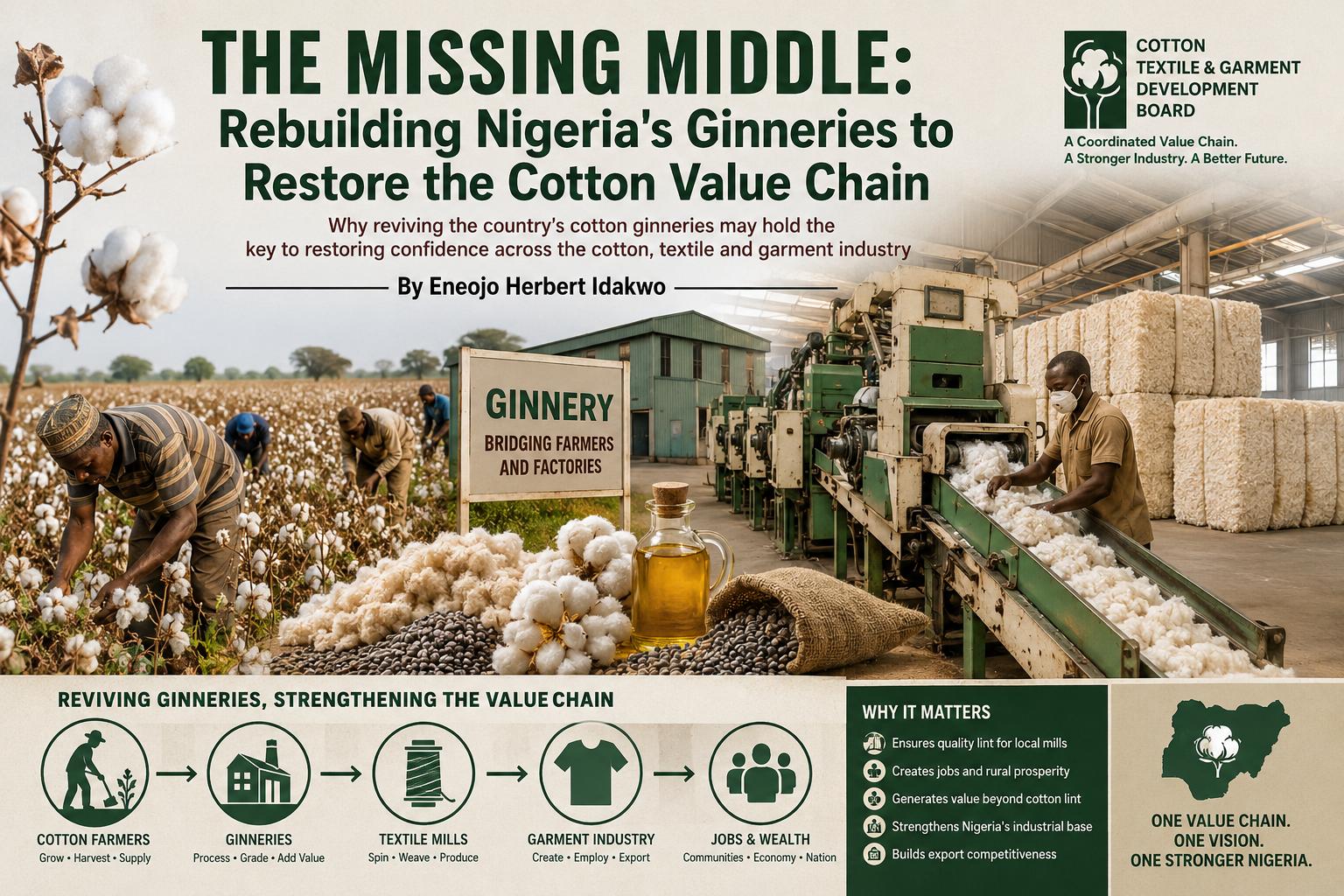
The cotton farmer, the ginnery operator, the textile manufacturer and the garment producer are all links in one chain.
The institutions that serve them must function with the same unity of purpose.
For many across the industry, that is why the implementation of the NEC-approved Cotton, Textile and Garment Development Board has become more than an administrative proposal.
It has become a test of whether Nigeria is prepared to coordinate its industrial ambitions with the institutions responsible for delivering them.
If the nation truly seeks to rebuild its cotton economy, then every policy, every intervention and every institutional action must pull in the same direction. Only then will revival become more than a promise. It will become a measurable national achievement.
This feature was first published in dailytrust.com on the 25/72026
Eneojo Herbert Idakwo, development journalist, Agribusiness analyst, writes from Abuja
eneojoherbert@gmail.com