
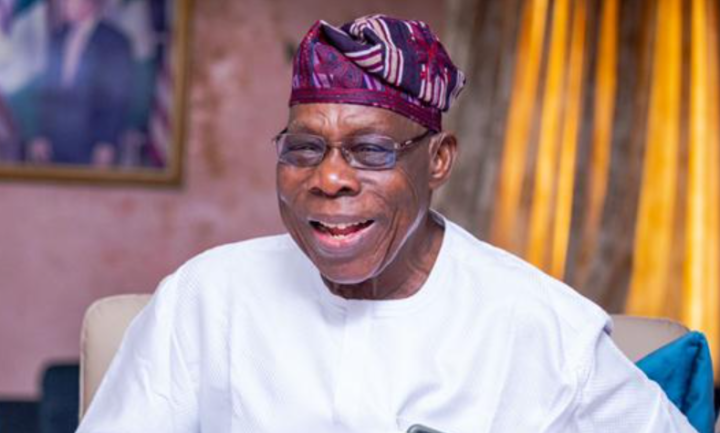

CHIEF OLUSEGUN AREMU OBASANJO
THE MAN OLUSEGUN OBASANJO………
by Agbonmagbe Kazeem
“Obasanjo’s avid love of learning, acquiring knowledge and doing new things deriving from that knowledge is evident throughout the different stages of his life”.
The decision to honour the declaration and the actual handing over power from military rule to a civilian administration in Nigeria on 1st October, 1979 was a defining moment in the life progression of the man, Olusegun Obasanjo. It highlighted significant traits in his character and was to shape his image within the international community.
He was certainly the first military Head of State to voluntarily hand over power to an elected civilian president if not in most of the developing world but certainly in Africa. It underscored his being a man of honour, of considerable integrity, a true officer and gentleman; a man whose word is his bond and a person with whom the world can readily do business.
Olusegun Obasanjo, sometime in 1977 when, as the head of the military Head of State, he came to the newly defined Federal Capital Territory to see what were doing in respect of the ecological survey and the census of the economic assets and inhabitants to be displaced from the area. And of course, as the military commander that brought the Nigerian civil war to an end.
He was the Chief of Staff, Supreme Headquarters, who was persuaded to take over as Head of State and Commander-in-Chief of the Armed Forces on the assassination in February, 1976 of his predecessor in that office, General Murtala Mohammed. But it was not until after he left office in 1979.
THE EARLY INFLUENCES ON OLUSEGUN OBASANJO
Three influences from his early life would seem to me to define much in the character of the man, Olusegun obasanjo. The first is the love of hearth and land; the second is a strong religious conviction and trust in God; and the third is an avid love of learning, acquiring knowledge and doing new things deriving from that knowledge. Olusegun Obasanjo was born on March 5,1937 in Ibogun OLAOGUN, one of some 30-odd villages bearing the name “Ibogun’’ in an extensive tract of land north of the small town of Ifo in Ogun State. Obasanjo’s belong to the Owu sub-tribe of the Yoruba.
The Owu are a subgroup of the Yoruba whose history has been pivotal to much of what happened in this part of Nigeria in the 19th century. The heartland of the Owu Kingdom in history was in an area north of Ibadan. Owu town, however, was destroyed around 1821 and a sizeable part of the displaced population moved to join the Egba in their new settlement of Abeokuta, sometime after 1830. From here, many Owu people moved towards southwestward from Abeokuta to establish numerous rural settlements including the Ibogun group of villages.
Although regarded as part of Awori land, this area was a scantily populated and insecure border region requiring people of considerable courage and determination to establish settlements there at the time. The Owu have always had the reputation among the Yoruba of being a courageous and stubborn people, a trait which must have passed down through the generations and of which the man, Olusegun Obasanjo, show ample evidence.
Obasanjo’s love of hearth and land is particularly evident in the continued strong attachment to his birthplace. Apart from building himself a modern house in the village which he visits frequently, he is always proud to take his friend to the village, showing them the primary school he attended and relating easily with his kinsmen even after he had risen to be the Head of State of the Federal Republic of Nigeria and presently a statesman.
His love of dancing to native airs with his people is also one of the manifestations of this ease of relating to the common man anywhere and everywhere. It is seen, for instance, in his later years when he leads his political party on election campaigns. He went on to establish an experimental primary health care system for the villagers, offering them both conventional modern and traditional alternate clinic to deal with their ailments.
When the Ogun State Government under Chief Bisi Onabanjo decided to locate a campus of the Ogun State University Ibogun, Obasanjo was greatly enthused and wished that the campus could be made a focal point for planning the merging of all the Ibogun villages to form a single town. He was willing to rally all Owu sons and daughters in Egbaland to support the development of this campus, a development which halted with Buhari military coup of 1983.
Since then, however, Obasanjo, with others, has succeeded in fostering a new sense of Owu consciousness among his kinsmen not only in Egbaland but everywhere they had settled in Yoruba and since the dispersal of their home town in 1821. Today, he has collaborated in instituting an annual Owu day celebration for promoting solidarity amongst them and is very proud of his chieftaincy title of Balogun (Commander-in-Chief) of the Owu of Abeokuta.
It is also to this strong love of hearth and land in the rural setting of Ibogun that we must attribute Obasanjo’s ardent and passionate love for farming and agriculture. And, it is to this same attribute that we must appreciate his strong patriotic fervor, his love for and commitment to Nigeria, his fatherland, which his years in the military must have helped to greatly consolidate.
His strong religious conviction and trust in God is evident to anyone close to his household, during his years as a military head of state and then by the time he returned as civilian president, the day began for him with family devotion involving all members of his household and other close colleagues who cared to join in. As President, he had the advantage of the state house chaplain to preside on these occasions. The dea of his faith is due to Baptist Christian Missionary influence in his schooling years at the Baptist Boys High School in Abeokuta.
There is, however, no doubt that his commitment to a temperance posture where alcoholic drinks are concerned and even his use of word “Temperance” in naming some of the private institutions established by him derive from this source. Obasanjo’s redoubtable courage and fearlessness can also be ascribed to this strong religious conviction. It certainly underscores his brilliant achievements as a military commander, especially in the decisive manner in which he brought the Biafran war to a close. It is also evident in his outspokenness on national issues in the current democratic dispensation.
Obasanjo believes in divine interventions in critical periods of his life. His escape from the fatal injection planned for him under Abacha’s regime and his second coming as the civilian head of state of the Nigerian Federation he puts down to God’s intervention in his life. It has also been claimed that his difficulty in dealing peremptorily with the proponents of “The Third Term Saga’’ during his presidency was because he wondered whether this was another instance of divine promotion.
Obasanjo’s avid love of learning, acquiring knowledge and doing new things deriving from that knowledge is evident throughout the different stage of his life. He did not go to school until he was nine years of age. The story is told of his being on the farm with his father when the latter, out of the blues, stopped and asked his dutiful and hardworking farmer-son: “This school thing, can’t you also go?” Apparently surprised, he assured his father that he could if his old man so desired.
His avid love of learning soon began manifesting at the primary school in Ibogun and later at the Baptist Boys’ High School in Abeokuta. Even when he joined the army in 1958, this love was only starting to blossom. Indeed, at the Defense Service Staff College in Wellington, India, the commandant’s confidential report of the 20th Staff Course in 1965, noted that he was “the best officer who was sent up till then from that country (Nigeria) to Wellington.’’
Nonetheless, it was after his military career that this capacity of his had free rein. When he chose to retire into farming, he decided to go for short-term training at the International Institute of Tropical Agriculture (IITA). To help promote the idea of learning as a life-long obligation, he registered as a student in the National Open University of Nigeria (NOUN) when he was still the nation’s president. On his own, he continues to spend time learning and innovating over a wide range of issues.
It is, of course, presumptuous to single out only three influences in the life of any individual. There can be no doubt that for a person of such forceful and versatile personality, other influences can be identified especially as he grew up and operated in different theatres of life such as the military, the political, the social and the economic. There is little doubt, however, that in all these areas, something from these three influences of his early childhood would be found to underpin the manner of his operations.
Since he was such a towering national figure on becoming military head of state and a two-term civilian president, it will be useful to see how these influences affected his dispositions in these various contexts.
The first examines the man – Obasanjo – when occupying the highest seat of power in the country; the second looks at him when he was out of power whilst the third attempts to capture something of the image he has created for himself internationally. The fourth part then considers the nature of his legacy the man –Obasanjo- is likely to leave for the coming generations of Nigerians. A concluding section evaluates the controversial nature of his impact on the Nigerian nation and society.
The Man—Obasanjo in Power
In his first attempt at providing some explanation of his intervention in the power politics of the country titled: Not My Will, written in 1981, Obasanjo tries to indicate how his ascension to power was not a matter of personal ambition but of divine promotion. Once he found himself in that position, however, he threw himself fully into making the decisive impact on national life which the situation demanded.
The history of his progression from being Chief of Staff Supreme Headquarters to General Murtala Mohammed and his becoming the Head of State on the assassination of the latter is captured very well in that publication. What is interesting to me and relevant to our present purpose is the light the whole process casts on the nature of his personality. Whatever one thinks of the Nigerian Army, it has evolved as a veritable microcosm of what the Nigerian nation should become—a melting pot of many ethnic groups living together in mutual respect and providing opportunities for individuals to prove their mettle especially in leadership positions. Obasanjo seemed to have flourished in such a milieu.
His competence, decisiveness and leadership qualities were already manifest in the manner in which he moved as Commander of the Third Marine Commando to bring an end to Nigerian Civil War. These qualities were to make him one of the reference figures that junior colleagues considered when they decided to terminate the first military regime under General Yakubu Gowon. He, of course, did not participate in that coup d’etat. Those who did knew Obasanjo was one of their senior officers who could help redeem the situation that had provoked them to this extreme measure.
Even though with hindsight it is possible to see that his colleagues did not fully appreciate the implications of the multi-ethnic nature of the Nigerian nation or how truly and effectively to manage such complexity, he tried to forge a high degree of unity and uniformity into the administration of the country. What was impressive, however, was that they tried to be innovative in many decisions they took. The Local Government Reform and the Land Use Decree testify to this trait.
In all these, Obasanjo’s decisiveness in policy matters continued in the military tradition of insisting that conclusions be implemented “with immediate effect”. It must be admitted, though, that these conclusions occur after due consultation with the relatively narrow “Kitchen-cabinet” of civil servants and military colleagues in the Supreme Military Council.
The general approach to national issues at the time, especially in the social and economic realm was what can be referred to as “statist’’. This approach is best reflected in the words of the Second National Development Plan (1970-74) which expects that “the State must control all the commanding heights of the nation’s economy’’. This meant that both at Federal and State levels, government became the major proprietor or operator.
“Whether it is in air, marine, or rail transportation, the development of the nation’s Iron and Steel and Petroleum Industry, in the ownership of Schools, Universities or Health Institutions, Sport stadia and so on, the role of government as owner and operator was paramount. Of course, this posture was possible partly because of the heavy windfall from the export of petroleum and partly from the apparently successful template presented by the Soviet Union and other Socialist countries at the time”.
Twenty years later, when he returned as civilian president, so much had changed that Obasanjo too had to change his views and strategy. Most of the areas of social and economic life in which government had intervened so heavily had to rise up to the challenges of growth and development. Indeed, everywhere the failure of states enterprises has dragged down the development thrust of the country and enthroned huge infrastructure deficit, debilitating corruption and pervasive poverty in the land.
The Nigerian Airways had lost most of the 27 aircraft in its fleet and was being harassed all over the world for indebtedness. The shipping line had lost of most of its vessels and the last was about to be sold off cheaply to a local bidder. The dual carriage ways constructed to ease the heavy, port-oriented traffic from Lagos northwards to Ibadan and eastward to Benin had gone into serious state of disrepair whilst the railway system had become truly comatose.
The situation in the educational and health sector was no better. The Universities, most of which were now owned by the Federal government, had fallen sharply from their international rating. Government hospitals including the teaching hospitals of universities had come to be “mere consulting clinics’’. Most of them had lost their highly skilled staffs to other countries, especially Saudi Arabia and the United States.
Obasanjo, as a very pragmatic and insightful leader, had to critically reappraise the situation. He appreciated that the country, with its federal character syndrome and indifference to meritocracy in appointment to important management positions, was certainly not ready for a “statist” approach to development. The private sector with the inevitable market sanctions for poor management had to be enthroned to drive large sections of the nation’s social and economic life.
This turn-around, he immediately set out to initiate on his return as a civilian president. The jury, of course, is still out in terms of evaluating his achievements in providing the appropriate socio-economic framework and the right enabling environment for the private sector to flourish and develop, especially in the critical areas of infrastructural deficits. Years of public sector dilatoriness and incompetence had helped to breed a high level corruption in getting anything done in the country.
Much of public resources especially in the oil sector, had come to be allocated to eminent individuals. It was thus not surprising that the first bill that Obasanjo sent to the National Assembly then on the occasion of his second coming was on how to deal with corruption. He did not appreciate how much his own principled position on corruption was at variance with many in the National Assembly. It took nearly two years before a watered down version of the bill he sent to the Assembly could be passed into law.
This difference in posture as to the urgency of dealing with corruption in the land was to undermine to a large extent the relationship between the Presidency and the National Assembly particularly during the first term of Obasanjo in office. The decision to deal with corrupt individuals more via the police route of the EFCC (Economic and Financial Crimes Commission) under the chairmanship of Mallam Nuhu Ribadu rather than the judicial route of the ICPC (Independent Corrupt Practices and other related Offenses Commission) under the chairmanship of Honourable Justice Mustapha Akanbi and later Honourable Justice Tunde Ayoola did a lot to reduce the feeling of impunity and complacency on issues of corruption in the country.
Of course, there were grumblings, especially in the media, that the EFCC was selective in its operations, dealing allegedly only with those unbeloved of the presidency. Whether true or not, the determined manner the agency went after those whose corrupt practices came to its notice sent a strong message to everyone in the country and helped to raise the expectation that corruption in the country could be contained. Since the end of the Obasanjo’s presidency, the more relaxed posture of the succeeding presidents based on observing “the rule of law” has led to a backsliding in the struggle and strongly indicates that corruption is not something to be fought with kid gloves.
The same expeditiousness characterised his approach to decision-taking this time around. When an issue was brought for consideration to Obasanjo or when he presided over a deliberation, once he had listened to both sides and a decision had been arrived at, one could expect action on the matter within hours or a matter of days. Obasanjo used the telephone as a veritable and critical tool of decision making.
Any of his ministers then could expect to be called on the telephone at any time of the day or night to shed light on his or her part in a decision making process.
HAPPY BIRTHDAY BABA
“THE HISTORIAN”
AGBONMAGBE REMILEKUN KAZEEM
+2348036472826






Leave a comment