
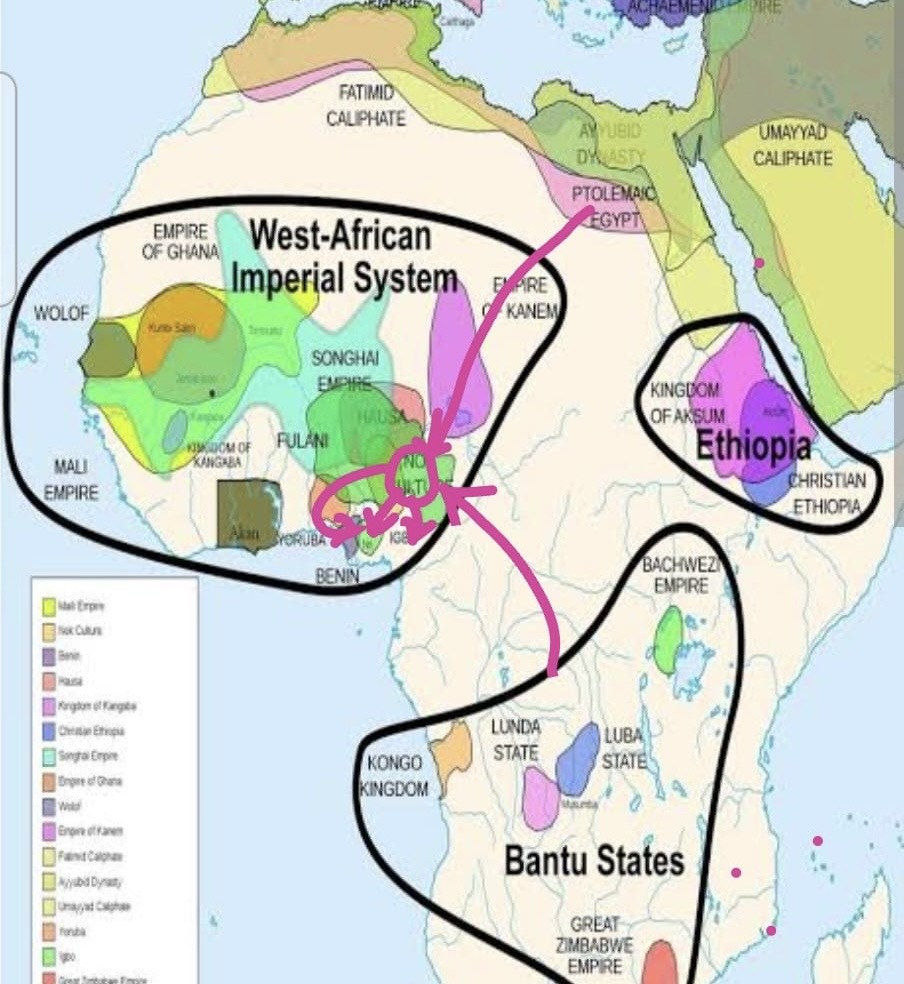

Africa, the Middle East, and Ancient Migration Theories .
by Okoi Obono-Obla
The point is that most population groups in Africa migrated from the so‑called Middle East into the continent, because in antiquity the region was a conterminous part of Africa. This perspective emphasizes that the boundaries we recognize today between Africa and the Middle East are modern constructs, whereas in ancient times the two regions were deeply interconnected.
Geographic Continuity in Antiquity
– Ancient geographers often described Africa and Asia as parts of a single landmass.
– The Nile Valley, the Red Sea, and the Arabian Peninsula formed natural corridors of movement, trade, and cultural exchange.
– What we now call the Middle East was not seen as a separate “world region” but as an extension of northeastern Africa.
Migration and Population Movements
– Archaeological and linguistic evidence suggests waves of migration from the Nile Valley and the Arabian Peninsula into West, Central, and Southern Africa.
– These movements were driven by climate shifts, conflicts, and trade opportunities.
– Many African ethnic groups trace their oral traditions to origins in the East, reinforcing the idea of shared ancestry across the regions.
Cultural and Historical Implications
– The blending of African and Middle Eastern influences shaped early civilizations, including Egypt, Nubia, and Kush.
– Religious traditions, technologies, and political systems often spread along these migration routes.
– Theories of origin—such as those linking the Yoruba or other groups to ancient Near Eastern conflicts—reflect this interconnectedness.
Conclusion
The notion that African populations migrated from the Middle East underscores the fluidity of ancient geography, where Africa and the Middle East were seen as contiguous parts of a larger cultural and ecological zone. This perspective helps explain the deep historical ties between peoples of both regions and highlights how modern boundaries can obscure ancient realities of migration and shared heritage.
@ Okoi Obono-Obla











Leave a comment