By Okoi Obono-Obla
Historically, ganging up in the guise of an alliance has never worked in the chequered history of Nigerian politics.
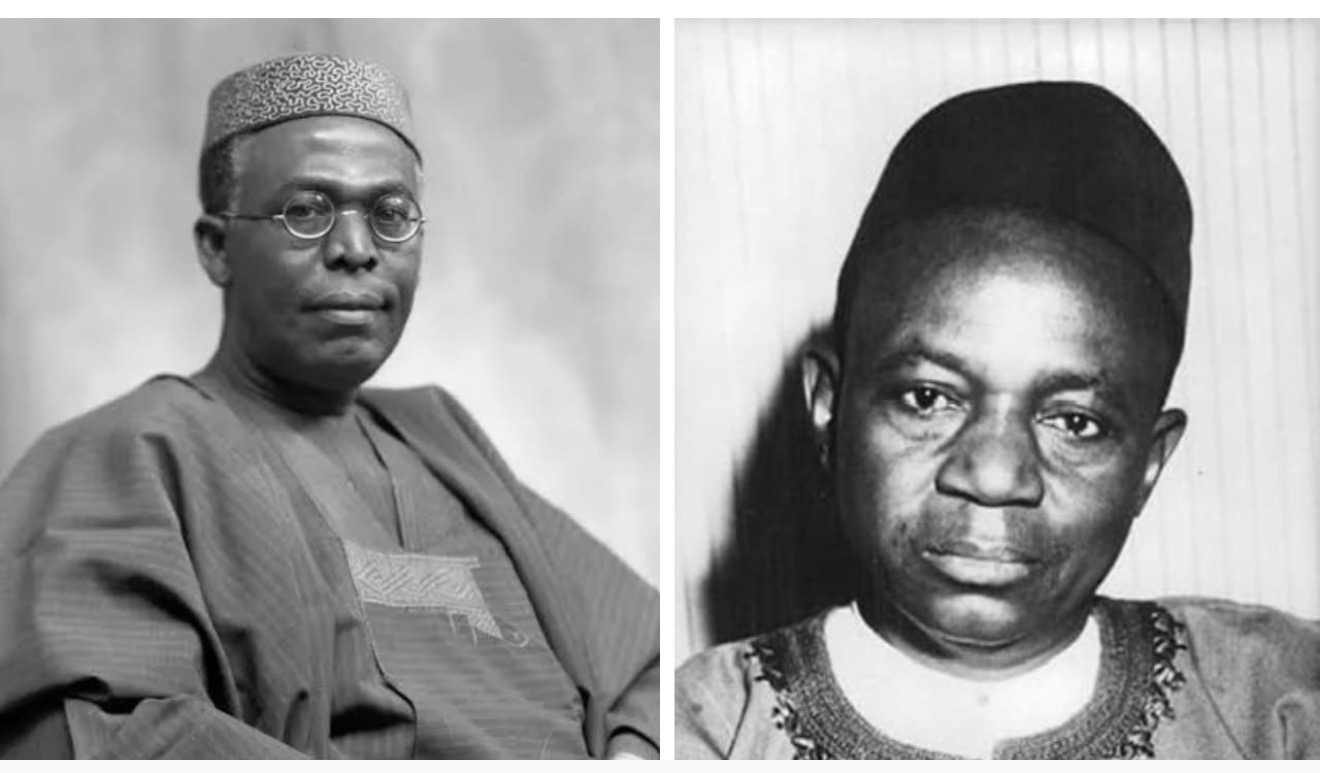
The lesson dates back to 1964, when a crack in the opposition Action Group over whether it should continue to remain an opposition party or align with the ruling Northern People’s Congress resulted in a political row and crisis, with the Action Group fractionalising into two irreconcilable factions: one led by Chief Obafemi Awolowo and the other by Chief Samuel Ladoke Akintola.
That crisis spiralled into fighting in the Western Nigeria House of Assembly. It had begun in 1962, when Prime Minister Sir Abubakar Tafawa Balewa declared a state of emergency, suspended Premier Akintola from office, and appointed Dr M. A. Majekodunmi as Administrator of the Western Region.
The Akintola faction eventually joined an alliance forged between it and the Northern People’s Congress, known as the Nigerian National Alliance (NNA). On the other hand, the Awolowo faction forged an alliance with the National Council of Nigerian Citizens (NCNC), Aminu Kano’s Northern Elements Progressive Union (NEPU), Joseph Tarka’s United Middle Belt Congress (UMBC) and other parties under the aegis of the United Progressive Grand Alliance (UPGA) to fight the 1964 general election. At the end, the NNA prevailed against the UPGA.
History repeated itself in similar fashion in 1983, when there was the formation of a similar alliance by the so-called Progressives against the defunct National Party of Nigeria (NPN), which had grown into a behemoth like the APC, and other parties such as the Nigerian Peoples Party (NPP), Unity Party of Nigeria (UPN), Great Nigeria Peoples Party (GNPP) and the Peoples Redemption Party (PRP), to form the Progressive Parties Alliance (PPA).
It was disjointed and disparate, not united by any ideological or philosophical coherence to advance the interest of Nigeria, but a hurried package of ambitious and self-centred politicians nursing self-serving individual ambitions to unseat President Shehu Usman Aliyu Shagari, driven as much by hatred and envy of the NPN as by principle. The fatal flaw was personal: neither Chief Obafemi Awolowo nor Dr Nnamdi Azikiwe would step down for the other. Both ran. The anti-NPN vote split. At the end, the NPN dealt the PPA a crushing blow at the election.
In 1999, such an alliance between the All Peoples Party (APP) and the Alliance for Democracy (AD), fielding Chief Olu Falae as its presidential candidate and the APP producing Alhaji Umaru Shinkafi as his vice-presidential candidate, failed woefully to stop the victory of Chief Olusegun Obasanjo of the PDP.
Again in 2011, the defunct Congress for Progressive Change (CPC) of General Muhammadu Buhari and the Action Congress of Nigeria (ACN) of Asiwaju Bola Tinubu, at the twilight of the 2011 presidential campaign, impetuously and hurriedly tried to forge an alliance but woefully failed, this time over who would be vice-president.
History is intertwined with culture and the behaviour pattern of a given society and people. The DNA of Nigerian politicians for the past eighty years or so, which manifests in their culture and behaviour, is the same, just as human biology and social science intersect. Nigerian politicians do not like alliances that are hurriedly packaged, rather than coerced or brought together by a natural alignment of political interest. I can bet that the so-called summit of 30 November 2026 will turn out a mirage.
THE LESSON BUHARI AND TINUBU ACTUALLY LEARNT
The lessons of history, and the difficulty of forging political alliances as learned from history, perhaps more than anything propelled General Muhammadu Buhari and Asiwaju Bola Ahmed Tinubu to agree, late in 2012, that the only way to defeat the behemoth which the PDP had become was to merge their different political parties.
That agreement culminated in the formation of the APC in 2013. The rest is history.
But the crucial point is often missed: Buhari and Tinubu did not repeat the mistake of 1964, 1983, 1999 or 2011. They did not settle for a hurried electoral alliance, a joint ticket, a summit communiqué, or a loose understanding at the twilight of an election. They chose a full merger.
The ACN, CPC, ANPP and a faction of APGA dissolved into a single party, formed on 6 February 2013 and registered by INEC on 31 July 2013. It had one constitution, one logo, one ballot identity, one presidential candidate, and two full years to sell itself to the electorate before the 2015 election.
That is the difference between an alliance and a merger. An alliance preserves separate ambitions. A merger forces a single ambition. An alliance allows each leader to keep his party, his logo, his structure and his escape route. A merger burns the boats.
The opposition leaders meeting on 30 November 2026 are doing the opposite of what Buhari and Tinubu did. They are keeping their separate parties, ADC, NDC, APM, PRP, keeping their separate logos, keeping their separate presidential ambitions, and hoping that a handshake in Abuja will do the work that a merger did in 2013. It will not.
THE PUNCH SUMMIT AND ITS FAULT LINE
That is the proper lens through which to read the report in The PUNCH, 2027: APC unfazed as Atiku, Obi, Makinde meet Monday.
According to that report, opposition leaders, including the African Democratic Congress presidential candidate, Atiku Abubakar; his National Democratic Congress counterpart, Peter Obi; and the Allied Peoples Movement presidential candidate, Seyi Makinde, are expected to meet in Abuja on Monday to advance discussions on forging a common political front against President Bola Tinubu. Also expected is the presidential candidate of the Peoples Redemption Party, Donald Duke. The meeting is scheduled for the NAF Conference Centre.
Ahead of the meeting, The PUNCH gathered that Atiku and Makinde had held extensive discussions on a possible power-sharing arrangement, including the possibility of Makinde being considered for Secretary to the Government of the Federation should the opposition succeed. Yet some APM sources in Ibadan insisted Makinde would not step down for Atiku. Makinde believes the South must complete their term, a party leader stated.
That single sentence exposes the regional rivalry now thrown up by the 2026 race.
Southern politicians such as Makinde, Peter Obi and Donald Duke are clinging tightly to the claim that it is the turn of the South to produce the President for the next four years. Atiku Abubakar tenaciously rejects such a claim. He is a northern candidate who believes his own entitlement, experience and national spread entitle him to lead the opposition, regardless of the zoning argument.
This is not a minor disagreement over tactics. It is a fundamental contradiction at the heart of the proposed alliance. How can men who disagree on who is entitled to lead Nigeria, on the basis of region, agree on who should lead their alliance?
Makinde himself, in an interview with Chude Jideonwo, confirmed discussions with Atiku and Obi but clarified that the emerging arrangement was not intended to replicate the full-scale merger that produced the APC ahead of 2015. It would be a loose political arrangement. That admission is telling: even its promoters do not believe in it enough to merge.
Meanwhile, the claim by Lere Olayinka, media aide to the Minister of the Federal Capital Territory, Nyesom Wike, that Makinde had agreed to withdraw in favour of Atiku on 30 November and negotiate for SGF, remains unconfirmed by Atiku, Makinde or the ADC. The APM has rejected it outright. The PDP has likewise rejected reports that its factional candidate, Senator Sandy Onor, might withdraw to support Tinubu. Much of the present noise is therefore speculation dressed as negotiation.
The APC, for its part, has expressed confidence that the emerging alliance would not affect Tinubu’s chances. Its Director of Publicity, Bala Ibrahim, said no agreement between Atiku and Makinde would frighten the party.
He may be right, not because the APC is invincible, but because history is against hurried alliances.
THE BALLOT-PAPER PROBLEM
In 50 days’ time, we are going to have a presidential election in which all the contesting parties are required by law to present single candidates who will use the platforms and logos of their respective parties on the ballot papers on which the electorate will vote for them.
An alliance hurriedly forged at the twilight of electioneering, when parties are expected to educate and enlighten their supporters on how to thumbprint on the ballot papers given to them, will hardly produce the magic wand to victory, especially as the majority of the voting population need to be sufficiently educated on how to cast their votes, not merely about candidates, but on the logo of the political party they want to vote for.
Will the supporter of Atiku in Adamawa know to vote for Obi’s logo if Obi emerges? Will the supporter of Obi in Anambra know to vote for Makinde’s logo if Makinde emerges? Will the supporter of Makinde in Ibadan know to vote for Atiku’s logo if Atiku emerges? These are not rhetorical questions. They are the practical questions that have destroyed every hurried alliance since 1964.
An alliance is not a press conference. It is not a summit. It is not a communiqué. It is a convergence of interest, ideology, organisation and trust, built over time. What we are witnessing is none of those things. It is a gathering of rivals, each convinced that he alone should lead, each nursing the ambition to be president, each distrustful of the other, and each hoping to use the others to climb to power.
Nigerian politicians have been here before, in 1964, in 1983, in 1999, in 2011. Each time, the alliance collapsed under the weight of ambition, regional rivalry and the absence of a shared philosophy.
The one time it worked, in 2013, it worked because the leaders stopped forming alliances and started building a party.
The summit of 30 November 2026 will be no different from the failures that preceded it.