
By Okoi Obono-obla
Caption:
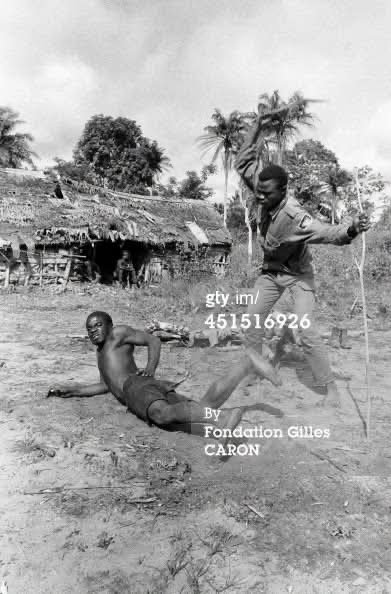
A Biafran soldier flogs an Ibibio young man lying on the ground, writhing in pain, helpless and pleading for mercy, in a village in Ibibio land, present-day Akwa Ibom State, c. 1968. Photo: Gilles Caron / Getty Images, via HistoryVille.
Surely.
A friend in the United States shared with me last night a telling and poignant photograph, originally posted by HistoryVille, taken probably between 1967 and 1970 during the horrific and brutal Nigerian Civil War. It shows a Biafran soldier flogging an Ibibio young man lying on the ground, writhing in horrible pain, completely helpless and pleading for mercy, while the soldier in uniform stands over him.
The flogging did not take place at Gakem. It took place in one of the villages belonging to the Ibibio people in present-day Akwa Ibom State.
I have written several times in Chatafrik about the dehumanisation of our people by Biafran forces, under the guise that they were undermining Biafra and supporting the Federal forces.
The Ibibio are an ethnic nationality found in present-day Akwa Ibom State, Nigeria. They were one of the ethnic nationalities that made up the old Eastern Region of Nigeria, which Lt. Col. Chukwuemeka Odumegwu Ojukwu, on 30 May 1967, ceded from the Federal Republic of Nigeria to form the defunct Republic of Biafra, without their consent.
It is important to get the sequence right. On 27 May 1967, Ojukwu received a mandate from the Eastern Region Consultative Assembly to declare secession. On that same day, General Yakubu Gowon announced the creation of 12 states, breaking up the Eastern Region into East-Central, South-Eastern and Rivers States. Three days later, on 30 May 1967, Ojukwu proclaimed the Republic of Biafra.
The Federal Military Government of General Gowon promptly declared the secession illegal and ordered a “police action” against Ojukwu. A column of troops from the 1st Division of the Nigerian Army, headquartered in Kaduna, then capital of Northern Nigeria, was ordered to move to Enugu to arrest Ojukwu. The troops took the Kaduna–Makurdi–Gboko road, en route to the Ogoja–Abakaliki–Enugu road.
When the column reached Gakem, which lies on the boundary between the former Eastern and Northern Regions, fighting broke out on 6 July 1967. That first clash — the shooting at Gakem — marked the beginning of the war. Gakem is today in Bekwarra Local Government Area of Cross River State, where it shares a boundary with Vandeikya Local Government Area of Benue State.
Who fired the first shot at Gakem remains contested to this day. Federal accounts say their artillery opened fire at 5:30 a.m. Others from Cross River say Federal troops fired first at civilians at Ushara Hills. Still others say Biafran troops guarding the border town opened fire first. What is not contested is that Gakem was where Nigeria’s 30-month fratricidal war began.
What followed in the minority areas was a pattern of grave atrocities. Biafran troops carried out grave atrocities against people from the Calabar, Ogoja and Rivers Provinces, which constituted the minority areas of the then Eastern Region. Men suspected of being “saboteurs” were beaten, detained and killed. Able-bodied young men were forcibly conscripted. Women and children bore the heaviest burden of displacement, hunger and violence.
The photograph is a reminder that this was not only a war at the front. It was also a war in the villages. In Ibibio villages like the one in this picture, ordinary civilians could be seized and flogged on the suspicion that they were undermining Biafra.
Unfortunately, this history has been suppressed and not adequately documented. And instead of apologising to the people of Akwa Ibom, Bayelsa, Cross River and Rivers States, some people from the present South-East keep denying it.
But history does not die, even though it can sometimes be brutal and expose what the perpetrators of evil thought they had succeeded in blotting out from the harsh realities of history. This picture tells the story which many of our young people did not know, because they were born after the war, and some of us who were born between 1966 and 1967 were too young to appreciate the depth of the horror at the time.
Conclusion
History is about the past and the present. We cannot build a just Nigeria by remembering only one side’s pain and erasing the other’s.
The young man in this photograph was not a soldier. He was not a saboteur. He was a son of the soil, pleading for mercy in his own village in Ibibio land. If we do not tell his story, and the stories of thousands like him in Ibibio land, in Calabar, in Ogoja and in Rivers, we will leave our children to inherit a history that is incomplete, and therefore untrue.
To remember is not to seek revenge. It is to insist that no Nigerian — Ibibio, Igbo, Efik, Ijaw, Ogoni or any other — should ever again be flogged, conscripted, or killed for the crime of belonging to a minority inside someone else’s war.