


By Okoi Obono-obla
The United States midterm congressional election of 3rd November 2026 has produced one of the most consequential political reversals in recent American history.
The Democratic Party defeated the Republican Party. The Democratic Party’s national organisation is the Democratic National Committee, the DNC.
In that election, Democrats won control of both the Senate and the House of Representatives, ending the unified Republican control of the presidency and Congress that began in 2025.
The results, as projected after the election, gave Democrats roughly 254–255 seats in the House against about 162–168 for Republicans, with a few races still uncalled at the time of reporting. In the Senate, Democrats secured at least 54 seats against 44 for Republicans, again with two races initially uncalled.
The new majorities do not take effect immediately. They take effect when the new Congress convenes in January.
The dialectic: from unified rule to divided government
In dialectical terms, the election can be read as thesis, antithesis, and a new, still-unresolved synthesis.
Thesis: Unified Republican government.
From 2025, Republicans held the White House and both chambers of Congress. That allowed a relatively coherent governing programme, including the president’s signature tax-cutting legislation, the One Big Beautiful Bill Act, which Hakeem Jeffries famously spoke against on the House floor for 8 hours and 44 minutes.
Antithesis: A Democratic Congress against a Republican presidency.
The midterms created divided government. The immediate consequences are clear:
A legislative check: A Democratic House and Senate can block, amend, or reframe presidential priorities, while the president retains the veto.
Oversight: Democratic committee chairs gain subpoena and investigative power, shifting the focus from passing the administration’s agenda to scrutinising it.
Confirmations: A Democratic Senate changes the calculus for judicial and executive nominations.
Impeachment debate: Some commentary after the result raised the prospect of a third impeachment effort in 2027. That remains speculation, not a decided course, and impeachment would still require conviction in the Senate by two-thirds, which Democrats do not have.
Synthesis: Neither full reversal nor continuity.
The likely outcome is not a clean reversal of the previous two years, but friction. Democrats can stop new Republican legislation and investigate, but cannot easily repeal existing laws without presidential agreement or veto-proof majorities. Republicans can still use the presidency, the veto, executive action, and Senate rules to resist Democratic legislation.
The result is a period of negotiation, gridlock, court challenges, and competition to define the terms of the 2028 presidential election.
Jeffries and the Speaker’s chair
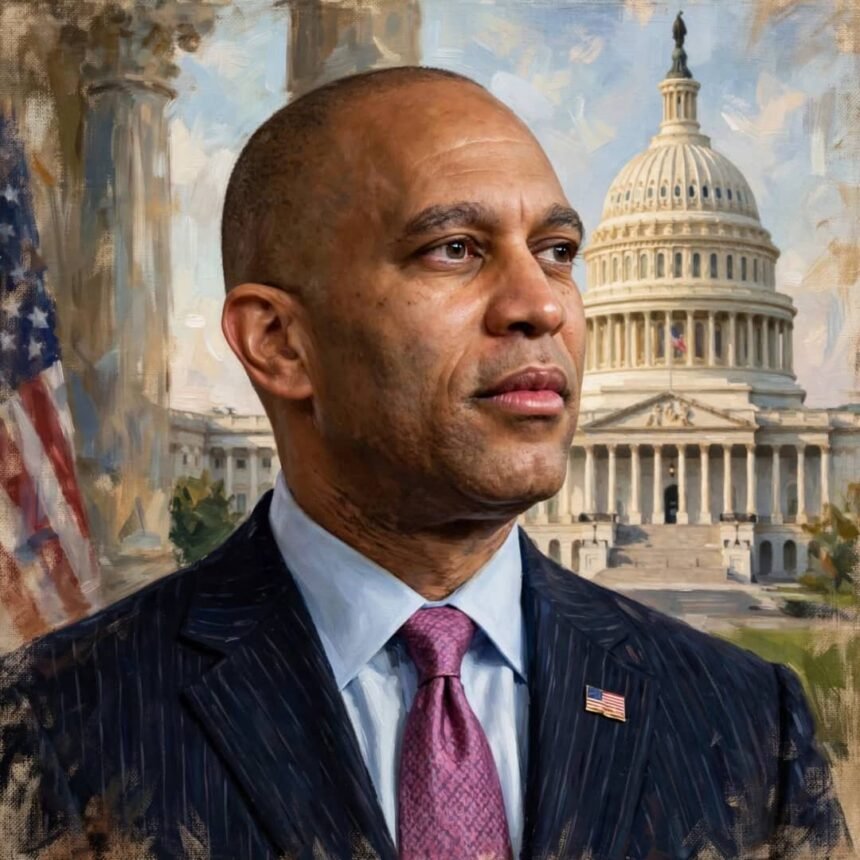
At the centre of this new dispensation stands Hakeem Jeffries of the Democratic Party.
Jeffries is 56 years old, a lawyer, and a Representative from the State of New York. He has represented New York’s 8th Congressional District since 2013 and has led House Democrats since January 2023.
He studied political science at Binghamton University, earned a Master of Public Policy at Georgetown University, and earned his law degree magna cum laude from New York University School of Law.
On 18 November 2026, it became clear that no member of his party in Congress would seriously challenge his bid. In a closed-door secret ballot, House Democrats nominated him to be Speaker by 251 votes to 11.
That is a decisive mandate, but it is not yet the speakership itself. Jeffries still needs 218 votes on the House floor when the new Congress convenes on 3 January 2027.
If he wins that vote, he will make history as the first Black American to become Speaker of the House of Representatives. He would also be the first Speaker from New York City.
The historical weight of that moment should not be understated. The first House convened in 1789, making its history about 237 years, not 250 years of constitutional democracy in the sense sometimes loosely claimed. In all that time, no Black American has held the Speaker’s gavel.
If elected, Jeffries will also become second in line of succession to the American presidency, after the Vice President.
What the Speaker actually does
The Speaker of the House is not merely a ceremonial presiding officer. It is one of the most powerful offices in the American system.
The Speaker presides over debates in the House, decides which bills come to the floor for a vote, controls the legislative timetable, appoints members to committees, and represents the House in its dealings with the Senate and the President. In practice, the Speaker sets the agenda of the House: what is debated, what is delayed, and what never reaches a vote at all.
Because of that agenda-setting power, the Speaker is also the public face and chief strategist of the majority party in the House. Jeffries would therefore not only lead debates, but shape what kind of opposition, negotiation, or compromise the Democratic majority offers to a Republican president.
Conclusion
Jeffries’ rise is therefore both symbolic and institutional.
Symbolically, it is a major break in representation. Institutionally, however, his power would still be constrained by the Senate, the presidential veto, the courts, and the internal diversity of his own caucus. The 11 votes against him in the Democratic nomination ballot show that even within his party, unity is not absolute.
In short, the midterm result is best understood not as the end of the struggle, but as its inversion. Power moves from unified Republican control to a divided system in which a Democratic Congress and a Republican president must either bargain, block each other, or let the courts and voters arbitrate.
Whether Jeffries’ speakership becomes a moment of historic transformation or simply a new phase of American gridlock will depend less on the symbolism of his election than on how he uses the Speaker’s power: to check, to negotiate, or to build a governing alternative ahead of 2028.