
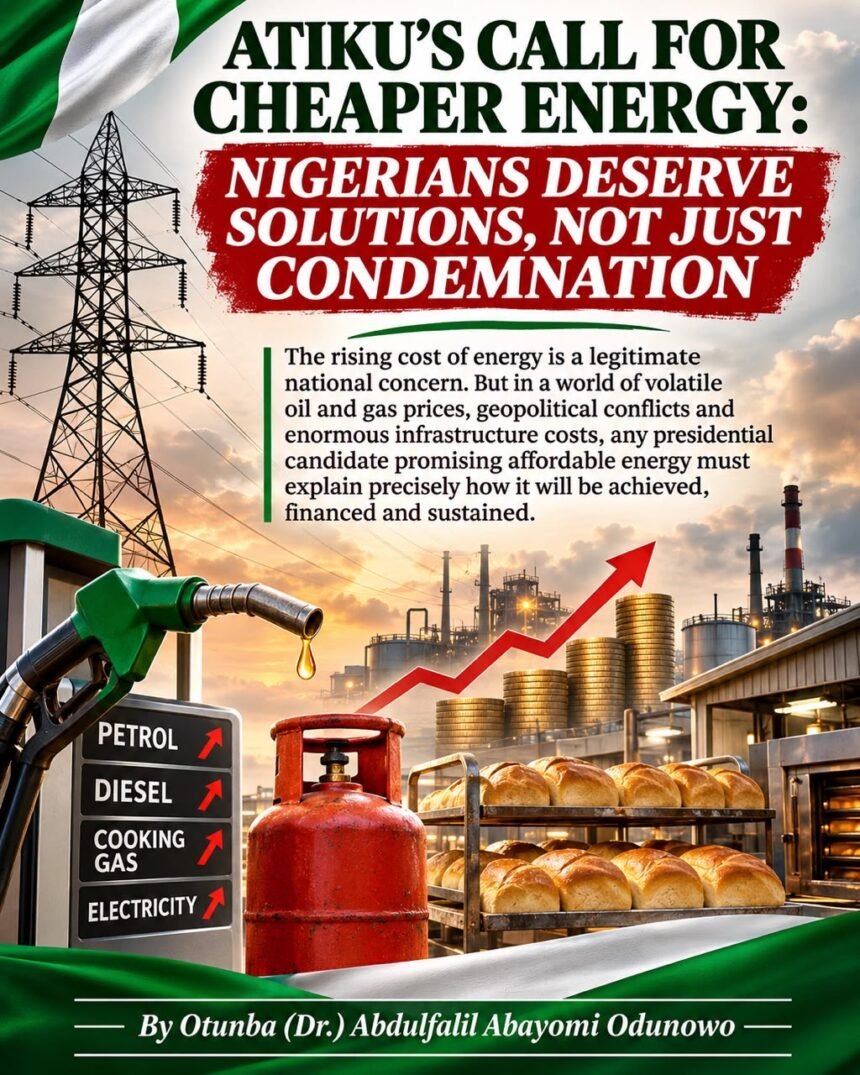
By Otunba (Dr.) Abdulfalil Abayomi Odunowo
Rising energy costs are a legitimate national concern. At a time of volatile oil and gas prices, geopolitical conflict, and massive infrastructure expenses, any presidential candidate who promises affordable energy should spell out exactly how that goal will be achieved, financed, and sustained.
Former Vice President Atiku Abubakar has again drawn attention to a major issue in the Nigerian economy: rising energy costs and their harmful effects on businesses, jobs, and household purchasing power. His intervention, especially on the reported closure of nearly 40 per cent of businesses within the Premium Breadmakers Association of Nigeria (PBAN) over the last two years, merits serious attention. PBAN itself publicly sounded the alarm at its 2026 Day-Out event, citing business closures, costly financing, and rising production expenses. Those concerns should not be waved aside as political propaganda simply because an opposition presidential candidate has amplified them.
Even so, recognising an economic problem is not the same thing as offering a believable solution to it. That is exactly where Atiku Abubakar, as a man seeking to lead Nigeria, must go beyond criticism and present Nigerians with policy alternatives that are specific, measurable, and financially sustainable.
The reality of the global energy crisis
Energy prices are not detached from international economic conditions. Nigeria operates within a global energy market shaped by geopolitical instability, international oil and gas prices, shipping disruptions, exchange-rate shifts, financing costs, and changing global demand patterns.
The International Energy Agency has documented major disruptions in international natural gas and LNG markets during 2026, particularly after the Middle East conflict and repeated interruptions to supplies through the Strait of Hormuz. Loadings from major producers such as Qatar and the UAE fell sharply for prolonged periods, adding to extreme volatility and pushing Asian and European gas prices to their highest levels since the 2022/23 energy crisis.
Those developments have direct spillover effects on imported fuels, logistics, and the cost of alternative energy sources around the world. It would therefore be economically misleading to claim that every rise in domestic energy costs is solely the result of decisions made by President Bola Ahmed Tinubu. At the same time, it would be irresponsible for the Federal Government to cite global economic pressures as a blanket excuse for every domestic failure. Both realities can exist at once.
International events can drive prices higher, while domestic inefficiency, poor infrastructure, weak competition, logistics costs, and flawed implementation can make the impact far worse for Nigerian businesses.
The government’s central responsibility is not to pretend that global market forces are irrelevant, but to build institutions and policies that reduce Nigeria’s exposure to them. That is the standard by which President Tinubu’s administration should be judged. It is also the standard by which Atiku Abubakar’s proposed alternative should be tested.
The questions Atiku must answer
Atiku has called for urgent steps to reduce energy costs. That demand is understandable. But Nigerians are entitled to ask what, exactly, he would do differently.
Does he plan to bring back petroleum subsidies? If so, what would the yearly fiscal cost be, how would government pay for it, and what protections would stop the return of the subsidy-related inefficiencies and abuses that marked earlier regimes?
History offers a warning: before 2023, successive subsidy regimes consumed hundreds of billions of naira each year, encouraged smuggling, distorted markets, and crowded out investment in refining and infrastructure, while often failing to provide lasting relief to the poorest households. If he does not support a return to subsidies, then how does he intend to secure significantly lower petrol, diesel, and cooking gas prices in a market shaped by international prices and exchange-rate movements?
Would his administration impose price controls? If so, how would those controls avoid causing supply shortages, deterring private investment, or shifting unsustainable losses to the public treasury?
Does he intend to subsidise electricity for manufacturers and small businesses? If yes, which categories of consumers would qualify, how would the subsidy be financed, and how would government ensure that electricity suppliers still receive enough revenue to maintain and expand infrastructure?
What is his strategy for increasing domestic natural gas production, improving gas transport infrastructure, expanding electricity generation, strengthening transmission capacity, and reducing the extraordinary dependence of Nigerian businesses on diesel generators?
Would he create a dedicated energy-transition financing programme to help bakeries, farmers, and manufacturers move from costly diesel systems to more efficient alternatives? If so, what interest rate would be proposed, what would be the source of funding, who would qualify, and what repayment structure would apply?
These questions are not meant to embarrass an opposition candidate. They are the very questions Nigerians should ask anyone seeking control of the country’s economic future. Political leadership should be measured not simply by the problems a candidate identifies, but by how credible the candidate’s solutions are.
Nigeria must confront the domestic causes of expensive energy
Although instability in global markets matters, it does not account for all of Nigeria’s energy troubles. Nigeria is a major crude oil producer and has substantial natural gas resources among the largest in Africa, yet millions of Nigerians and thousands of businesses still endure unreliable electricity, costly alternative power generation, inadequate gas distribution infrastructure, and high transport costs. This contradiction has deep roots, stretching across decades of underinvestment, gas flaring, weak regulatory enforcement, incomplete privatisation outcomes after 2013, and repeated failures to commercialise domestic gas for power and industry.
Nigeria needs a more efficient energy system in which domestic resources are turned into reliable, competitively priced energy for households and industry. Reaching that goal will require investment, regulatory consistency, better infrastructure, stronger competition, and sound fiscal management. It cannot be delivered by political declarations alone.
Expanding domestic refining capacity may cut some import and logistics costs, but local refining does not automatically remove the influence of international crude oil prices. Increasing natural gas production may improve domestic supply, but consumers will not necessarily see much lower prices unless problems in processing, transportation, distribution, and market access are also resolved. The same is true of electricity: cutting tariffs without improving efficiency or transparently financing any resulting revenue gap could damage the sector’s financial sustainability.
The real task, then, is to reduce the actual cost of producing and delivering energy, not merely to force suppliers to sell below sustainable prices.
A practical intervention for struggling Nigerian businesses
Rather than treating the hardship facing breadmakers only as proof of political failure, the situation should be seen as an opening for constructive national action. PBAN has pointed to the high cost of converting bakeries to alternative energy systems, reportedly between ₦40 million and ₦50 million for some smaller operators. Its leadership has also asked for grants and single-digit financing to help businesses make that transition. These are concrete problems around which policy can be built.
A credible national response should weigh several complementary measures:
1. Targeted energy-conversion financing: Create transparent, competitively managed financing arrangements to help viable manufacturers and food-processing businesses adopt cost-effective gas, solar, hybrid, and energy-efficient technologies.
2. Expansion of domestic gas infrastructure: Speed up commercially viable investment in gas processing, distribution, storage, and industrial supply networks, especially around manufacturing clusters.
3. Improved electricity reliability: Prioritise dependable supply, lower technical and commercial losses, and better distribution performance so businesses spend less on self-generation.
4. Affordable productive-sector credit: Consider carefully funded credit guarantees and development-finance arrangements, while recognising that indiscriminate cheap lending cannot sustainably replace efforts to control inflation and reduce broader borrowing costs.
5. Transparent monitoring of results: Judge success by lower business energy costs per unit of output, improved reliability, jobs preserved, and stronger industrial productivity.
None of these measures would necessarily be cheap or simple. They demand careful economic assessment, implementation capacity, and sustainable funding. But they represent the kind of practical policy discussion Nigeria urgently requires. Importantly, such measures should not be framed as the sole duty of a future administration. Where they are feasible, the present government should pursue them now.
Criticism must also be supported by credible evidence
There is another aspect of Atiku’s statement that deserves scrutiny. The former Vice President reportedly suggested that government borrowing, together with the hardship businesses are facing, could indicate that borrowed funds are feeding corruption. That is a serious allegation.
Borrowing raises valid questions about debt sustainability, transparency, project delivery, and whether Nigerians are getting adequate value from public spending. But the fact of government borrowing alongside business closures does not, by itself, prove that borrowed funds have been diverted through corruption. Conclusions of that kind require verifiable evidence, including audit findings, procurement records, financial documentation, or credible investigative findings.
Political disagreement should never erase the duty to distinguish between allegations and established facts. At the same time, the Federal Government must be prepared to account transparently for borrowed funds and show the economic and social returns of projects financed through public debt. Accountability should be applied consistently, no matter which political party is in power.
What does the reported 40 per cent really tell us?
The reported loss of about 40 per cent of PBAN’s membership is alarming. Even so, the figure must be interpreted correctly. It refers to the association’s reported experience. It should not automatically be treated as proof that 40 per cent of every bakery in Nigeria has shut down.
A proper assessment would require data on bakery registrations nationwide, closures, employment, output, operating margins, and shifts in consumer demand. Still, the association’s reported experience is serious enough to justify immediate government engagement. It is also important to recognise that energy is only one part of bread production costs. Flour, transport, packaging, wages, machinery maintenance, financing, and purchasing power all affect profitability and retail pricing.
As a result, even a major drop in diesel prices may not restore profitability for every struggling bakery. Any effective economic recovery programme must address these interlocking pressures rather than assume that energy pricing alone explains every business difficulty.
The responsibility of an opposition presidential candidate
Nigeria’s democracy is strengthened when opposition leaders challenge government policy and draw attention to economic hardship. Atiku Abubakar is fully entitled to question the performance of President Tinubu’s administration. In fact, government policy should be under constant scrutiny, especially when it affects business survival, employment, and household welfare.
But political opposition should do more than offer a different reading of economic distress. It should present an alternative programme of government capable of surviving economic scrutiny. When Atiku says that his administration would prioritise local production, Nigerians are entitled to ask what makes his proposed approach materially different from goals already announced by successive Nigerian governments.
How much additional energy capacity would his policies produce? Over what time frame? At what financial cost? Where would the funding come from? How would implementation be shielded from inefficiency and political interference? And perhaps most importantly, what measurable reduction in the cost of doing business could Nigerians reasonably expect?
Those are the questions that separate a governing programme from a campaign promise.
Tinubu’s administration is not exempt from accountability
None of this should be read to mean that the Federal Government bears no responsibility for current economic hardship. President Tinubu’s administration must show that its reforms are delivering tangible improvements in the productive economy. Macroeconomic stabilisation, stronger fiscal indicators, and structural reforms matter, but they are not enough on their own to measure success.
The survival of small businesses, household purchasing power, affordable transport, reliable electricity, and sustainable employment matter just as much. Government must explain how its reforms are translating into lower production costs and better living standards. Where implementation has fallen short, corrective action should follow. Where hardship is falling disproportionately on vulnerable households and productive enterprises, targeted interventions should be considered. And where existing policies are not producing their intended results, government must show the flexibility to improve them.
In the end, economic reform must be judged by outcomes, not by the political resolve with which it is defended.
Conclusion: Nigerians deserve a contest of solutions
Atiku Abubakar has pointed to a real economic problem. The difficulties facing breadmakers and other Nigerian manufacturers demand urgent attention. But identifying hardship is not the same as showing how to end it.
Nigeria’s energy problems are closely tied to global market conditions, domestic infrastructure shortfalls, financing costs, regulatory weakness, and longstanding structural inefficiencies that predate any one administration. No presidential candidate can credibly promise to solve these challenges simply by declaring that energy prices are too high.
The proper response is to explain which specific reforms will be introduced, what they will cost, how they will be funded, how quickly they can take effect, and what economic trade-offs Nigerians may need to accept. I therefore respectfully challenge former Vice President Atiku Abubakar to publish a detailed, costed, and measurable energy-affordability programme, especially for the manufacturing, agricultural, and small-business sectors. Let Nigerians compare that programme with the policies and performance of the present administration. Let the debate focus on evidence, implementation, economic feasibility, and measurable outcomes. And let both government and opposition recognise that the Nigerian people are no longer adequately served by an endless exchange of accusations and assurances.
The real issue is not whether energy is expensive. Every Nigerian already knows that it is. The question for Atiku Abubakar, President Bola Ahmed Tinubu, and every other person seeking to govern Nigeria is this: What exactly will you do to make energy more affordable, how will you fund it, and what evidence gives Nigerians confidence that your solution will succeed?
Until those questions are answered convincingly, criticism remains criticism and promises remain promises. Nigeria needs something far more valuable: credible, sustainable, and implementable solutions.
Otunba (Dr.) Abdulfalil Abayomi Odunowo
National Chairman AATSG