
By Otunba (Dr.) Abdulfalil Abayomi Odunowo
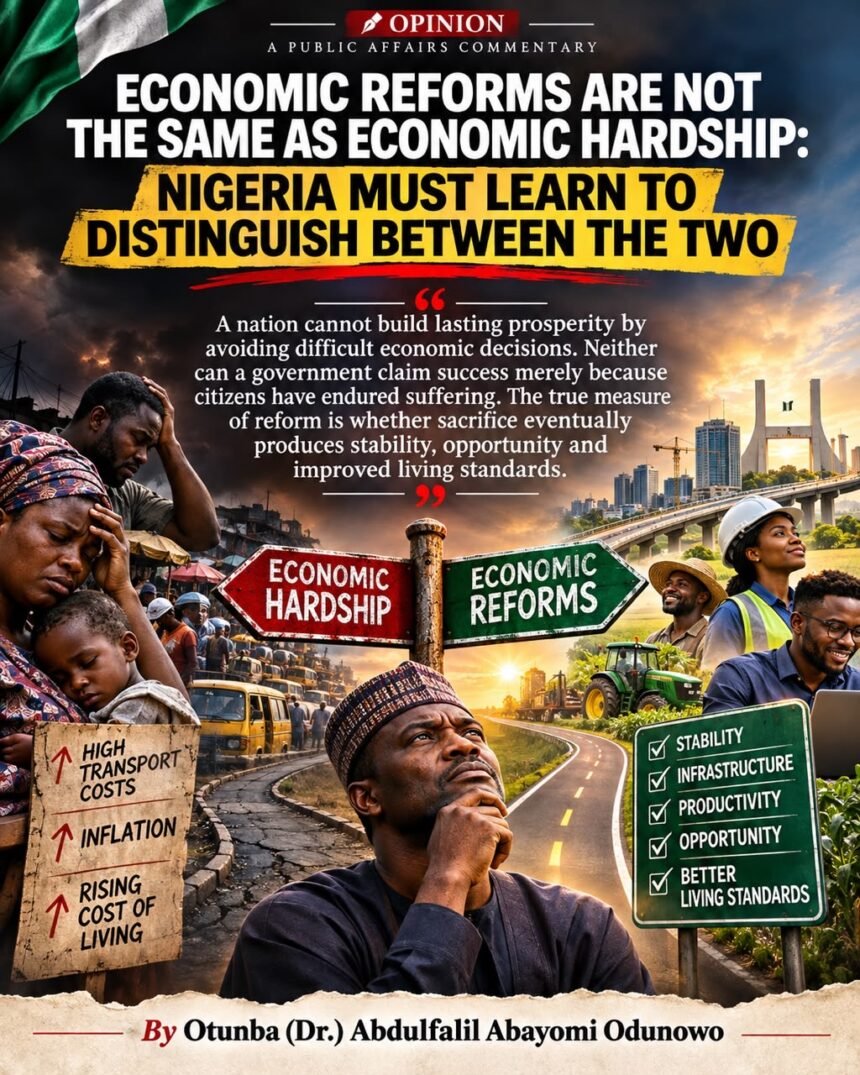
*No country secures durable prosperity by refusing to make hard economic choices. But a government also cannot point to citizens’ suffering and call that success. Reform should be judged by one test: whether the sacrifices it demands eventually lead to stability, wider opportunity, and better living standards.*
A statement shared widely on Nigerian social media listed hunger, poverty, higher taxes, rising fuel prices, naira depreciation, costly electricity, continued borrowing, weaker purchasing power, expensive transport, overlapping budgets, and insecurity. It then questioned why some educated Nigerians still describe such conditions as economic reforms, calling those who defend them “Educated Liabilities.”
That anger is understandable. For millions of Nigerians, economic policy is not measured by charts showing revenue, reserves, or GDP. It is measured by the cost of food, transport, electricity, school fees, and rent, and by whether a family can still meet its basic needs. Even so, the statement points to a deeper issue that calls for evidence, not emotional exchange: are we properly separating economic reforms from the temporary hardships that may accompany them, and from the outcomes those reforms are supposed to produce?

That distinction matters. If a country interprets every painful adjustment as bad policy, it may never address its structural problems. But if a government treats public suffering as evidence that reform is working, it risks forgetting the very people its policies are meant to serve.
**Reform and Hardship Are Not the Same**
Economic reform is a conscious attempt to fix structural weaknesses, remove distortions, strengthen institutions, and create the basis for sustainable growth. Hunger is not reform. Poverty is not reform. Insecurity is not reform. Falling purchasing power is not reform. These are problems policy is supposed to solve.
Some reforms, however, bring painful short-term effects before any benefits become visible. The most obvious recent example is fuel subsidy removal. For years, the subsidy placed heavy pressure on public finances, encouraged arbitrage, and made government spending highly exposed to global oil prices and domestic consumption. By mid-2023, a full-year subsidy was projected to cost about ₦6.7 trillion, roughly 70 percent of the Federal Government’s actual revenue. Removing it was meant to end those distortions, release fiscal resources, and move the country toward a more efficient energy market.
The steep increase in petrol prices was a consequence of that decision, not its objective. Between June 2023 and December 2025, the Federation recorded ₦15.8 trillion in subsidy-related savings ₦5.4 trillion to the Federal Government and ₦10.4 trillion shared by states and local governments. Those funds did not erase hardship, but they changed the fiscal picture.
The same reasoning applies to exchange-rate unification. For years, multiple exchange rates created preferential access, distorted the market, and misallocated scarce foreign exchange. A shift toward a more market-responsive system was intended to correct those weaknesses. The depreciation that followed imposed genuine costs on households and businesses in an import-dependent economy. But depreciation was not the goal. The goals were greater transparency, less arbitrage, and eventual stability. The gap between the official and parallel markets, once above 60 percent, has fallen to below 5 percent. Gross external reserves have increased from about $35 billion in 2023 to between $52 billion and $55 billion in 2026, while net reserves have recovered from around $3 billion to more than $34 billion an 18-year high by some measures.
These are measurable gains in the macroeconomic framework. On their own, however, they do not restore household purchasing power.
**Necessary Reforms Can Still Be Poorly Sequenced*^
A policy may be necessary in principle and still be badly sequenced or weakly cushioned in practice. It may strengthen government finances while leaving vulnerable households exposed. It may improve investor confidence while local producers continue to struggle with energy costs, expensive credit, and poor infrastructure. These outcomes can exist at the same time. Even if subsidy removal was justified on fiscal grounds, the real question is whether supporting measures affordable mass transit, dependable electricity, targeted assistance for vulnerable groups, and better food-distribution logistics were introduced quickly enough and on a sufficient scale. Higher electricity tariffs may improve the finances of power-sector operators, but if supply reliability, metering, and service quality do not improve measurably, households are justified in questioning the practical benefit.
Nigeria’s own history provides a warning. The Structural Adjustment Programme of the mid-1980s also involved devaluation, subsidy cuts, and market liberalisation. It delivered some stabilisation and temporary improvement in non-oil exports, but it also brought sharp inflation, industrial contraction in import-dependent sectors, and increased poverty. The lesson was not that adjustment is always mistaken. It was that sequencing, social protection, and the simultaneous strengthening of productive capacity determine whether short-term pain produces lasting benefit.
**Higher Revenue Does Not Equal Prosperity**
A government may report stronger revenue even while households suffer falling real incomes. Both realities can coexist. Federation revenues have increased substantially in real terms since 2023. States have expanded capital spending. Stock market capitalisation has grown markedly. Headline inflation has come down from peaks above 30 percent and from a May 2023 baseline of about 22 percent to around 15 percent by mid-to-late 2026. Food inflation has also eased, although it remains high. Real GDP growth has improved from the low-2 percent range to between 3.9 percent and 4.4 percent, with Q2 2026 recorded at 4.43 percent. International institutions have recognised stronger macroeconomic resilience and improved external buffers.
Yet the World Bank and other assessments still place poverty at high levels, in the 50–63 percent range depending on the poverty line, and continue to note that the recovery of household welfare remains unfinished. During the adjustment period, millions more Nigerians fell into extreme poverty. Food insecurity also remains high. Macro stability is necessary, but it is not enough. The central questions therefore concern how the improved fiscal space is being used. Are public hospitals and schools becoming more functional? Are road and logistics costs declining? Is electricity becoming more dependable for households and businesses? Are domestic industry and agriculture creating more jobs and increasing output? Most importantly, are ordinary Nigerians beginning to regain the purchasing power they lost during the transition?
**Borrowing, Taxation, and Accountability**
Persistent borrowing and heavier taxation are often cited as further proof that “reforms” simply mean hardship. Borrowing on its own does not prove failure. Governments borrow for infrastructure, emergencies, and long-term investment. The real tests are why the money is borrowed, what it costs, whether debt service is sustainable, and what economic returns it generates. Recent assessments show some stabilisation or modest decline in debt-to-GDP, yet debt service still consumes a large share of federal revenue. That limits spending on health, education, and security. Tax reform can widen the base, reduce arbitrary exemptions, and improve fairness. But increasing the burden on households and small businesses that are already under strain, without visible improvements in public services, weakens both confidence and economic activity. Overlapping budget cycles raise a different set of concerns about transparency, coordination, and legislative oversight. Citizens cannot reasonably be asked to sacrifice while public institutions seem unwilling to show comparable restraint.
**Transition Cannot Be Endless**
Economic adjustment has transitional costs. Both theory and history make that clear. But transition cannot serve forever as an explanation for worsening living standards. There must be clear goals, credible timelines, measurable indicators, and regular public reporting.
If fiscal sustainability is the objective, the public should be able to see how the released resources are being used. If the aim is a more efficient foreign-exchange market, progress in market performance and currency stability should be visible. If the aim is stronger domestic production, there should be evidence of greater industrial competitiveness, rising agricultural output, and more employment. And if the ultimate goal is national prosperity, improvements must eventually be reflected in household welfare. Not every gain appears at once. Investments in infrastructure and human capital take time. Even so, citizens deserve transparent accounting of what has been achieved, what remains unfinished, and what corrective action is being taken.
**Debate the Evidence, Not One Another**
Calling supporters of reform “Educated Liabilities” may provide emotional release, but it does not deepen national debate. Education should help citizens weigh evidence, separate policy aims from policy outcomes, and insist on accountability. Supporting the principle of reform does not mean approving every aspect of its implementation. Criticising implementation does not automatically amount to rejecting reform. A citizen may support fiscal discipline while condemning waste. A citizen may support exchange-rate correction while demanding stronger protection for domestic producers. A citizen may recognise better macro indicators while remaining seriously troubled by hunger and poverty. These positions are not contradictory.
**From Policy Announcements to Real Benefits**
The next stage must be an intentional effort to turn macroeconomic adjustment into visible improvements in living standards. Agriculture requires modern irrigation, storage, mechanisation, processing, and efficient distribution, not only seasonal interventions. Transport policy must focus on affordable and reliable public mobility. Electricity reform must provide dependable power for households, manufacturers, and small businesses. Industrial policy must cut excessive import dependence and strengthen competitiveness. Public finance management must ensure that higher revenues translate into visible infrastructure and better services.
Above all, government must build credible systems for measuring how reforms affect different groups of Nigerians. A reform that improves the national balance sheet while permanently weakening household purchasing power has not fulfilled its purpose. A reform that attracts investment but does not expand productive employment remains unfinished.
**The Ultimate Test Is the Welfare of the People**
Nigeria faces real structural problems that cannot be erased by slogans or indefinitely delayed through temporary palliatives. Hard choices may be unavoidable. But economic necessity does not free government from responsibility for the consequences of those choices. Public hardship should not automatically be treated as an argument against every effort to correct inherited weaknesses. Those who read every painful adjustment as proof of failure ignore the possibility that delaying necessary correction can create deeper trouble. But those who celebrate every policy change as historic success, regardless of what it does to ordinary citizens, ignore the basic purpose of government.
The right standard is neither blind optimism nor permanent pessimism. It is measurable progress. When public revenue rises, citizens should see better services. When distortions are removed, productive opportunities should widen. When sacrifice is demanded, government should show transparency, discipline, and fairness. And when reforms begin to deliver, their effects should eventually be visible in employment, purchasing power, reliable infrastructure, and everyday living conditions.
Nigeria must never confuse suffering with reform. But it must also not treat the temporary pain of necessary correction as proof that reform itself is undesirable. The decisive question is whether today’s sacrifices are laying the groundwork for tomorrow’s prosperity.
Economic reforms are not judged by how much hardship people are told to endure, by the enthusiasm of those defending them, or by the polish of official presentations. They are judged by what they finally deliver for the people. The goal is not simply a stronger government balance sheet. It is a more productive economy, more effective institutions, and more prosperous citizens.
Otunba (Dr.) Abdulfalil Abayomi Odunowo
*National Chairman AATSG.*
Public Affairs Commentator