by Emmanuel Adegbite
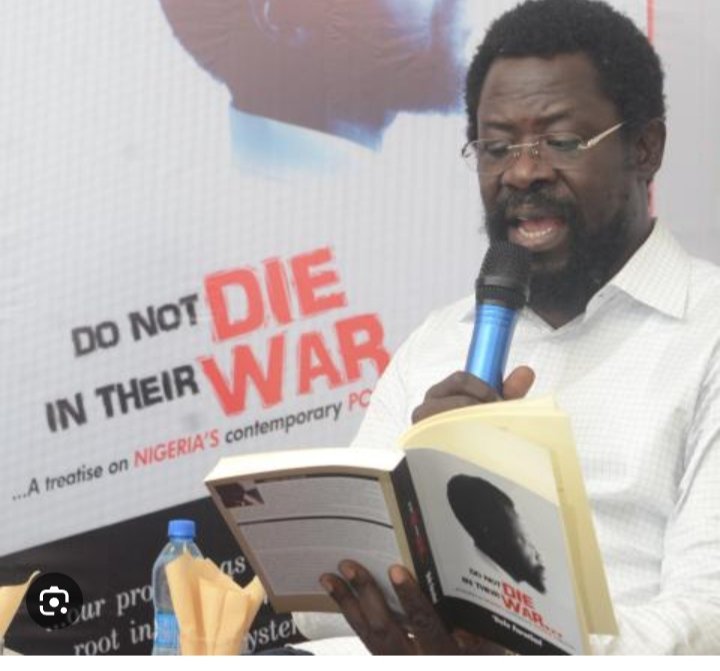
Dele Farotimi’s Do Not Die in Their War was published in 2019, but its central warning has become even more urgent in Nigeria’s political reality today. The faces may change, party flags may change, alliances may collapse and new political movements may emerge, but the fundamental question remains unanswered: what exactly are ordinary Nigerians defending when they surrender their peace, relationships, conscience and future to the political ambitions of men who have mastered the art of turning public suffering into private advantage?
As Nigeria approaches another election cycle, the political class is already rearranging itself. Politicians are defecting, coalitions are being negotiated, opposition figures are changing platforms, and the familiar struggle for relevance and power is gathering momentum. In May 2026, Reuters reported that Peter Obi and Rabiu Kwankwaso had left the African Democratic Congress, dealing another blow to efforts to build a united opposition. By October, reports emerged of politicians and defectors from opposition platforms joining the All Progressives Congress and pledging support for President Bola Tinubu’s re-election. These developments reveal a political environment in which alliances are fragile, ambitions are fluid and the search for electoral advantage often appears more urgent than the construction of a credible alternative. (Reuters, May 5, 2026; Nigerian media reports, October 2026.)
This is precisely where Farotimi’s argument deserves serious attention. In Do Not Die in Their War, he challenges Nigerians to examine the interests behind the political conflicts they are encouraged to treat as existential battles. His criticism of the political establishment, particularly the similarities he identifies between the dominant parties, is an argument about the nature of power in Nigeria: political competition does not automatically amount to ideological difference, and a change of political platform does not necessarily represent a change in political character. The book is not a prophecy that every politician is identical, nor does it establish that every political disagreement is fraudulent. Its enduring value lies in the demand that citizens look beyond party labels and judge political actors by their conduct, their records and the consequences of their decisions.

Consider the absurdity of the Nigerian political experience. A politician can spend years condemning a government, denouncing its policies and presenting himself as the conscience of the opposition, only to cross over when the political calculation changes. Yesterday’s enemy becomes today’s ally; yesterday’s betrayal becomes today’s strategic realignment. The explanations are always available: national interest, party crisis, the need for unity, the search for a better platform or the desire to rescue democracy. Yet the public is rarely given a convincing account of what has changed in the politician’s principles, beyond the circumstances surrounding his political survival. If the government was unacceptable yesterday, what has made it acceptable today? If the party was irredeemably compromised yesterday, what moral transformation has occurred overnight? Nigerians deserve answers, not rehearsed political vocabulary designed to make opportunism sound like statesmanship.
The problem is not that politicians change parties. In a democracy, political realignment is legitimate, and no citizen should be condemned merely for changing political allegiance. The problem arises when political actors demand that the electorate treat every defection as evidence of wisdom, every alliance as an act of patriotism and every betrayal of a previous position as a sophisticated political calculation. The same politicians who ask Nigerians to vote according to principle often behave as though principles are optional once political opportunities arise. They want citizens to be consistent in their loyalty while reserving for themselves the privilege of inconsistency.
The All Progressives Congress, the Peoples Democratic Party and the other parties must therefore be judged by more than their manifestoes, campaign promises and carefully manufactured public images. The relevant questions are straightforward. What did they promise? What did they deliver? How did they exercise power? What happened to public money? What became of public services? Did they strengthen institutions or weaken them? Did they expand opportunities or deepen dependency? Did they improve the conditions under which ordinary people live, or did they merely change the individuals controlling the machinery of government? A party cannot become progressive simply because it says so, just as an opposition party cannot become democratic merely because it opposes the government. Political identity is not proof of political virtue.
Under President Bola Tinubu, Nigeria has witnessed significant economic policy changes, including the removal of the petrol subsidy and foreign-exchange reforms. The government and its supporters have defended these measures as necessary corrections to longstanding economic distortions. There is a legitimate argument that some reforms were unavoidable and that the costs of postponing difficult decisions had accumulated over decades. The International Monetary Fund’s 2026 assessment acknowledged improvements in macroeconomic resilience and reductions in some fiscal vulnerabilities. Any serious examination of the administration must recognise those developments rather than pretending that every economic indicator has deteriorated.
But the existence of economic reform is not the same thing as the existence of economic justice. A government cannot indefinitely demand applause for correcting macroeconomic figures while millions of citizens struggle to afford food, transport, housing, healthcare and education. The IMF’s 2026 assessment placed poverty at about 63 per cent under Nigeria’s national poverty line and reported that approximately 27 million people faced food insecurity in the autumn of 2025. These figures are a reminder that economic recovery must ultimately be measured against the lives people are able to live, not merely the language used in fiscal reports. The World Bank’s October 2026 Nigeria Development Update likewise emphasised the need for faster, more inclusive growth, job creation, poverty reduction and improved living standards.
This is where political propaganda becomes particularly insulting. Nigerians are not asking for an economy that exists only in a minister’s presentation or a presidential speech. They are asking for an economy in which work can provide a decent living, businesses can survive without being strangled by rising costs, parents can feed their children, and young people can imagine a future beyond unemployment, migration or dependence on political patrons. When the government points to improving economic indicators, citizens are entitled to ask how those improvements are translating into affordable food, reliable electricity, productive employment and functioning public institutions. That is not economic illiteracy. It is accountability.
Neither should the opposition be permitted to exploit public hardship without presenting a credible alternative. It is easy to condemn the government when one does not bear responsibility for its decisions. It is easy to promise relief when one is not required to explain how that relief will be financed, implemented and sustained. Nigeria does not need an opposition whose principal qualification is that its members are not currently in power. It needs an opposition capable of demonstrating intellectual seriousness, internal democracy, policy competence and the willingness to hold its own members to the same standards it demands of the government. The public should not have to choose between a government that asks for patience and an opposition that offers only anger.
Farotimi’s discussion of the weaponisation of poverty and ignorance is especially relevant here. Poverty does not automatically make a person politically ignorant, and poor Nigerians should never be spoken about as though they lack intelligence or agency. Many understand their circumstances with a clarity that is entirely absent from the corridors of power. The tragedy is that material deprivation can narrow the choices available to citizens and make immediate survival more urgent than long-term political accountability. A hungry person can understand the value of a credible government and still be forced to accept a small payment from a politician who has offered no serious solution to hunger. That contradiction is not proof that the voter is foolish. It is evidence of a political and economic environment in which vulnerability can be converted into an electoral advantage.
The politician who distributes money during an election and disappears when the community needs roads, hospitals, schools, clean water or employment is not a benefactor. He is a political actor purchasing temporary consent in circumstances of public desperation. The citizen who accepts such money may be trying to survive the day, but the transaction cannot be mistaken for a development programme. A bag of rice cannot substitute for agricultural policy. A few thousand naira cannot replace a functioning healthcare system. A campaign gift cannot compensate for years of neglect. And no politician should be allowed to present the distribution of public resources, or the purchase of votes with private wealth, as proof of generosity when the public is entitled to demand a much greater return from political office.
There is also a particularly cynical dimension to the way political loyalty is manufactured through religion and ethnicity. Nigerians are repeatedly encouraged to believe that a politician’s ethnic origin or religious identity offers some guarantee of competence, honesty or concern for their welfare. It does not. A corrupt politician does not become accountable because he speaks your language. An incompetent governor does not become competent because he worships in your church or belongs to your religious community. A president does not become your friend merely because he shares your ancestry. The poor suffer under bad governance regardless of the language spoken by the person responsible for it.
Identity is part of human life, and ethnic or religious affiliation is not inherently dangerous. The danger emerges when politicians turn these affiliations into instruments for suppressing scrutiny. Citizens are told that criticising a political leader amounts to betraying their ethnic group, undermining their religion or helping the enemy. In this way, legitimate questions about governance are transformed into emotional battles over belonging. The politician escapes examination because the citizen is too busy defending an identity that the politician has learned to manipulate. Meanwhile, the cost of food does not recognise ethnicity, insecurity does not respect religious boundaries, and unemployment does not ask which political party a young person supports before denying that person a livelihood.
The opposition’s fragmentation is therefore more than a contest of personalities. It raises a question about whether Nigeria’s political alternatives are being built around shared principles or merely around the ambitions of individuals seeking the most advantageous route to power. A coalition can be useful, but unity without a coherent programme is merely an arrangement for distributing future benefits. Bringing politicians together is not the same thing as bringing ideas together. A collection of aggrieved officeholders does not automatically constitute a movement for democratic renewal. Nigerians need to know what an alternative government would do differently about the economy, security, education, healthcare, corruption, public accountability and the independence of institutions. They need more than a promise that the people currently in power will be replaced by people who are angry about being outside it.
And this is where supporters of every major political camp must confront an uncomfortable truth. If you condemn corruption only when it is committed by an opponent, you are not fighting corruption; you are fighting for your side. If you denounce electoral manipulation only when it disadvantages your preferred candidate, you are not defending democracy; you are defending your preferred outcome. If you demand evidence when your own politician is accused but accept rumours as established facts when an opponent is accused, you have abandoned the principle of justice in favour of political convenience. The standard that protects a politician today may become the shield used against you tomorrow. No society can build a credible system of accountability on selective outrage.
This does not mean that every political actor is equally culpable or that meaningful differences between parties and candidates should be ignored. They should be examined carefully. A responsible voter must distinguish between degrees of competence, policy choices, records of public service and credible allegations of misconduct. But those distinctions must be established through evidence rather than inherited loyalty. The task is not to pretend that everybody is the same; it is to refuse to declare anybody innocent merely because they belong to our political camp. A democracy becomes a theatre of impunity when citizens treat their preferred politicians as people who are incapable of wrongdoing.
The responsibility of young Nigerians is equally important. In “The Lazy Youth,” Farotimi challenges the contemptuous habit of blaming young people for conditions shaped by political and economic failures beyond their individual control. Young Nigerians have every right to demand an economy that rewards effort, institutions that work and a political system that treats them as citizens rather than as disposable campaign material. They are entitled to reject the suggestion that unemployment, hardship and limited opportunity are simply evidence of laziness. Yet the answer cannot be to become the most enthusiastic defenders of the same political arrangements that have failed to provide them with meaningful opportunities.
Young people must resist becoming the infantry of elite ambition. They should not have to insult their friends, threaten their neighbours or sacrifice their integrity because a politician has paid for their loyalty. They should not confuse access to a politician with access to power, or confuse a political appointment with evidence that the wider society is progressing. A few individuals may rise through patronage while millions remain excluded. The success of a handful of loyalists does not prove the success of the system. Nor should young Nigerians mistake visibility on social media for political influence. The capacity to trend a slogan is not the same as the capacity to organise, scrutinise policy, demand public records, defend institutions and hold elected officials accountable after the election is over.
The same lesson applies to Osun and every other state in Nigeria. When voters reject a party at the polls, the purpose should be to communicate a judgement about governance, not to provide a permanent emotional weapon for whichever political faction benefits from the result. If citizens vote for the Accord Party, the APC, the PDP or any other platform, the mandate belongs to the voters and must be assessed against the promises made to them. It does not become the personal property of the candidate, the party leadership or the political godfather. A vote is not a blank cheque for a politician to pursue whichever ambition becomes attractive after the election. If a candidate campaigns on the promise of better governance but becomes more interested in the re-election of a national leader, the public is entitled to ask whether the original mandate is being honoured or repurposed for a different political objective.
That scrutiny must be applied consistently. No party should be condemned merely because it negotiates with another party, and no politician should be declared a traitor simply because political circumstances change. The question is whether the decision serves a defensible public interest and whether the politician can explain it without insulting the intelligence of the electorate. The people who elected a representative are not spectators who must applaud every new alliance. They are citizens entitled to judge the representative’s decisions, including decisions that reveal a widening distance between campaign promises and political conduct.
The war Nigerians should be fighting is not the manufactured war between supporters of rival politicians. It is the war against poverty that leaves families unable to meet basic needs. It is the struggle against insecurity that deprives communities of peace and livelihood. It is the struggle for public institutions that serve citizens rather than political masters, for schools that educate rather than merely certify, for hospitals that treat people rather than expose them to further suffering, and for an economy in which hard work has a reasonable chance of producing dignity. It is the struggle to ensure that public office is treated as a responsibility rather than an opportunity for private accumulation. These are not abstract ideals. They are the ordinary expectations of people who contribute to a country and deserve a government that takes their lives seriously.
As the 2027 elections approach, Nigerians must be careful not to confuse political excitement with political progress. The rallies will come. The endorsements will come. The defections will be described as historic. The candidates will promise renewal, rescue, transformation and a new beginning. Their supporters will insist that this time is different. Some candidates may indeed offer better policies and more credible leadership than their opponents, and voters should be willing to examine those differences. But the burden of proof belongs to the politicians asking for power. They must explain what they intend to do, how they intend to do it, how they will pay for it, how citizens will measure their performance and what mechanisms will exist to hold them accountable when they fail.
Nigerians must also reject the dangerous idea that political loyalty requires silence. You can support a candidate and still criticise his policies. You can vote for a party and still demand answers from its leaders. You can oppose a government without endorsing every accusation made against it. You can recognise a reform’s economic rationale while condemning its inadequate protection for vulnerable citizens. Political maturity is not the ability to defend every action of one’s preferred leader; it is the willingness to distinguish what is right from what is convenient, even when that distinction embarrasses one’s own side.
Farotimi’s warning is not an instruction to abandon politics or to retreat into helpless cynicism. It is a demand that Nigerians refuse to surrender their judgement to politicians. Democracy requires participation, but participation without independent thought can become a mechanism through which citizens help reproduce the very conditions they complain about. The answer is not to conclude that all politicians are identical, that every election is meaningless or that public engagement is futile. The answer is to make political loyalty conditional, evidence-based and accountable. No candidate should receive permanent allegiance for a temporary mandate, and no party should be treated as a moral authority simply because its opponents are worse in the eyes of its supporters.
The most dangerous political weapon in Nigeria may not be the campaign poster, the television interview or the social media propaganda machine. It may be the citizen’s willingness to defend a politician more fiercely than the citizen defends the principles by which that politician ought to be judged. Once loyalty becomes more important than truth, every scandal becomes a conspiracy, every failure becomes the fault of an enemy, every defection becomes a masterstroke and every demand for accountability becomes an act of betrayal. At that point, the politician no longer needs to earn the citizen’s confidence. The citizen has volunteered to protect the politician from scrutiny.
Nigerians have paid too much for this arrangement. They have paid in taxes, lost opportunities, insecurity, deteriorating services, economic hardship and years of political promises that have not translated into the quality of life they deserve. They should not be expected to pay again with their conscience, their relationships or their lives simply because political elites are fighting over who will control the state. Those who seek public office must be prepared to answer for their records, their policies and their decisions. Those who support them must be prepared to ask difficult questions. And those who claim to represent the people must understand that a mandate is a responsibility, not a personal possession.
The truth is brutally simple: the politician’s ambition is not your destiny, his party is not your identity, and his struggle for power is not automatically your struggle for liberation. If a politician asks you to defend him, ask what he has done to deserve your defence. If he asks you to hate his opponent, ask what evidence supports the hatred. If he asks you to endure hardship in the name of reform, ask what protections exist for those who can least afford the cost. If he asks you to celebrate his defection, ask what principle he is carrying with him. If he promises to rescue Nigeria, ask for the programme, the resources, the timeline and the means of accountability.
Do not die in their war. Do not surrender your judgement to their propaganda, your future to their ambition or your conscience to their political convenience. Vote, organise, participate, question and demand better. But never allow a politician to convince you that defending his personal interest is the same thing as defending Nigeria. The country belongs to its citizens, not to the people who temporarily occupy its highest offices. And when the campaign vehicles have departed, the rallies have ended, the alliances have collapsed and the politicians have found new friends, it is the ordinary Nigerian who must still wake up to the consequences.
That is the uncomfortable truth of Do Not Die in Their War: political power is what the politicians are fighting to acquire, but the price of their struggle is too often paid by people who receive little of its benefits. Until Nigerians understand this distinction, they will continue to supply the passion, the insults, the votes and the sacrifices while the political class negotiates its interests above their heads. The time has come to stop confusing the survival of politicians with the survival of Nigeria.
Emmanuel Adegbite