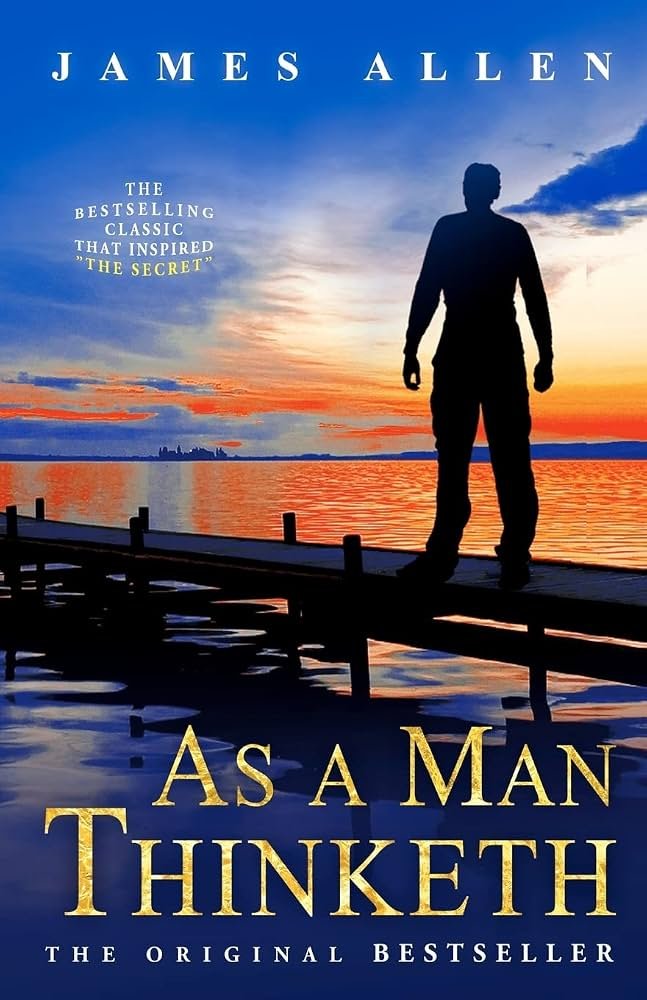
Allen, James (1903), As a Man Thinketh. New York: G.P. Putnam’s, 72 Pages. : A Book Review by Ozodi Osuji Ph.d
Let me begin with a few words about James Allen (1864-1912). He was born into an English working-class family. His father worked in a textile factory. With a prolonged downturn in the textile industry, his father went off to America to try his luck there. Two days after arriving in New York in 1879, he was found dead (murder suspected). James, at age 15, had to leave school and obtain a job and help support his mother and brother. He worked in a factory in a writing capacity and eventually devoted his life to journalism. He found himself writing Spiritual material, especially of the inspirational variety. He moved to Wales and established a magazine, The Light of Reason, later renamed the Epoch; he edited the magazine and wrote inspirational material. He published approximately a book every year and in 1903 wrote the book that made him world famous, As A Man Thinketh.
The book became a worldwide best seller and inspired many later books in the self-help genre. He died in 1912 from tuberculosis at age 47. He published 19 books. His wife, Lily Allen, said that he did not write for the sake of writing or to try to write theory, but wrote what he believed is the truth that he had first lived in his own life and knew that it worked, and he shared the message with the entire world. His books are not analytic or intellectual but are assertions on what he believed is spirit-inspired living. He did not make any effort to prove the existence of God, aka spirit, but assumed his reality and projected positive qualities onto him.
James Allen’s basic thesis is that the mind has power. As he sees it, it is the individual’s thinking that shapes his character and even influences the circumstances he finds himself in.
I summarize the book as follows: As a man thinks, he attracts events and people to his life. The individual’s thinking affects his body and gives him the sickness he has; the individual’s thinking is even responsible for his death.
Wealth or poverty are produced by the individual’s thinking; joy, happiness, and their opposites are the result of one’s thinking.
There are no accidents in one’s life because one’s thinking determines what type of life one experiences.
Whereas Mr. Allen did not say that the individual creates his reality, as later New Age religionists said, he left no doubt in his writing that he believed that one’s thinking determined what happens to one in life. There is no external other person for one to blame for what happened to one in one’s life because one’s thinking produced what happened to one in life.
Courageous people think courageous thoughts, and those produce wealth and abundance in their lives; weak people are filled with fear and self-doubt and produce the poverty they live in.

You have to make up your mind what purpose you want to seek; posit a goal, and courageously pursue it, and you will get it.
If you do not know where you are going, you will get nowhere; that is the idea.
In his own words, James Allen said that his book deals:
“With the power of thought, and particularly with the use and application of thought to happy and beautiful issues. I have tried to make the book simple, so that all can easily grasp and follow its teaching and put into practice the methods which it advises. It shows how, in his own thought-world, each man holds the key to every condition, good or bad, that enters into his life, and that, by working patiently and intelligently upon his thoughts, he may remake his life and transform his circumstances. The price of the book is only one shilling, and it can be carried in the pocket. It is a book that will help you to help yourself, A pocket companion for thoughtful people, and a book on power and right application of thought.”
The title of his book is influenced by a verse in the Bible from the Book of Proverbs, chapter 23, verse 7: “As a man thinketh in his heart, so is he”. The full passage, taken from the King James Version, is as follows:
“Eat thou not the bread of him that hath an evil eye, neither desire thou his dainty meats: For as he thinketh in his heart, so is he:
Eat and drink, saith he to thee; but his heart is not with thee.
The morsel which thou hast eaten shalt thou vomit up and lose thy sweet words.”
Whereas the title of the book is influenced by the Bible, however, it is difficult to say that the book is strictly Christian. It could fall into classic Hinduism, even Buddhism. Let us then say that Mr. Allen pulled from many sources and conjoined them with his own life’s experience and wrote what he believed worked for him and would work for other people who cared to apply its spiritual cum psychological insights to their lives; the thesis that our thinking and thoughts influence how we experience our lives indeed may determine the outcomes we receive from life.
Mr. Allen was not an intellectual and did not explore possible shortcomings to his thesis. For example, we know that a man’s inherited body and the condition of that body influence his thinking. Biology, it can be said, influences character more than anything else. But making that point is deviating from the thesis that Mr. Allen was exploring. If you stay in his lane and consider what he said, it is all logical: as we think, we experience our lives.
Positive thinking tends to enable the individual to experience his life joyfully and peacefully, whereas negative thinking tends to make people fearful, depressed, and angry.
Any criticism of the book is similar to the criticism folks have made of inspirational and motivational writing: their tendency to make feel-good assertions that do not take into consideration the entirety of factors operating in people’s lives, factors that limit the outcome they receive from their positive thinking.
Positive thinking has power, alright, but there is also such a thing as politics and economics operating in our world, and those affect people’s range of outcomes.
For example, we currently live in Donald Trump’s America; the man and his MAGA conservatives deliberately removed African Americans from top positions in the US military and government. Trump is a world-class racist and wants to make America a white country and does not hide his intentions. White racists found him the hero they had been waiting for since the 1960s, when President Lyndon Johnson and Democrats passed laws that gave nonwhite people a fair chance to succeed in America.
The MAGA crowd has made America great again, meaning that they have returned America to its pre-1960s racist America where black folks were placed in their supposed right place.
How is a black person’s thinking producing this regressive America, a dead America, an America in decline? A self-destructive America that has the delusion that it is doing the right thing for America!
The point is that there are factors in the environment that the individual’s positive thoughts alone cannot change, at least in the immediate term, but in the long term, yes. The thinking of good men will, sooner or later, sweep Trumpism into the gutter where it belongs.
Mr. Allen’s book, As A Man Thinketh, is an especially useful read. I enjoyed reading it and will recommend it to my friends. It made a simple point: we tend to receive results attendant to our dominant thinking; think fearful thoughts and see fearful events everywhere you turn and limit your life; think courageously and have a realistic purpose of what you are seeking, and somehow, as Goethe said, the entire universe cooperates with you and opens doors for you.
I read the book in less than three hours, but I suspect that it will have a lifelong influence on my thinking; it is a powerful book. Go read it.
Ozodi Osuji
October 14, 2026
Question:
Do you generally read book reviews provided by major newspapers on Saturdays? How do my occasional book reviews compare to them? I write book reviews for the joy of it, not because anyone pays me a dime to do so and help them sell books.