By Ademola Rabiu
1. CONTEXT AND BACKGROUND
Nigeria’s digital lending market has grown fast because formal banking has not reached many people. Credit through an app is quick, but it is often costly. Under President Tinubu’s administration, the state has begun to respond. The FCCPC’s digital lending regulations took effect on July 21, 2025, covering registration, transparency, data privacy, ethical recovery and fair interest rates. They require lenders to disclose rates, repayment terms and fees before a customer accepts a loan. They also make it illegal to shame borrowers or to contact third parties beyond reasonable reference checks. The Commission has removed non-compliant lenders from its register of approved operators. CREDICORP, meanwhile, disbursed over ₦37 billion to more than 200,000 Nigerians in its first year, with over half accessing formal credit for the first time.
The masses are not asking too much. They are asking for fairness. They are asking for what every government owes the people who gave it a mandate: that life be made a little easier, and that concrete steps be taken to lessen their hardship. The present moment makes the case plainly. High crude prices have pushed up the cost of fuel and, with it, the cost of transport, food and nearly everything else, and inflation has followed. Yet the same high prices are filling the national purse, because the state earns more from every barrel sold. What is good news for the treasury is bad news for the market woman, the commercial driver and the salary earner.
When hardship bites, many families borrow to bridge the gap, and too often the nearest lender is an app that charges more than they can bear. This is why credit is now a question of welfare and not only of finance. We commend the Renewed Hope administration for the reforms and relief measures already in place, including the digital lending rules, the petrol relief package, and the support for first-time borrowers through CREDICORP. These are gains on which the next steps must be built. Our plea is simple and fair: let the windfall of the barrel become the relief of the people, so that what the state gains is felt in the pocket of the citizen.
2. PROBLEM STATEMENT

- Excessive rates. Digital lending apps have drawn scrutiny over annual interest rates said to exceed 300%. The case reported to this Forum is milder, yet still troubling. A member took a six-month loan at an advertised 10.8% a month. On a simple basis, that is about 130% a year.
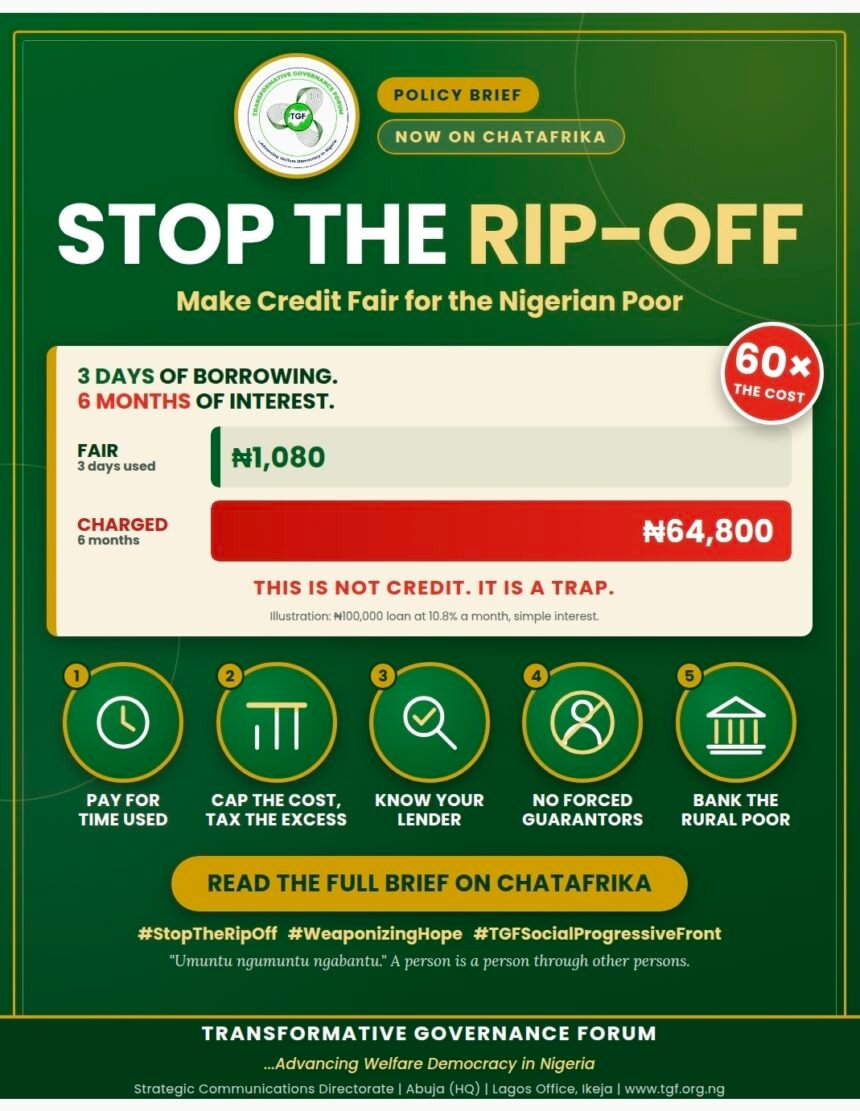
- Unfair exit. Three days after disbursement, she tried to repay in full. She was told she must still pay all six months of interest. On a ₦100,000 loan, simple interest for three days is about ₦1,080. The six-month charge is ₦64,800, more than sixty times higher for money used for three days. Interest is the price of time. No Nigerian should pay for time she did not use.
- A regulatory gap. We have found no explicit Nigerian rule on how interest should be treated when a borrower repays early. The disclosure rules help, but they do not set a fair standard of their own.
- Guarantors who never agreed. A troubling practice has been reported to the Forum. Some lenders list the names and phone numbers of a borrower’s parents, next of kin or friends as guarantors, without telling them or asking their consent. When the borrower falls behind, these people are called and pressed to pay for a debt they never agreed to guarantee. Borrowers have reported harassment and defamatory messages sent to third parties such as family members, employers and social contacts. The rules on third-party contact help, but they do not state plainly that no one may be made a guarantor without consent.
- A public in the dark. Between 2021 and 2025, the number of approved digital money lenders rose from 173 to more than 515. With so many operators, an ordinary citizen cannot easily tell which lender is legal, which has been sanctioned, or where to report abuse.
3. COMPARATIVE PRACTICE
- European Union. Borrowers may repay at any time and are entitled to a reduction in the total cost of credit, covering interest and costs for the remaining period. Any compensation to the lender is limited to costs directly linked to early repayment, capped at 1% of the amount repaid early (0.5% if under a year remains), and never above the interest the borrower would have paid.
- South Africa. A consumer may settle a credit agreement at any time, and the settlement amount is the unpaid principal plus interest and fees only up to the settlement date. An early termination charge is allowed only for large agreements, typically R250,000 and above.
- United Kingdom. Lenders must give a rebate of charges on early settlement, calculated by a statutory formula. In practice, a lender may charge up to 28 days of interest where 12 months or less remain on the loan.
- From January 1, 2026, lenders may not charge pre-payment fees on floating-rate loans to individuals, and loan agreements must state clearly whether any such charges apply.
The lesson is consistent. The borrower may leave early, interest stops on the day of settlement, and any fee is small, cost-based and disclosed.
But in Nigeria? Three days of borrowing. Six months of interest. This is not credit; it is a trap. Nigeria must cap the cost of digital borrowing and protect those who repay early.
4. POLICY ANALYSIS
- The FCCPC must move from rule-writing to market policing.
Rules matter only when they are enforced. The Commission is expected to monitor interest rates to prevent exploitative charges. We ask it to treat that duty as a daily task, not a paper promise. Its collaboration with app stores and payment service providers is a useful start.
- The poor borrow from the costliest source because the cheapest source is far away.
A farmer or trader in a rural community often has no branch nearby, so the nearest lender is an app. Two public institutions can change this. The Federal Government’s reform programme for the postal service includes a “Post Bank” offering financial inclusion services under a CBN licence. NIPOST has also had its international money transfer and super-agent licences restored. The post office already stands in communities that commercial banks ignore. The World Bank has observed that postal services are used by poorer, older and less educated people than those who bank only with formal institutions. On the farm side, President Tinubu has approved a recapitalisation programme for the Bank of Agriculture, and a new board was inaugurated on July 3, 2026. Letting the bank take deposits was floated as far back as 2016. Deposits from rural savers would give both institutions a stable, low-cost pool of funds to lend from, and cheaper funds mean cheaper loans. Take the bank to the people, and the people will leave the loan shark
- The progressive case.
Aristotle distrusted money that breeds money, because money was made to serve exchange and not to multiply itself on the back of need. Rawls taught that inequalities are just only when they benefit the least advantaged. African thought says it more simply: a person is a person through other persons. A progressive party in office must therefore ask one question of every programme: who does it lift, how widely, and for how long? Programmes that help a few for a season are charity. Programmes that open lasting doors for the many are justice. A progressive government is measured by who it lifts, how widely, and for how long. The Renewed Hope Agenda has begun that work, and we urge the government to deepen it.
- The fiscal lever.
Rules restrain, but taxes motivate. Nigeria has used this tool before. In 2024, the National Assembly imposed a 70% levy on banks’ realised foreign exchange profits for the 2023 to 2025 financial years. The principle was sound: a gain that comes from circumstance, and not from service, may be claimed back for the public good. The same logic applies to the margin that some fintech lenders earn when annual rates run far above any reasonable cost of funds, risk and operation. Conscience will not lower such a price, but a fiscal system can. Elsewhere, bank windfall levies range from 2% in Romania to 60% in the Czech Republic and Lithuania, with Italy at 40%. A levy works through lender behaviour and takes time to bite, whereas a hard ceiling on the total cost of credit works from day one. We therefore propose both: a ceiling for immediate relief, and a steep levy on any excess income, so that high pricing stops being profitable. One warning must be heeded. Commentators have cautioned that a levy on lenders can be passed on to customers as higher rates. The tool must therefore be built to hit the excess, forbid pass-through, and reward fair pricing. Tax the excess, not the poor.
- Transparency and consent
Two simple ideas hold up every honest bargain: that people may know who they are dealing with, and that no one is bound to an obligation they never accepted. A regulator’s register that sits unseen in a file does little good. It must be open to every citizen, and its findings must reach the public regularly, so that the honest lender is rewarded and the abuser is exposed. In the same spirit, consent is the root of any guarantee. A guarantee is a promise made by a person, and no one can promise through a stranger’s keystroke. No Nigerian should be made a guarantor by a phone number.
5. POLICY RECOMMENDATIONS
5.1 A National Responsible Credit Framework. The FCCPC and the CBN, with the Ministry of Finance, should issue one national framework for consumer credit that sets a single fair standard for every lender, whether bank, microfinance bank or digital lender. It should rest on four pillars:
(a) Effective cost of borrowing. Regulate the true annual cost of credit, including interest and all fees, through a published benchmark rate and a ceiling on the total cost of short-term loans (see 6.4).
(b) Protection for early repayers. Guarantee every borrower the right to repay at any time, with interest charged only to the day of settlement and any fee capped and cost-based (see 6.2 and 6.3).
(c) Responsible lending duties. Require lenders to check that a borrower can afford the loan before approving it, to obtain the written consent of every guarantor (see 6.9), and to treat borrowers fairly in collection and in cases of hardship.
(d) Transparency and redress. Plain-language disclosure of the full cost before acceptance, a written settlement statement on request, a public register of lenders, and a clear complaints and enforcement route (see 6.8).
The framework should be issued as a joint regulation first and backed by legislation where needed.
5.2 Early settlement rule. The FCCPC and the CBN should jointly require that a borrower who repays early pays principal plus interest only up to the day of settlement.
5.3 Capped fees. Any early repayment fee must be cost-based, low, and barred on small short-term loans.
5.4 Cost of credit. The FCCPC should publish a benchmark annual percentage rate, set from the CBN policy rate plus a defined margin for default risk and operating cost, and require lenders to justify rates far above it. The FCCPC and the CBN should also set a hard ceiling on the total cost of short-term consumer credit, including interest and fees, effective on commencement, with any charge above it unenforceable. The ceiling should be set from Nigerian cost data and not copied from other countries.
5.5 Honest disclosure. Every loan screen should show, in plain language, what the borrower would owe if repaying on day 3, day 30 and day 90.
5.6 Fiscal measures against excessive lending rates. The Federal Government, working through the Ministry of Finance, the national tax authority, the CBN and the FCCPC, should introduce a fiscal framework that makes excessive rates unprofitable. It should include:
(a) An excess-rate levy. A levy of 70% on interest and fee income earned above the benchmark annual percentage rate, rising to 90% on income earned above 1.5 times the benchmark, applied to digital and non-bank consumer lenders. The benchmark and the threshold should be tested against lender data before enactment.
(b) A strict ban on pass-through. No lender may recover the levy from borrowers through higher rates or new charges. Any attempt, including renaming interest as processing, insurance or service fees, should count as a breach, and the levy base should capture all such charges.
(c) Tax relief for fair lenders. Lenders whose average annual percentage rate stays below the benchmark, or who lend into rural and underserved communities, should qualify for a reduced tax rate or tax credits. Those who cut rates should be rewarded.
(d) Ring-fenced proceeds. All revenue from the levy should go into a Rural Credit and Liquidity Fund that supports NIPOST Bank, the Bank of Agriculture and CREDICORP, so that money taken from excess pricing returns to the poor as cheaper credit.
(e) Reporting and review. Lenders should report rates, loan volumes and default data to the FCCPC and the tax authority, and the framework should be reviewed after 24 months to confirm that borrowing costs are actually falling.
This should be enacted through an amendment to the relevant finance legislation, on the initiative of the Presidency and with the support of the National Assembly.
5.7 Active enforcement. The FCCPC should run consumer education in Nigeria’s major languages, publish complaint data, and sanction repeat offenders in line with 6.8.
5.8 A public register of lenders and a reporting portal. The regulator should be required by law to maintain a public website that is linked to its live database of registered money lenders. It should include:
(a) A status checker. Any member of the public should be able to search a lender or app by name and see its legal status, such as fully approved, conditionally approved, suspended or delisted, together with its registration details.
(b) A malfeasance reporting channel. The same site should let citizens report abuse by any registered operator, through the web, WhatsApp or a simple phone line, with a tracking number and a fixed timeline for a response.
(c) A quarterly public circulation. Every quarter, the regulator should send the register link and the current list of registered lenders to the public, through text messages, email, radio and social media, working with telecom operators, the National Orientation Agency and the media.
(d) Public announcement of sanctions. Every sanction against any lender, whether a fine, suspension or delisting, should be announced publicly within 7 days, naming the lender, the offence and the penalty, and kept on the register site.
5.9 Written consent of guarantors. The framework should make it illegal for any lender to name or treat any person as a guarantor without that person’s prior knowledge and written consent. It should provide that:
(a) Consent comes from the guarantor. Consent must be given directly by the guarantor, by a signed form or a secure digital confirmation sent to the guarantor’s own phone or email, and the guarantor must receive a copy showing the loan terms and the extent of his or her liability.
(b) No unconsented use. No lender may use the name, phone number or details of a parent, next of kin, friend, colleague or any other person as a guarantor or as a recovery contact without that person’s consent. A reference check must also be agreed to by the person concerned.
(c) No liability and no pursuit. A person who has not consented is not liable for the loan and must not be contacted for its recovery. The lender must delete that person’s data once the matter is raised.
(d) Real penalties and redress. Breaches should attract fines, suspension or delisting, and the affected person should be able to complain through the portal in 6.8 and seek compensation.
5.10 NIPOST Bank. The Federal Government and the CBN should complete the licensing and take-off of NIPOST Bank, using post offices as rural savings and payment points.
5.11 Bank of Agriculture deposits. The recapitalisation should include authority to accept deposits, with safeguards, to deepen liquidity and lower lending rates for farmers and rural traders.
5.12 One standard for all. These rules should apply equally to CBN-licensed institutions and FCCPC-registered lenders, so that no borrower falls into a gap.
6. CONCLUSION
Credit should be a bridge out of poverty and not a toll gate on it. Nigeria has the rules, the institutions and the political will to make that true. What remains is to close the gaps, enforce the standards, open the register to every citizen, protect people from debts they never agreed to, use the tax system to reward fair lending, and take banking to where the poor live. TGF stands ready to work with the FCCPC, the CBN, CREDICORP, NIPOST and the Bank of Agriculture to see it done.
Contributors:
The Transformative Governance Forum, TGF thanks Ademola Rabiu, CEng., Hon Olusegun Oyeyemi, Dr O’Diakpo Obire, Dr Bolade Agbola and Chief A. Adisa whose expertise and research provided the foundation for this advisory; and Dr. Oluseye Samuel Ajuwon and Ms Saratullah T. Owoyemi for their critical review, and editorial inputs. Their efforts have ensured that this brief is both evidence-based and policy-relevant. The views expressed in this brief reflect the collective position of the Forum.