By Chief Okoi Obono-Obla
Preamble
When discussing the intricate connections and relationships among the diverse peoples and cultures of the Cross River Basin, some individuals react with skepticism instead of approaching the work with intellectual curiosity and analysis. My historical and anthropological writings aim to foster deeper scholarly exploration and comprehension rather than fueling ethnic discord and division.
This article is the result of an inquiry that began on 28 December 2024 on my Facebook page, was reignited on 12 October 2026 by a post on the Opobo Historical and Cultural Society (OHCS) page, and has been enriched by field discussions in Ugep on 7-10 October 2026.

I. The OHCS Provocation: The Igbonised Thesis
On 12 October 2026 I read a post on the Facebook page of the Opobo Historical and Cultural Society (OHCS) where the writer suggested that the Abiriba people of Abia State are not originally Igbo but one of several groups that were rather Igbonised:
“This is an example of people who are not ancestrally Igbo, but were Igbonised over time. Some others include the Ndoki, who were ancestrally Ijaw; the descendants of Nri (Igala); the Oguta; parts of Nsukka, Onitsha and the ancient Ijaws called Oru around the Orashi River and the River Niger…”
The writer further stated:
“The Abiriba are originally from the Enna clan in the Yakor (Yakurr) Local Government Area of Cross River State. This area is known for a lot of Uda trees which led to the name Ena-Uda. It is not debatable that the Abiriba are part of the Agunaguna sub-tribe of the Ekoi. At Yakor today, there are still villages called Ebiribara and Ebom-Ebiriba that changed their names to Ebom for broader visibility. The Abiriba are Igbo today because of their centuries-old migration, settlement and intermarriage with Igbo people. They have no direct links with the Nri, and this is why so many Igbo sub-groups today are not actually Igbo but were Igbonised over time.”
This provocation is anthropologically valid. Igbonisation — the process by which non-Igbo groups adopt Igbo language and culture through prolonged contact, settlement and intermarriage — is well documented for Ndoki, Oguta and others. The question is whether it applies to Abiriba.
II. The Abiriba Internal Tradition: Sunny Idiaka’s Account
Samuel Idiaka, an Abiriba man from Abia State, provides the classic internal account, which I earlier quoted:
“The people who occupied the territory known as Abiriba descended from the Igbo and Efik people of Calabar. They migrated from the upper Cross River area centuries ago led by Nnachi Oken, from whom the title ‘Enachioken’ (The Monarch) originates. Initially, they occupied a smaller territory which expanded when the Abiriba people routed the surrounding Nkporo people and took over their lands. The Abiriba people were war-like and quickly established themselves in the area.
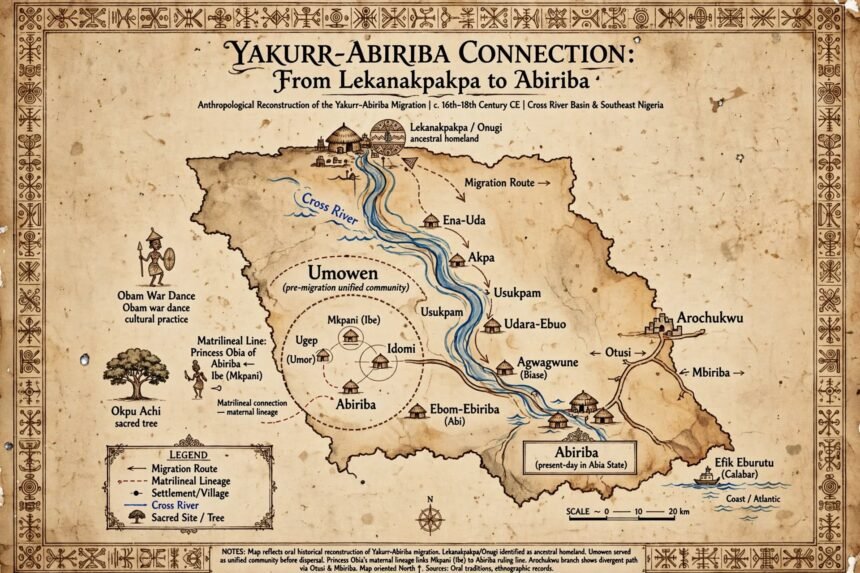
The origin of the Abiriba people is not as speculative as the origin of other Igbos of southeastern Nigeria. Historical evidence supports the fact that Abiriba people have common ancestor with the Yakor tribe of Ekoi of Cross River basin and the people of Arochukwu. At Ekoi, constant disputes between the seven families under Ukpaghiri prompted the clan to move to Ena and finally to Akpa. The settlement at Akpa was difficult for many years due to hostilities with neighbors. After the death of Ukpaghiri, Mbiriba and his group moved to Usukpam and stayed there for many years but were never at peace with the neighbors. Mbiriba decided to move to Udara-ebuo whereas Otusi led the other branch of the family downstream and eventually founded Arochukwu. The term Nwajim is often used between Abiriba and Arochukwu people because of our common lineage.
Mbiriba who had advanced in age, moved his group once more and settled at Udara-ebuo. Nature was inhospitable at Udara-ebuo. There was no water and the place was overrun by monkeys. Oral history has it that monkeys used to visit homes to look for food, and the people became sick living on monkey meat only. Mbiriba died at Udara-ebuo and left his son Ifa Mbiriba in charge.
Oko Ogo opened Ndi Okogo which is currently where the Chief’s Palace ‘The Agboezi’ is situated. Nwagu Ifa founded Okagwe and later Agboji. Ngwu founded Ihungwu. Chukwu Oke founded Amogudu. The name Amaeke was derived from the market day Eke. The Capital of Abiriba is Ameke and the paramount Chief for the whole Abiriba uses the title Enachi-oken.
Incessant conflicts and border skirmishes between the Item and Amogudu led to the creation of a standing army in form of the age-grade system. Historical artifacts exist to support the consensus that the age-grade system started at Amogudu.
At the heart of Abiriba the very centre of the town is a large, ancient tree ‘Okpu Achi’ (Achi tree). The tree is both symbolic and spiritual; and many believe that in the event of its fall, water from Okpu Achi would engulf the entire Abiriba land.”
The migration sequence — Upper Cross River (Ekoi-Yakurr area) → Ena (Ena-Uda) → Akpa → Usukpam (Urukpam) → Udara-Ebuo → Uranta → Agboha/Ihe/Amelunta → Present-day Abiriba — is preserved in the popular map titled Migration of Ndi Abiriba: From the Upper Cross River to Present-Day Abiriba.
III. The Cross River Evidence: Yakurr, Agwagwune, Ebom and Obam
The OHCS mention of Agwagwune, Ekoi-Yakurr and Ebom aroused my curiosity because these are not distant places.
Ebom is presently in Abi Local Government Area, but originally it was in Ugep Local Government Area. Abi LGA was first created in 1983 and abolished, then recreated out of the defunct Ugep LGA in 1991 by the Babangida Administration. Yakurr LGA itself was created out of Obubra LGA in 1987. In 1991, Ugep was divided into Ugep North and Ugep South, then less than 48 hours later reorganized into Abi LGA with headquarters at Itigidi and Yakurr LGA with headquarters at Ugep. Ebom, therefore, is administratively in Abi today but culturally Bahumono-Yakurr. It is listed today as Ebom, Abi LGA, alongside Ediba, Usumutong and others.
Agwagwune (Akpet Central) is in Biase LGA. It was part of the cluster of Biase, Agwagwune, Okurike, Unyanga, Akamkpa that moved to the bank of the Calabar River during the Akpa dispersal, while the cluster of Yakurr, Mkpani, Nko, Idomi, Ekuri moved north.
That old unity survives in language. In Ugep, especially in Ijiman and Okurubong, Agwagwune was like a second language until recently. The Nsibidi cultural troupe of Ijiman sings in Lotung rather than Lokaa, and elders explain: “It is the language of our fathers.” Lotung is the ritual language of Akpa/Lekanakpakpa.
It also survives in war memory. Ugep traditions demonstrate interconnectedness with Agwagwune, and the Ugep war dance — Obam — always eulogizes Agwagwune and Efik Eburutu. Obam is a traditional dance of the Yakurr people, a victory dance of warriors performed at Leboku with gun displays. When the Obam leader shouts “Agwagwune! Efik Eburutu!” he is reciting the Akpa confederacy — the riverine brothers and the southern Efik trading partners of Akwa Akpa (Old Calabar). The tapestry between Agwagwune, Ebom and Yakurr is therefore not symbolic; it is migratory fact.
IV. The Matrilineal Clue: Princess Obia and the Ibe Tradition
It is pertinent that a tradition preserved by the Yakurr Ibe people of Mkpani states that a princess of Abiriba by the name of Obia gave birth to Yakurr and his name was Ibe.
Ibe is the indigenous name of Mkpani. In this tradition, Yakurr is not merely a brother to Abiriba but a son through a royal Abiriba woman. This matrilineal founder account is consistent with the strong matrilineal aspects of both Yakurr and Abiriba inheritance and title systems.
However, Dr. Otu Abam Ubi, the noted Yakurr historian, differs from that perspective in his seminal work The Yakurr People of the Middle Cross River Region 1600-1950 (International Edition, 2019). Dr. Ubi is the foremost historian of Yakurr descent, an 83-year-old patriarch from Egbizum, Ikpakapit, Ugep. He obtained a PhD in History from the University of Lagos in 1978, focused on reconstructing Yakurr history from 1600-1950. He was Principal of the defunct School of Basic Studies, Akamkpa, and Head of Department of History, University of Calabar.
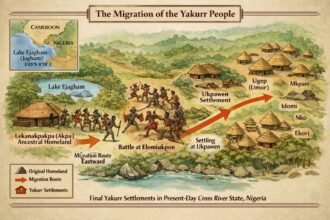
Dr. Ubi asserts that the ancestral home of Yakurr was at Lekanakpakpa — which Ikom people call Onugi — and that Okuni traditions confirm that the Yako were neighbours at Onugi. According to his method of extrapolating kinglists from the five Yakurr villages, the Yakurr began leaving Akpa around 1617 after a dispute over a burial custom led to war. Between 1617 and 1677 they founded Idomi and Ugep around 1660, and between 1677 and 1707 they founded Ekori and Nko. His computed regnal means were Ugep 20.6, Ekori 25.0, Nko 24.3, Mkpani 24.8, Idomi 20.3.
For Dr. Ubi, Yakurr and Abiriba are collateral descendants of Lekanakpakpa, not parent and child.
V. The Synthesis: Umowen
The resolution lies in a third tradition: Ugep, Mkpani and Idomi were one community known as Umowen in Akpa before migration. Therefore the Yakurr Ibe tradition also resonates and is interwoven with Umor (Ugep).
Umor is the indigenous name of Ugep. Umowen was the pre-migration unity of Umor, Ibe (Mkpani) and Idomi. They were not three separate migrations; they were one body that moved together in the 1660 wave and only differentiated after settlement. This explains why Dr. Ubi’s kinglist averages for Ugep, Mkpani and Idomi are so close.
If Princess Obia gave birth to Ibe, she gave birth to a son of Umowen — therefore symbolically to Umor and Idomi as well. The Obia tradition is thus not a contradiction of Lekanakpakpa; it is the Umowen memory of a marriage alliance at Akpa or Ena-Uda between Abiriba royalty and the Yakurr core, before Otusi left downstream to found Arochukwu and Mbiriba moved to Udara-Ebuo and finally Abiriba.
In short:
Lekanakpakpa/Onugi = the deepest origin (Oban Hill, south Olulumo)
Umowen (Umor-Ibe-Idomi) = the community that left Akpa around 1617-1660
Ena-Uda, Akpa, Usukpam = staging camps where Umowen and Abiriba co-resided, where Princess Obia’s union occurred, and where villages Ebiribara and Ebom-Ebiriba (now Ebom) preserve the name
Udara-Ebuo, Agboha = final dispersal into present Abia State
Abi/Yakurr/Biase LGAs (1991) = modern administrative lines cutting through one cultural zone
VI. Conclusion
The Abiriba are Igbo today by centuries of settlement, conquest of Nkporo, blacksmithing enterprise in Arochukwu, and intermarriage. They are not Nri. They are Agunaguna, a sub-tribe of Ekoi, from the Yakurr world. They are part of the same Akpa exodus that produced Ugep (Umor), Mkpani (Ibe), Idomi (Umowen), Ebom (Bahumono), Agwagwune (Akpet) and Efik Eburutu (Calabar).
The OHCS writer was therefore right: Abiriba are an example of a people ancestrally from the Cross River Basin who were Igbonised. Sunny Idiaka was right: Abiriba share a common ancestor with Yakor and Arochukwu. The Mkpani Ibe elders are right: a princess of Abiriba, Obia, is remembered as mother of Ibe. Dr. Otu Abam Ubi is right: the scientific origin is Lekanakpakpa and the dating is 1617-1707.
These are not competing histories. They are the same story told from Abiriba, from Mkpani, from Ugep, and from the archive.
It is not debatable. It is interconnected.