By Olalekan Idowu JIMOH
The Nigerian Church is bleeding from self-inflicted wounds. Yes, Christians in Nigeria face real persecution from terrorism, banditry, and other forms of insecurity and marginalisation, but the deeper crisis is that our divisions are not the product of persecution from outside, but of pride, politics, and power struggles within. Instead of being a prophetic conscience to the nation, the Church has too often become a mirror of Nigeria’s corruption.
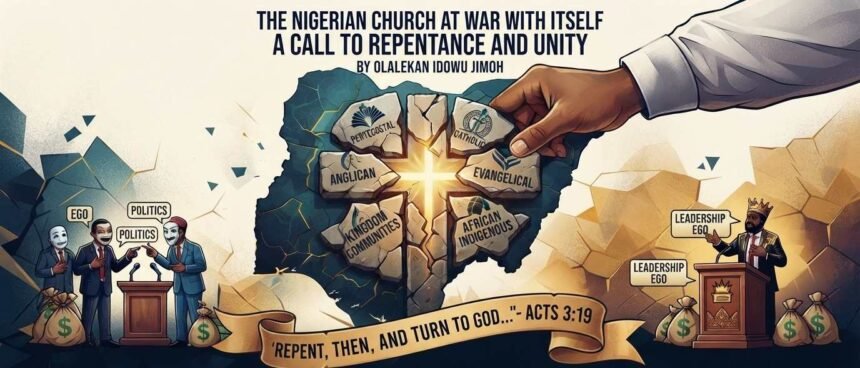
Denominational Turf Wars
Pentecostals, Catholics, Anglicans, Evangelicals, and African Indigenous Churches treat one another as rivals. Prosperity preachers dismiss liturgy as “dead religion,” while orthodox leaders condemn charismatic expressions as “theatrics.” Too often, these battles cease to be about truth and become contests over turf, weakening the Church’s witness to a nation desperate for moral clarity.
Doctrinal disputes over prosperity, charismatic gifts, and social justice have become weapons of division rather than opportunities for oneness and dialogue. Instead of sharpening one another in love, denominations compete for influence, members, and recognition. Yet Christ is not divided (1 Corinthians 1:13). If He is one, why do we persist in fragmenting His Body? Even umbrella bodies such as the Christian Association of Nigeria (CAN), with its constituent blocs- the Catholic Secretariat, Christian Council, Pentecostal Fellowship, Organisation of African Instituted Churches, and TEKAN/ECWA, can at times reflect these divisions instead of providing the unifying platform the wider Body of Christ needs.
Meanwhile, unity does not require uniformity. The Church need not erase legitimate doctrinal, denominational, cultural, or political differences. But those differences must not become excuses for hatred, ethnic idolatry, corruption, personality cults, or the fragmentation of our common witness.
Ethnic and Political Captivity
Ethnic loyalties have hijacked the pulpit. Oftentimes, Yoruba, Igbo, Hausa, and Middle Belt Christians are tempted to rally behind “their own” rather than submit collectively to the counsel of God. Too many political endorsements appear less like Spirit-led discernment and more like tribal calculations dressed up as prophecy.
We must harmonise our divergent views and sincerely ask the Lord: “Who should we throw our weight behind? What should we do together this season?” Once the Lord is clear, we must put aside affiliations that make us unfaithful and yield honestly to His counsel. Anything less is disobedience.
Leadership Ego, Corruption, and Misplaced Priorities
Too many leaders have enthroned themselves as monarchs. Ministries revolve around personalities, not Christ. Wealth without accountability is celebrated, even when sourced from corrupt politicians laundering their reputations through donations.
The Church has become complicit in Nigeria’s corruption, blessing what God has cursed. Worse still, we see a shameful craze for titles, superiority tussles, and ordination sprees, while weightier matters of national and global implication languish unattended. “Woe to you, teachers of the law and Pharisees, hypocrites! You give a tenth of your spices…but you have neglected the more important matters of the law- justice, mercy and faithfulness” (Matthew 23:23). What a misplaced priority!
Tragically, many emerging ministers are busy pursuing comfort, fame, wealth, huge auditoriums, large congregations, and the ambience that characterises the material orientation of some of their denominational fathers of faith, fathers who have long missed the mark and remain desperately unaware of their need to repent and rededicate themselves to the Lord. Some go the unimaginable extra mile, driven by what Elder Matthew Korede Owojaiye described as “the pressure to perform” and “the pressure to do something new”. Instead of breaking free from these errors, many of these rising voices are replicating them. Younger ministers today are in a hurry to become fathers in the faith before they have learnt to become faithful sons. They hunger for platforms, followers, titles, recognition, and the influence associated with spiritual fatherhood, yet often resist the submission, discipline, correction, service, genuine intimacy with Christ, and character formation through which genuine spiritual fatherhood is developed. They are compounding the crisis of leadership and the quality of faith in the Nigerian Church.
Christian Participation Without Political Captivity
The Church must also examine its relationship with political power. Christian participation in politics and governance is not only legitimate but necessary if believers are to contribute to justice, integrity, good governance, and the common good. The Church cannot retreat from the public square. But participation must never become dependence or political captivity. When access to political leaders, government patronage, appointments, donations, or proximity to power becomes more important than the courage to speak truth, the prophetic voice is compromised. The Church must be able to commend government when it does what is right and confront it when it does what is wrong, regardless of who occupies the seat of power. Christians who enter public office should therefore do so as servants of the common good, not as representatives of a denominational empire or instruments of partisan patronage. The Church must influence political power without becoming dependent upon it.
Nigeria’s Prophetic Destiny and Mandate
We cannot forget the prophetic word of Pa Sydney Granville Elton, who declared that Nigeria is shaped like a gun, with the trigger in the Niger Delta and the barrel pointing to the rest of the world. He foresaw Nigeria as a missionary force, firing the gospel to the nations.
In harmony with this, Apostle Arome Osayi recently reaffirmed that Nigeria’s destiny is not merely political or economic, but spiritual, to be a revivalist nation. This is a sacred calling: to ignite flames of revival that will spread across Africa and the globe.
Many of us still trust that the Lord is counting on Nigeria to yield to this calling. But let us ask ourselves bluntly: with all these shenanigans, denominational rivalries, ethnic politics, corruption, ego-driven leadership, and younger ministers chasing comfort instead of consecration, is this how we intend to fulfil it? Will a divided, compromised Church ever be the gun in God’s hand, firing the gospel to the ends of the earth? Will a fractured vessel ever carry the fire of revival? Come on, enough is enough!
Structures for Kingdom Governance
We must, therefore, build structures that intentionally raise well-grounded, deeply kingdom-rooted sons and daughters of God who are prepared to participate ethically and competently in public office and governance. They must embody fairness, justice, equity, mercy, humility, and truth, fulfilling the counsel of God in the public square.
Recent messages such as Apostle Femi Lazarus’s “Why Nigeria Might Become the Next Libya and Your Role in It” should also remind us that these are serious times that require more than emotional reactions, partisan narratives, or surface-level understanding. His documentary challenges viewers to look more deeply at geopolitics, national interest, natural resources, international agreements, and the long-term consequences of decisions that may shape the nation’s future. Whether or not one agrees with every argument or projection presented, the broader challenge is worthy of attention: citizens, particularly those who understand themselves as Kingdom citizens, must become more informed, discerning, responsible, and strategically engaged in the affairs of the nation. We cannot afford complacency. No more slumber!
Both young and old have spoken many times. We have held meetings upon meetings, conferences upon conferences, prayers upon prayers, both closed-door and open-air, yet we have not been passionate, selfless, and united enough to execute commensurate strategic actions. God is counting on us. So why are we holding the destiny of Nigeria back?
Why Unity Matters
Disunity severely weakens the Church’s capacity to confront injustice, terrorism, and bad governance. A divided Church cannot confront a corrupt state; it can only be co-opted by it.
Unity is not sentimental. It requires humility, mutual submission, and a willingness to hear God’s counsel even when it contradicts our religious and ethnic bias or ambition. Christ prayed “that they may be one” (John 17:21), not for denominational empires but for a unified witness.
We must recognise that God is currently confronting and dismantling hegemonic agendas that are seeking to stifle His will, suppress His purposes, and alter the spiritual destiny of Nigeria and Africa. This is not a time for sentiment. It is a time for obedience.
The Path Forward
- Repentance: Leaders must repent of pride, corruption, and political idolatry. “Repent, then, and turn to God, so that your sins may be wiped out, that times of refreshing may come from the Lord” (Acts 3:19). “God opposes the proud but shows favour to the humble” (James 4:6).
- Mutual submission: Denominations must submit to one another in love, not rivalry. “Submit to one another out of reverence for Christ” (Ephesians 5:21). “By this everyone will know that you are my disciples, if you love one another” (John 13:35).
- Prophetic courage: The Church must speak truth to power, even at the cost of influence. “Cry aloud, do not hold back; lift up your voice like a trumpet; declare to my people their transgression” (Isaiah 58:1). “We must obey God rather than men” (Acts 5:29).
- Integrity: Wealth and leadership must be scrutinised, not idolised. “What good will it be for someone to gain the whole world, yet forfeit their soul?” (Matthew 16:26). “Moreover, it is required of stewards that they be found faithful” (1 Corinthians 4:2).
- Strategic structures: Build systems that raise kingdom-rooted leaders for governance. “Choose for yourselves wise, understanding and respected men from each of your tribes, and I will set them over you” (Deuteronomy 1:13). “When the righteous increase, the people rejoice, but when the wicked rule, the people groan” (Proverbs 29:2).
- National and Global responsibility: Nigeria’s Church must recognise its national and global role and act accordingly. “Go therefore and make disciples of all nations” (Matthew 28:19). “You will receive power when the Holy Spirit has come upon you, and you will be my witnesses in Jerusalem, and in all Judea and Samaria, and to the ends of the earth” (Acts 1:8).
Conclusion
The Nigerian Church stands at a crossroads. She can continue in pride, division and corruption, and watch the nation descend further into chaos. Or she can humble herself, unite under Christ, and fulfil her eternal calling as salt and light to Nigeria and the world (Matthew 5:13-14).
The principle remains clear and sobering: when God’s people humble themselves, turn from their wicked ways and seek Him, they place themselves in the posture of repentance from which restoration can begin (2 Chronicles 7:14).
The time for sentiment is over. The time for obedience is now. And if Nigeria is truly being called to serve as a spiritual instrument for the spread of the gospel to the nations, as many have long believed, then the Church must stop playing games and yield to God’s eternal will, or risk becoming a vessel that never fulfils its purpose and a destiny that never manifests.
Olalekan Idowu Jimoh is a Nigerian writer, commentator, security and strategic studies scholar-practitioner, and Christian thinker whose work engages faith, governance, national security, and the prophetic responsibility of the Church in society. He writes at the intersection of Christian faith, public affairs, security, and nation-building, with a particular burden for the oneness of the Body of Christ, ethical leadership, and the fulfilment of God’s counsel for Nigeria and the nations.