By Okoi Obono-Obla
September 23, 2026
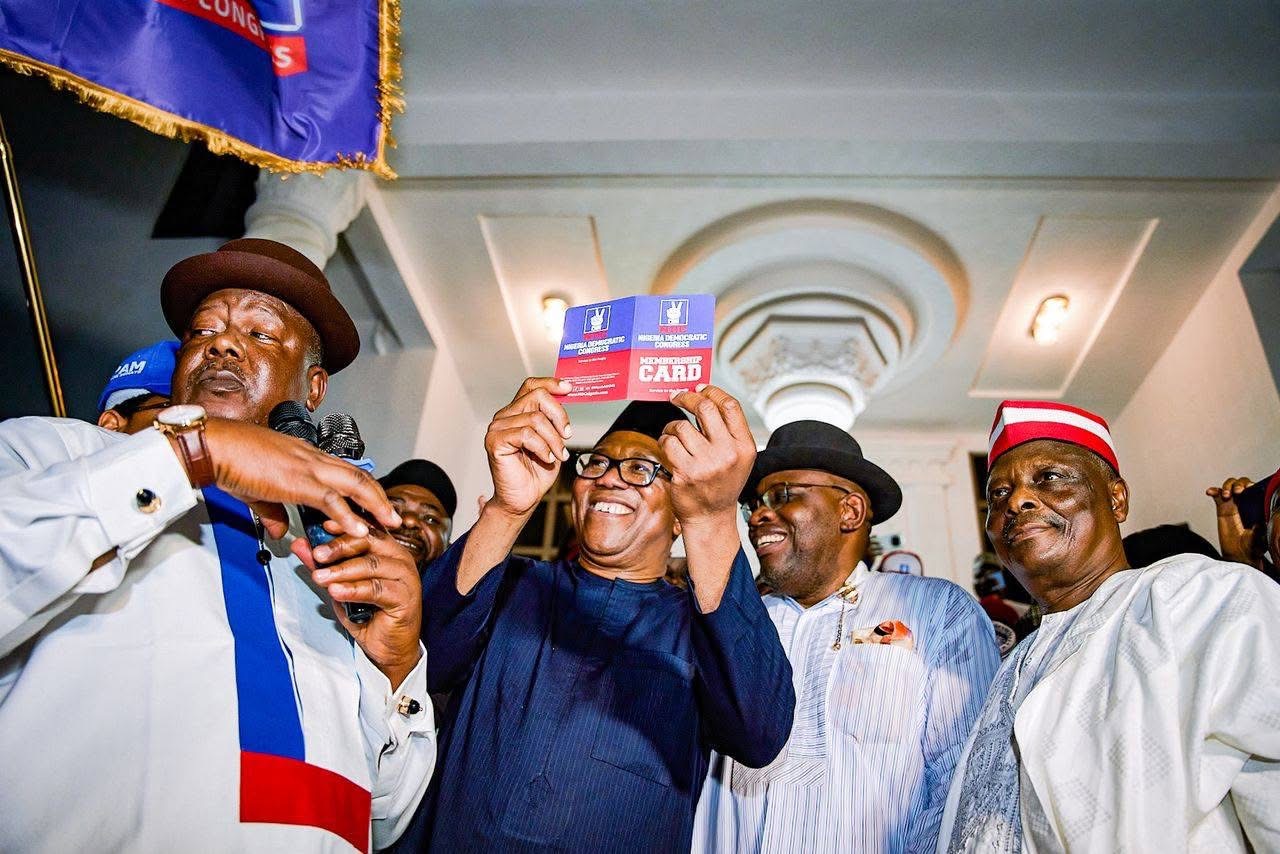
The Obi-Kwankwaso Movement (OK Movement) has vowed to maintain its independence and resist pressure to collapse its structures into the Nigeria Democratic Congress (NDC) ahead of the 2027 general elections.
Director-General of the Movement, John Ughulu, on Wednesday dismissed remarks by NDC leader, Senator Seriake Dickson, who had described the Movement’s decision to set up a presidential campaign council as “nonsensical.”
Ughulu said the Movement is not a support group created as an appendage of any political party. According to him, its national, state, local government and ward structures remain its responsibility and will not be transferred to the NDC or any other organisation. He added that the Movement comprises members drawn from different political parties who share a common commitment to the aspirations of Peter Obi and Musa Kwankwaso, and that it has the organisational right to establish its own campaign structures.
“Our position is therefore clear: The OK Movement remains an independent organisation. Its existence and internal administration are not subject to the internal management of the NDC Party,” he said.
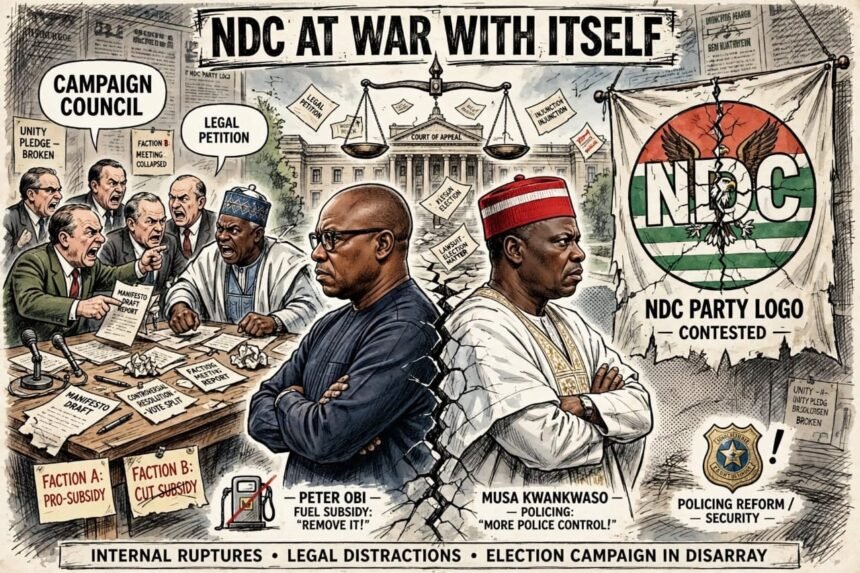
How can a political party like the NDC be publicly fighting itself in the thick of an electioneering campaign over something as frivolous as who has the rightful authority to constitute a campaign council? When members are not fighting over whose organ has the authority to do what, the presidential candidate and his running mate are disagreeing on two very vital policy agendas.
Peter Obi says he believes in the withdrawal of fuel subsidy but would rather use the savings from such withdrawal to cushion its effect on the people in order to ameliorate the resultant hardship. He also believes that federal policing should be decentralized and replaced with state policing.
In sharp disagreement, his running mate, Musa Kwankwaso, says he does not believe in state policing. He also says he believes in the state subsidizing petroleum products.
How can a political party that is fighting to win an election be that disoriented and disorderly to the extent that such a sharp disagreement would occur?
The second distraction: The logo litigation
In the face of these ruptures, the NDC has also been entangled in a protracted legal battle over its very identity.
A political association, the Peace Movement Party (PMP), filed an application challenging the NDC’s registration on the allegation that the NDC stole its logo and used it for registration with the Independent National Electoral Commission (INEC).
That claim initially succeeded. On June 26, 2026, Justice Isah Dashen of the Federal High Court, Lokoja reversed the court’s earlier judgment. The earlier judgment of December 10, 2025 had directed INEC to register the NDC. 0ee3
The NDC appealed.
On September 19, 2026, the Court of Appeal overturned the Lokoja ruling and upheld the NDC’s registration. The appellate court found that the lower court had no business sitting on appeal over its own earlier judgment of December 10, 2025, which had directed INEC to register the NDC. 9b72
On the logo issue specifically, the Court of Appeal dismissed the claims surrounding the NDC’s use of a logo said to belong to the Peace Movement Party. In a similar holding, it also dismissed the contention over the party’s logo which the PMP claimed belonged to it. c01dd7baad5a
The majority decision was delivered by Justice Mohammed Danjuma and Justice Muslim Sule Hassan. However, Justice Okon Abang dissented, upholding the Federal High Court’s decision to deregister the party. ad5a60cd9b72
What this portends
While the Appeal Court victory removes the immediate threat of deregistration ahead of 2027, subject to any further appeal to the Supreme Court, the episode illustrates the depth of distraction facing the NDC.
First, it shows a structural confusion. The party never defined whether the OK Movement is an affiliate or a merger partner, hence the public fight over who constitutes a campaign council.
Second, it shows a policy vacuum. Obi and Kwankwaso have not harmonized their positions on subsidy and policing, two core governance questions.
Third, it shows poor crisis management. Spending months in court defending ownership of a logo, while simultaneously litigating internal ownership of campaign structures through press releases, projects disorder at a crucial and dicey moment of the electioneering campaign.
If the NDC intends to be taken seriously as a governing alternative, it must quickly collapse parallel campaign councils into one, produce a single joint manifesto where Obi and Kwankwaso speak with one voice, and keep its internal disputes off the pages of newspapers.
Otherwise, it will go into 2027 as a house divided against itself.