By Okoi Obono-Obla
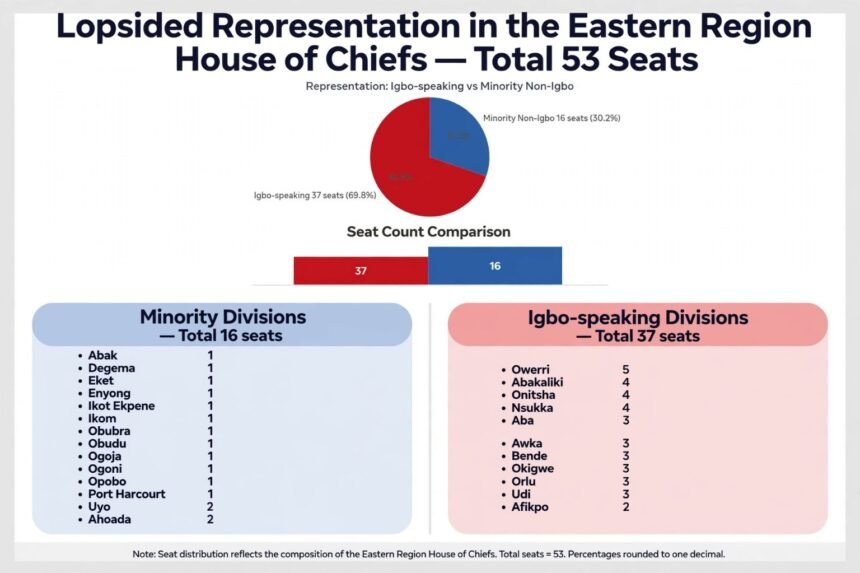
Another glaring instance of discrimination and maltreatment of the minority peoples in the defunct Eastern Nigeria was evident in the divisional representation in the Eastern Region House of Chiefs. The representation was starkly lopsided in favour of the Igbo-speaking areas of the region.
A breakdown of representation among the divisions, as illustrated in Tables 1 and 2 below, reveals the extent of the imbalance. While the fourteen non-Igbo-speaking divisions had only 16 representatives in total, the eleven Igbo-speaking divisions had 37 representatives in total.
In the minority areas, twelve divisions — Abak, Degema, Eket, Enyong, Ikot Ekpene, Ikom, Obubra, Obudu, Ogoja, Ogoni, Opobo and Port Harcourt — had only one representative each, while Uyo and Ahoada had two representatives each.
In contrast, the distribution among the Igbo-speaking areas was as follows: Owerri had five representatives; Abakaliki, Onitsha and Nsukka had four each; Aba, Awka, Bende, Okigwe, Orlu and Udi had three each; while Afikpo had two.
Table 1: Representation of Non-Igbo-Speaking (Minority) Divisions in the Eastern Region House of Chiefs
| Division | No. of Representatives |
| — | — |
| Abak | 1 |
| Degema | 1 |
| Eket | 1 |
| Enyong | 1 |
| Ikot Ekpene | 1 |
| Ikom | 1 |
| Obubra | 1 |
| Obudu | 1 |
| Ogoja | 1 |
| Ogoni | 1 |
| Opobo | 1 |
| Port Harcourt | 1 |
| Uyo | 2 |
| Ahoada | 2 |
| TOTAL | 16 |
Table 2: Representation of Igbo-Speaking Divisions in the Eastern Region House of Chiefs
| Division | No. of Representatives |
| — | — |
| Owerri | 5 |
| Abakaliki | 4 |
| Onitsha | 4 |
| Nsukka | 4 |
| Aba | 3 |
| Awka | 3 |
| Bende | 3 |
| Okigwe | 3 |
| Orlu | 3 |
| Udi | 3 |
| Afikpo | 2 |
| TOTAL | 37 |
In summary, out of a grand total of 53 seats, the Igbo-speaking divisions controlled 37 seats (69.8%), while the non-Igbo-speaking minority divisions held only 16 seats (30.2%), despite the vast geographical spread of the minority areas.