By Okoi Obono-Obla
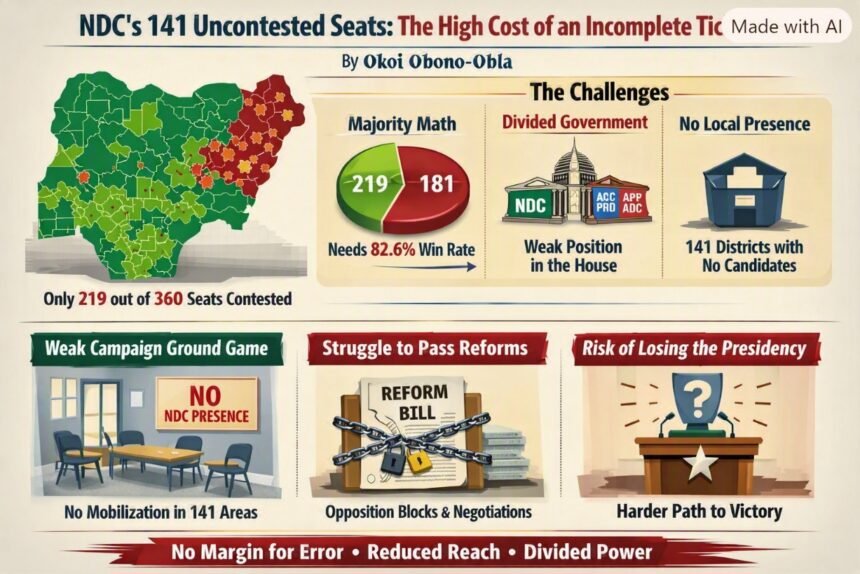
According to data from the Independent National Electoral Commission [INEC], the Nigeria Democratic Congress [NDC], one of the major opposition parties ahead of the general election scheduled for 16 January 2027, is fielding candidates in only 219 of the 360 seats in the House of Representatives.
This is in contrast to the All Progressives Congress [APC], the Peoples Democratic Party [PDP] and the African Democratic Congress [ADC], which are fielding candidates in all 360 constituencies available in the same election.
The gap is significant. There are 360 seats in the House, and the 181 seats required for a simple majority means a party contesting all seats needs to win 50.3% of its races. By contesting only 219 seats, the NDC has lowered its own ceiling to 219 seats and raised the bar for a majority. It must now win 181 of its 219 contests – an 82.6% win rate – and can afford to lose only 38 seats nationwide. In effect, it must win almost everything it contests to control the House.
This has direct implications for the fundamental political, social and economic reforms the party has promised, including a reduction in the cost of governance.
No such reform can be implemented by presidential proclamation alone. Under the 1999 Constitution, every bill, including the Appropriation Act, requires concurrence of both the Senate and the House of Representatives. If the NDC were to win the presidency without a House majority, it would face a divided government. Its budget and reform bills would have to be negotiated, amended, and often diluted to secure votes from opposition parties that would control the remaining seats. Governing would depend on building coalitions through concessions on leadership positions, committee chairmanships and constituency projects, making swift and far-reaching reforms far more difficult.
The incomplete ticket also affects the presidential race itself. House candidates are the field army of a presidential campaign. They provide the polling-unit agents, ward mobilizers and local structures that drive turnout and protect votes. In the 141 constituencies where the NDC has no candidate, that structure is absent, while APC, PDP and ADC will have full national presence. The absence also removes the coattail effect, where a House candidate helps pull votes for the presidential candidate in that constituency, and may be interpreted by voters as a lack of national spread or organizational capacity.
Conclusion
INEC’s data shows a clear strategic divergence: while its main rivals are contesting the entire House, the NDC is leaving 141 constituencies uncontested. The law does not require a party to contest every seat, and winning 219 seats is still mathematically enough to produce a majority. However, it leaves the party with no margin for error in the House and without a mobilization structure in nearly 40% of the country. Whether it wins or loses the presidency on 16 January 2027, the decision not to contest 141 seats makes both winning the presidency and implementing its promised reforms significantly harder.