By Okoi Obono-Obla
Mr. Anderson Ubetowan, in response to my post of 4th September 2026 on my Facebook page concerning how I have contributed to Meta AI having references on Ugep history, geography and culture, replied thus:
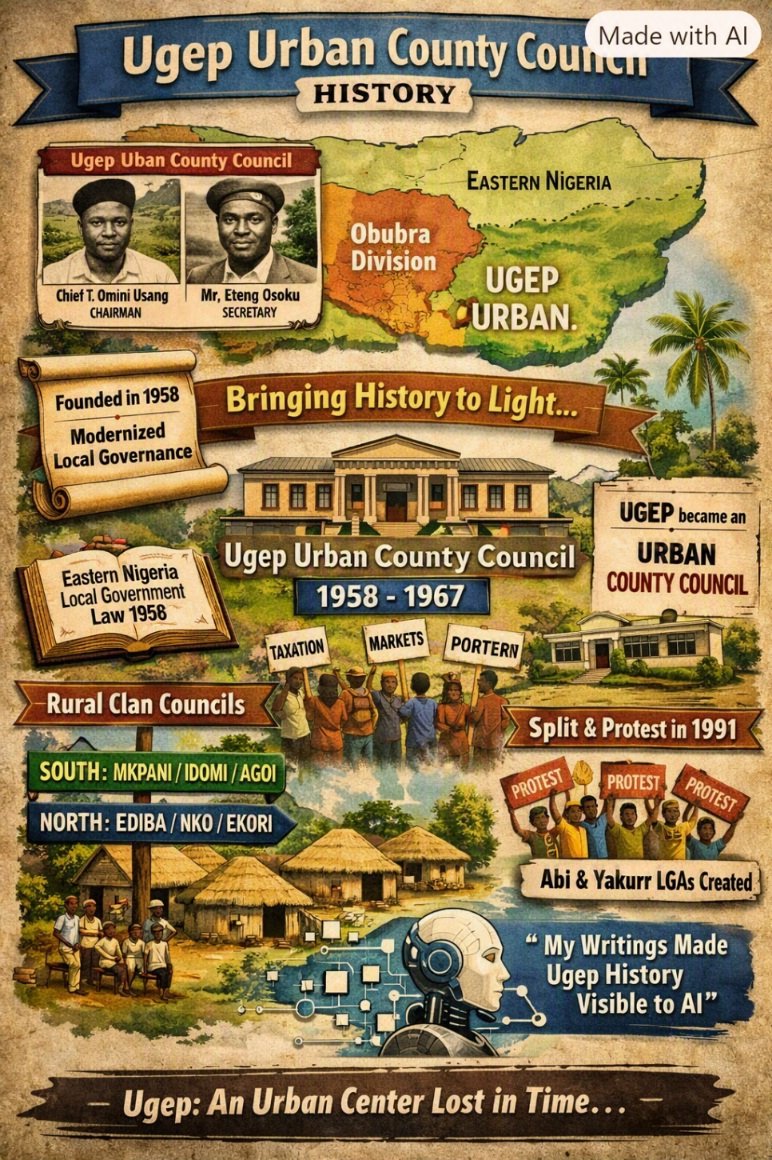
“If you are as old as I am or older you don’t need to pass through so-called AI research to learn that Ugep was once called Ugep Urban County Council, and Mr. I Omini Usang was its Chairman while Mr Eteng Osoku, my distant cousin was the Secretary. It is not so esoteric, Chief.”
I elect to rejoin for the purpose of veracity and completeness:

@Anderson Ubetowan, Yes, you are older than me. I was born maybe two decades after you were born.
I did not witness the Ugep Urban County Council. I did not witness when Chief Thomas Omini Usang was Chairman and Mr. Eteng Osoku was Secretary. Even my grandfather was a Councillor representing Ijiman in the Ugep Urban County Council.
The Ugep Urban County Council lasted from 1958-1967. I was just one year old. My father was in the Federal Civil Service in Jos, Plateau State, then in the Northern Nigeria Group of Provinces, when the crisis erupted and all people from the old Eastern Nigeria were asked to leave the North and return home. My father was then posted to Ogoja Province in the Eastern Region.
When I grew up and began to read widely after secondary school, there were no history books where it was written that the Ugep Urban County Council existed. I only knew Ugep as part of Obubra Division of South Eastern State and later Cross River State. In 1987, I was in the University when Ugep Local Government Area was created out of Obubra Local Government Area, and nobody even talked about Ugep Urban County Council. Your generation did not teach those of us who were younger that history.
Then on 26th September 1991, Ugep Local Government Area was suddenly divided into Ugep South and Ugep North with headquarters in Ugep and Idomi respectively, and there was pandemonium and protests. Within 48 hours, the Federal Military Government rescinded its decision and in its stead created Abi and Yakurr Local Government Areas.
I had just returned from NYSC in the first week of September 1991 and was resting in Ugep, contemplating what to do with my life. As a young man who was politically conscious, I was grossly incensed by the cancellation and immediately started talking and mobilizing young people to protest. The older people did not understand, and I did not know that as far back as 1958 Ugep had an Urban County Council, and indeed within our region we had South Clan Council (Agoi, Idomi and Mkpani) and Northern Clan Council (Ediba, Ekori and Nko). If your generation had been alive to its responsibilities and had written history, we would have in our protest submitted petitions for at least five Local Government Areas from the present Abi and Yakurr, and witnessed more development and created jobs for our people.
Our protest petered out because the elites then did not understand that in Nigeria when you want something you must voice it, and that Government is not the be-all and end-all. I grew up in a different generation where we were taught in the University that you can challenge Government when it implements policies that are against the people.
As I grew older, I developed the consciousness of researching and writing about the history of Ugep, Yakurr, Cross River State and Nigeria in general. I came to realize that if you want to be politically conscious and be the voice of the oppressed, the voiceless, the powerless and the marginalized, you must be armed with historical knowledge. Information is power.
I therefore did not use Artificial Intelligence to research Ugep history. My point was that my writings and research on Ugep history have enabled Artificial Intelligence to record them, and today when you write anything on Ugep history and culture, Meta AI references my writings and essays. I take that credit unabashedly.
AI is not a repository of every imaginable subject. It depends on how one prompts it. If you do not have knowledge of a subject, AI cannot help you. It can even mislead you, and it warns you that it is prone to making mistakes.
WHAT THE LAW ACTUALLY SAYS – EXCERPTS OF MY FINDINGS:
My research is confirmed by extant law and maps:
1. The Legal Foundation:
“The passage of the Eastern Nigeria Local Government Law of 1958, followed by amendments in 1959 and 1960, marked a turning point in local governance… These laws modernized the colonial local government system by formally distinguishing between urban councils and rural clan councils.”
“In the East, a similar order of arrangement was taken with the local government ordinance of 1950 which also introduced British modelled three tier structure comprising county, District and Local council. This three-tier system was replaced in 1958 by a two tier and provincial assemblies as the second county council were to consist of not more than one fifth traditional members.”
And:
“The East established a two-tiered District and local Council system in the rural areas, and a three-tiered system composed of an all-purpose municipal, urban County and County councils.” 8394
2. Ugep Urban Status:
“Under Eastern Region Legal Notice of 1958, Ugep Urban was formally recognized as an Urban County Council. This status reflected Ugep’s growing importance as a commercial and administrative headquarters of what was then Obubra Division.”
As an urban council, Ugep was granted:
Authority over taxation and revenue collection;
Responsibility for markets, sanitation, roads and infrastructure; and
A centralized administrative framework aligned with colonial policy of urban modernization.
3. The Rural Clans – Proof of South and North Blocs:
“To the south and south-east of Ugep Urban, the map shows a large area marked ‘MKPANI / IDOMI / AGOI’ and ‘SOUTH COUNTY.’ These communities were administered as Rural Clan Councils.”
“To the north and north-east of Ugep Urban, the same map clearly shows the inscription ‘EDIBA / NKO / EKORI’. This is Ekori.”
“Under the 1958, 1959 and 1960 Laws, Ekori was therefore not under South County. It was part of the Ediba/Nko/Ekori District Council, a rural district council within Obubra Division”
4. My Conclusion:
I started to research the local government system in the old Eastern Region and discovered that Ugep was indeed an Urban County Council, and other Urban County Councils were Enugu, Aba, Owerri, Port Harcourt, Ikom, Calabar, Umuahia, Uyo, Ikot Ekpene, Abakaliki and Onitsha. Today all these cities are now State Capitals and have several local government areas within them.
Ugep in 1958 was more populated than Owerri, Abakaliki, Ikom and Umuahia and today is not even a Local Government Area but only the headquarters of Yakurr Local Government Area which in 1958 constituted mere Clan Councils. This is stagnation and an egregious act of injustice.
If your generation had written history or taught us history, we would have had records to guide us and no such injustice would have been meted on our people.