By Okoi Obono-Obla
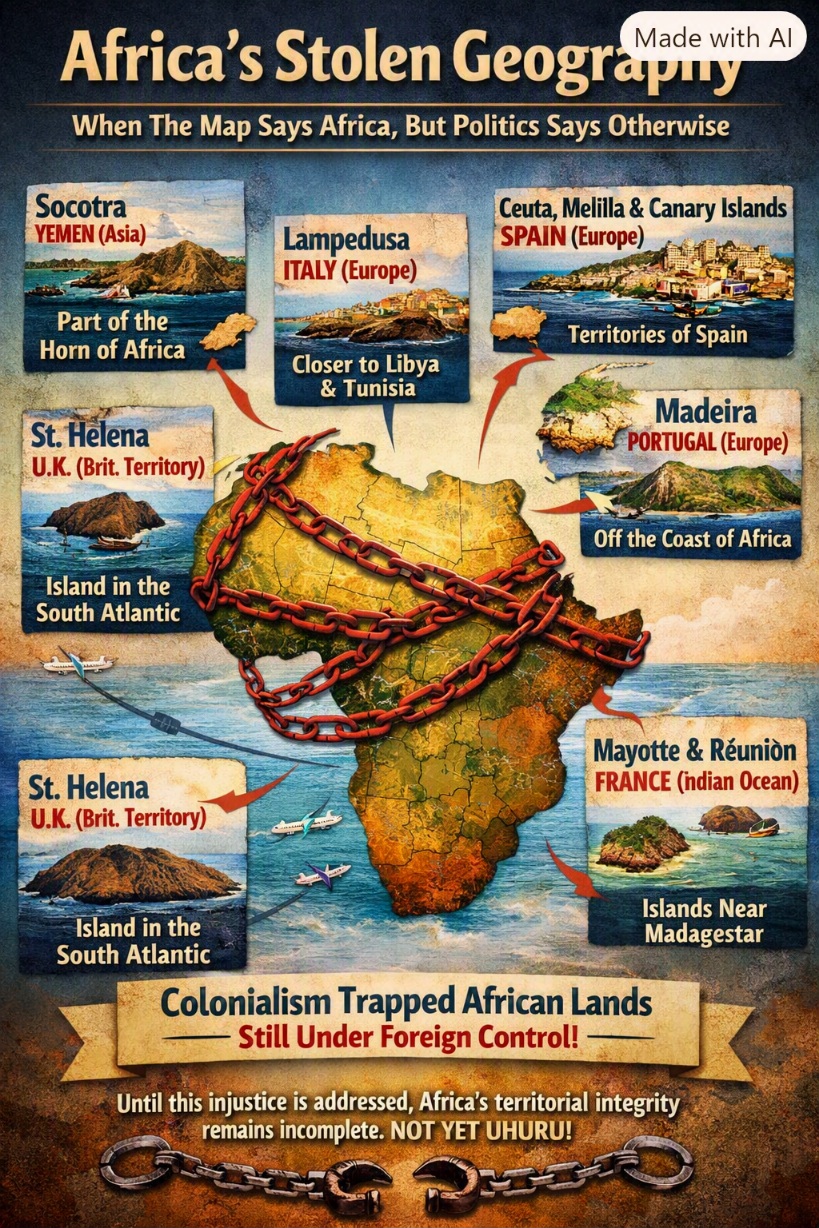
There are many parts of Africa that are geographically, geologically, evolutionarily and ecologically part of the continent, but which, because of geopolitical interests, manipulation, colonialism and twisted international law, are today classified as Asia and Europe.
The Socotra Archipelago is geographically and ecologically part of the Horn of Africa. It was indeed part of Africa until it severed from the continent millions of years ago. Although it lies on the continental shelf of Africa, Socotra is today part of the Republic of Yemen, which is in the Arabian Peninsula in Asia.
Lampedusa lies in the Mediterranean Sea between Libya and Tunisia and is much closer to both countries, yet today it is considered part of the Republic of Italy and a member of the European Union.
To get to St. Helena Island, it is easier to fly from South Africa and Angola than from anywhere else in the world. St. Helena is geographically part and parcel of Africa, but today it is an Overseas Territory of the United Kingdom. When Shaka Zulu, the great warrior of South Africa, was captured by British expeditionary forces in the 19th Century, he was taken and detained in St. Helena where he remained until his death.
Ceuta, Melilla and the Canary Islands are geographically part of Morocco in Africa, but today they are considered territories belonging to Spain. Ceuta was seized by Spain in 1497 from Morocco and has remained under Spanish control, although Morocco still lays claim to it.
Mayotte and Réunion are islands in the Indian Ocean off East Africa and Madagascar, but today they are considered French overseas territories.
Madeira Island belongs geographically to Africa but was seized by Portugal and has remained Portuguese territory and part of the European Union.
Conclusion:
These anomalies are not mere accidents of history; they are enduring products of colonialism that international law has refused to confront. As long as African lands continue to be administered from Europe and Asia, Africa’s territorial integrity remains incomplete. Until this injustice is addressed and resolved, it is not yet Uhuru for Africa.