

By Eneojo Herbert Idakwo
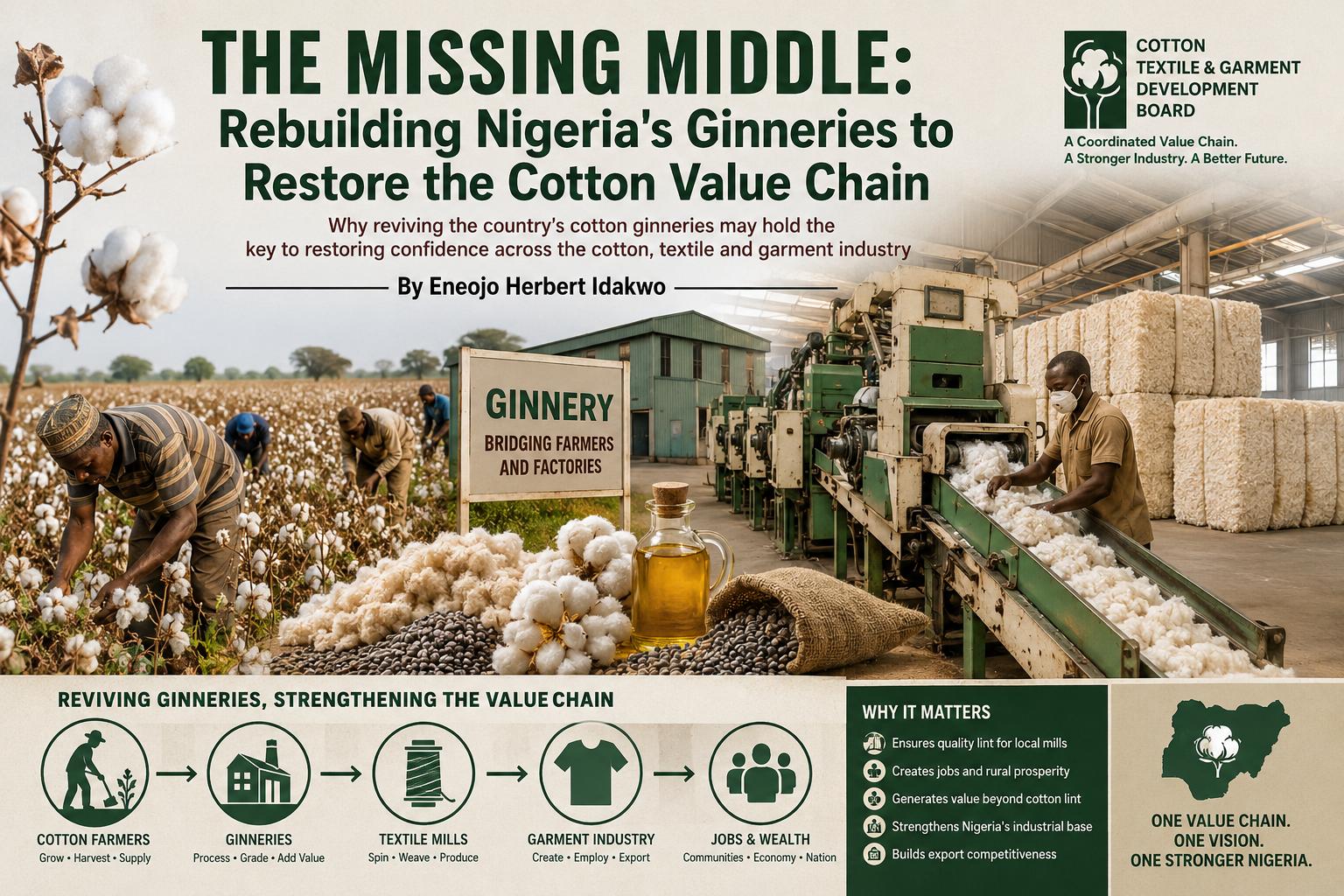
Why reviving the country’s cotton ginneries may hold the key to restoring confidence across the cotton, textile and garment industry
The efficiency of that process determines fibre quality, market value and the competitiveness of downstream manufacturers. Modern textile mills require consistent, contamination-free lint that meets internationally accepted standards. Poor ginning practices reduce fibre quality and weaken the competitiveness of domestic textiles in local and export markets.
For this reason, countries with successful cotton industries invest heavily in modern ginning technology, quality assurance systems and strong links between farmers and processors.
A sector in decline
Industry participants say Nigeria’s ginneries have struggled under multiple pressures over the past three decades.
The closure of many textile mills reduced demand for locally processed lint. As farmers shifted to alternative crops, raw cotton supplies also declined. Ageing equipment, unreliable electricity, high operating costs, insecurity in farming areas and limited access to affordable finance further weakened the industry.
Many ginnery operators now compete for limited quantities of seed cotton during each harvest season. Competition often drives up procurement costs while reducing profitability. Facilities designed to process tens of thousands of tonnes annually may operate for only a few weeks before running out of raw materials.
For investors, the uncertainty discourages expansion or technological upgrades.
The consequences extend beyond the ginnery gates. When processors cannot guarantee purchases, farmers reduce cotton cultivation. Lower production means even less raw material for processors, creating a cycle that affects every stage of the value chain.
More than processing plants
Ginneries generate value far beyond cotton lint.
Cottonseed has significant commercial importance. It can be processed into cooking oil, high-protein livestock feed, industrial chemicals and other products that support additional manufacturing activities. A vibrant ginning sector therefore creates multiple income streams and strengthens rural economies.
Employment opportunities also extend beyond permanent factory workers. Transport operators, warehouse operators, equipment suppliers, maintenance technicians and seasonal labour all benefit from active processing facilities.
Reviving ginneries would therefore contribute not only to industrial production but also to broader rural development.
Global lessons in value chain coordination
Countries that dominate global cotton markets treat ginneries as strategic industrial infrastructure.
India has modernised large parts of its ginning sector while strengthening quality standards to meet international market requirements. Pakistan has invested in improving fibre quality through better coordination between farmers, ginneries and textile manufacturers. Brazil has embraced advanced harvesting and ginning technologies to enhance efficiency and export competitiveness.
A common feature across these countries is institutional coordination. Ginneries do not operate in isolation. Their success depends on predictable supplies from farmers, quality assurance from research institutions, financing from development banks and reliable demand from textile manufacturers.
These relationships are supported by long-term policy frameworks rather than fragmented interventions.
Why operators are calling for coordinated reform
Many industry stakeholders believe the absence of a single coordinating institution has contributed to persistent inefficiencies within Nigeria’s cotton economy.
Agricultural agencies focus primarily on production. Industrial institutions concentrate on manufacturing. Financial interventions often target individual segments rather than the integrated value chain.
Ginnery operators argue that their industry’s recovery depends on stronger coordination among all these actors.
The Cotton, Textile and Garment Development Board, approved by the National Economic Council, is increasingly viewed within the sector as a mechanism that could provide this coordination. Rather than replacing existing institutions, supporters envisage the Board as a platform capable of aligning production targets, processing capacity, financing, quality standards, research, investment promotion and market development under a unified national strategy.
For ginnery operators, such coordination could improve raw material availability, encourage investment in modern equipment and strengthen confidence throughout the processing industry.
Rebuilding confidence
Reviving Nigeria’s ginneries will require more than concessional loans or occasional intervention programmes.
Operators point to the need for improved infrastructure, access to affordable finance, modern processing technology, skilled personnel, quality certification systems and stronger commercial relationships with farmers and textile manufacturers.
Equally important is policy stability. Industrial investments in ginning involve long planning horizons. Investors require confidence that government policies will remain consistent enough to justify substantial capital commitments.
This is where many stakeholders believe an institutional framework such as the NEC-approved Cotton, Textile and Garment Development Board could make a lasting difference by providing continuity, strategic planning and structured engagement across the value chain.
The forgotten link that cannot be ignored
Nigeria’s ambition to revive textile manufacturing cannot succeed if the processing link remains weak. Farmers need dependable buyers. Textile mills require reliable supplies of quality lint. Exporters need products that meet international standards.
Ginneries connect all three.
Ignoring this middle layer risks undermining every other intervention within the cotton economy.
The country’s cotton revival therefore depends not only on increasing production or reopening factories but also on restoring the industrial bridge that connects them. For many operators across the sector, the NEC-approved Cotton, Textile and Garment Development Board offers a practical framework for rebuilding that bridge through coordinated planning, stakeholder participation and sustained policy direction.
If Nigeria is serious about restoring its cotton economy, the revival of its ginneries cannot remain an afterthought. It must become a national priority, anchored in an institution capable of bringing every link in the value chain together under one coordinated vision.