By Ibrahim Bunu
Email: ibrahimbunu2520@gmail.com
The recent reflections by Citizen Bolaji O. Akinyemi, “Where Are the Four Lepers of the Middle Belt?”, and Dr. Polycarp Gbaja’s “The Middle Belt: Strategic & Urgent Convergence” deserve serious national attention. They are not merely opinion pieces; they are strategic warnings. They force us to confront uncomfortable questions about the future of the Middle Belt and, by extension, the future of Nigeria itself.
For decades, discussions about the Middle Belt have revolved around recurring violence, displacement, insecurity, political marginalisation, religious tension, economic neglect, and unresolved constitutional questions. Every tragedy produces a familiar cycle: condemnations, condolence visits, committee reports, promises, and then silence—until the next tragedy.
This cycle has become predictable.
The two authors argue that while advocacy remains important, advocacy alone is no longer sufficient. They call for strategic thinking, institutional capacity, and collective action. Their central message is simple: history is not changed by those who merely describe problems; it is changed by those who organise solutions.
Understanding the Middle Belt Question
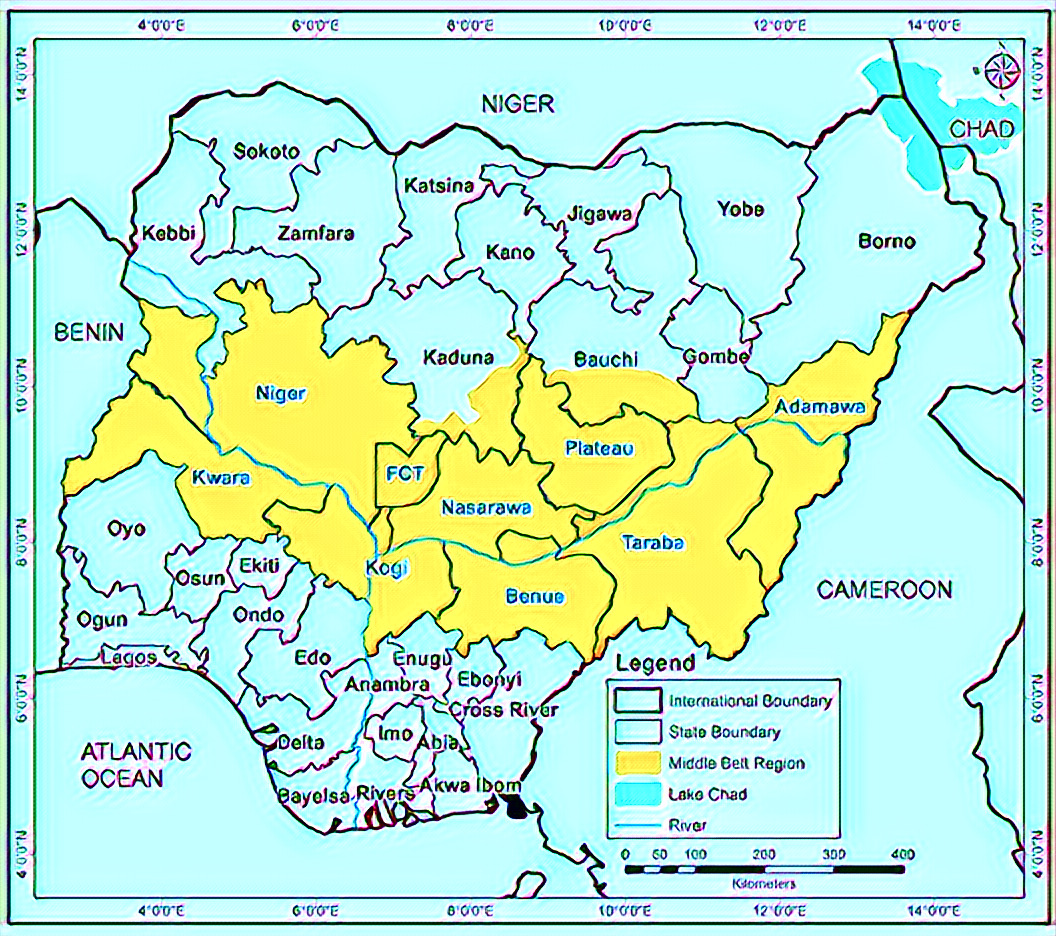
The Middle Belt is not merely a geographical expression. It represents one of Nigeria’s most culturally diverse regions, stretching across states such as Benue, Plateau, Nasarawa, Niger, Kogi, Kwara, Southern Kaduna, Taraba and parts of Adamawa, Bauchi, Kebbi and Gombe.
The region contains hundreds of ethnic nationalities, multiple languages, diverse religious traditions and enormous agricultural resources.
Ironically, despite being one of Nigeria’s richest regions in terms of human and natural resources, it has become one of the country’s most vulnerable regions.
Several structural challenges have converged:
* Persistent farmer-herder conflicts.
* Terrorism and banditry.
* Illegal occupation of communities.
* Rural displacement.
* Youth unemployment.
* Weak local economies.
* Declining agricultural productivity.
* Political fragmentation.
* Lack of coordinated regional strategy.
These problems have accumulated over decades.
They cannot be solved through emotional speeches alone.
The Four Lepers: A Powerful Strategic Metaphor
Bolaji Akinyemi’s use of the biblical account in 2 Kings 7 is particularly profound.
The miracle did not begin because heaven suddenly intervened.
It began because four ordinary men decided that remaining where they were guaranteed failure.
Movement created opportunity.
The lesson is timeless.
Communities trapped by fear eventually lose both hope and influence.
Communities that organise create options.
The “four lepers” therefore symbolise something larger:
* strategic leadership;
* courage under uncertainty;
* willingness to act despite limited resources;
* collective responsibility;
* innovation in difficult circumstances.
Every successful movement in history has had its “four lepers.”
The American Civil Rights Movement had them.
India’s independence struggle had them.
South Africa’s anti-apartheid movement had them.
Even Nigeria’s own struggle for independence depended upon organised citizens who moved beyond complaints into institution-building.
Why the Middle Belt Must Move Beyond Victimhood
One danger facing any oppressed community is allowing victimhood to become its permanent identity.
Victimhood attracts sympathy.
Strategy attracts transformation.
No society has ever developed simply because others pitied it.
Development follows organisation.
The Middle Belt possesses extraordinary assets:
* retired military officers;
* experienced civil servants;
* respected academics;
* accomplished entrepreneurs;
* traditional institutions;
* churches and faith-based organisations;
* energetic youth population;
* fertile agricultural land;
* abundant mineral resources.
The real question is not whether resources exist.
The question is why these assets have rarely been coordinated into a long-term regional development agenda.
Political Fragmentation Remains a Major Weakness
Perhaps the greatest challenge confronting the Middle Belt is internal fragmentation.
Ethnicity.
Religion.
Political parties.
Local rivalries.
Personal ambitions.
These divisions have repeatedly prevented collective bargaining.
Meanwhile, other regions often negotiate national interests through coordinated political platforms.
Unity does not require uniformity.
Different ethnic groups can maintain their identities while pursuing common regional interests.
That is how successful federations operate across the world.
Security Must Become Community-Centred
Dr. Polycarp Gbaja correctly argues that the region must reorganise itself strategically.
This does not imply taking the law into private hands.
Rather, communities should strengthen lawful security partnerships by:
* improving intelligence sharing;
* supporting community policing initiatives;
* investing in early warning systems;
* enhancing emergency response capacity;
* collaborating with security agencies;
* strengthening local resilience.
Security begins with information.
Most successful counter-insurgency operations worldwide depend upon trusted community intelligence.
Agriculture Is the Region’s Greatest Untapped Weapon
The Middle Belt feeds Nigeria.
Yet many farming communities remain among the poorest.
Large areas of fertile farmland remain abandoned because of insecurity.
Food insecurity has national consequences.
Reviving agriculture would produce multiple benefits:
* employment;
* food security;
* exports;
* industrial growth;
* reduced youth crime;
* improved regional stability.
Agriculture should therefore become not merely an economic policy but a strategic security policy.
The Constitutional Conversation Cannot Be Ignored
Many of today’s tensions originate from unresolved constitutional questions.
These include:
* federalism;
* state policing;
* resource control;
* fiscal federalism;
* local government autonomy;
* land administration;
* equal citizenship.
These debates affect every Nigerian—not only the Middle Belt.
Constructive constitutional advocacy, conducted peacefully and democratically, remains essential for long-term national stability.
Why Time Is Running Out
History occasionally presents societies with narrow windows for reform.
Ignoring those moments often carries severe consequences.
Several trends suggest urgency:
* rapid demographic changes;
* expanding insecurity;
* increasing youth unemployment;
* climate-induced migration;
* growing competition over land and water resources;
* widening distrust between citizens and institutions;
* economic pressures affecting rural communities.
If these structural issues remain unresolved, future conflicts may become more difficult to contain.
The cost of inaction always exceeds the cost of preparation.
Lessons from Other Regions
Successful regions rarely wait for perfect political conditions.
They invest in people.
They build institutions.
They educate future leaders.
They support local businesses.
They create think tanks.
They establish research centres.
They document history.
They preserve culture.
They develop regional economic plans.
The Middle Belt possesses enough intellectual capital to do the same.
What has often been missing is sustained coordination.
What Should Be Done Now?
A realistic roadmap could include:
1. Convening a non-partisan Middle Belt Strategic Summit bringing together traditional rulers, clergy, youth, women, business leaders, academics, security experts and elected officials.
2. Establishing a permanent regional policy and research institute to generate evidence-based solutions.
3. Creating an economic development blueprint focused on agriculture, mining, tourism and manufacturing.
4. Investing heavily in leadership development for young professionals.
5. Strengthening civic education so citizens understand both their constitutional rights and responsibilities.
6. Building lawful partnerships with federal and state security agencies to improve community safety.
7. Promoting regional unity across ethnic and religious lines while respecting diversity.
8. Forming strategic alliances with individuals and groups across Nigeria who support justice, constitutionalism, accountability and peaceful coexistence.
A Word of Caution
The pursuit of justice must never become an excuse for violence.
History shows that violence often destroys the very communities it claims to defend.
The path forward must remain anchored in the rule of law, constitutional engagement, democratic participation and peaceful organisation.
Sustainable progress is built through institutions, not vengeance.
Conclusion: A Defining Generation
Every generation is remembered for the choices it makes when confronted with crisis.
The present generation of Middle Belt leaders faces a defining responsibility.
Future generations will not ask how many conferences were organised.
They will ask whether today’s leaders built institutions.
They will ask whether communities were made safer.
They will ask whether agriculture was revived.
They will ask whether young people found opportunities.
They will ask whether unity triumphed over division.
They will ask whether courage replaced complacency.
Bolaji Akinyemi’s “four lepers” and Dr. Polycarp Gbaja’s call for a “strategic convergence” ultimately point to the same truth:
The future belongs to organised people.
The Middle Belt possesses the intellect, faith, courage and resources required for renewal.
What remains is the collective will to act.
History rarely waits.
Neither should the Middle Belt.
The choice before the region is not merely political—it is generational.
The time for lamentation has passed.
The time for strategic organisation, principled leadership and peaceful transformation is now.
If not now, when?