By Okoi Obono-Obla
Northern–South Eastern Alliances in Nigerian Politics: A Historical Reappraisal:
I read with amusement the call for synergy between Northern and South Eastern Nigeria for “national stability” by the Vice Presidential candidate of the Nigerian Democratic Congress (NDC), Dr. Rabiu Musa Kwankwaso, in the forthcoming general elections, as published in This Day Newspaper on 15 July 2026.
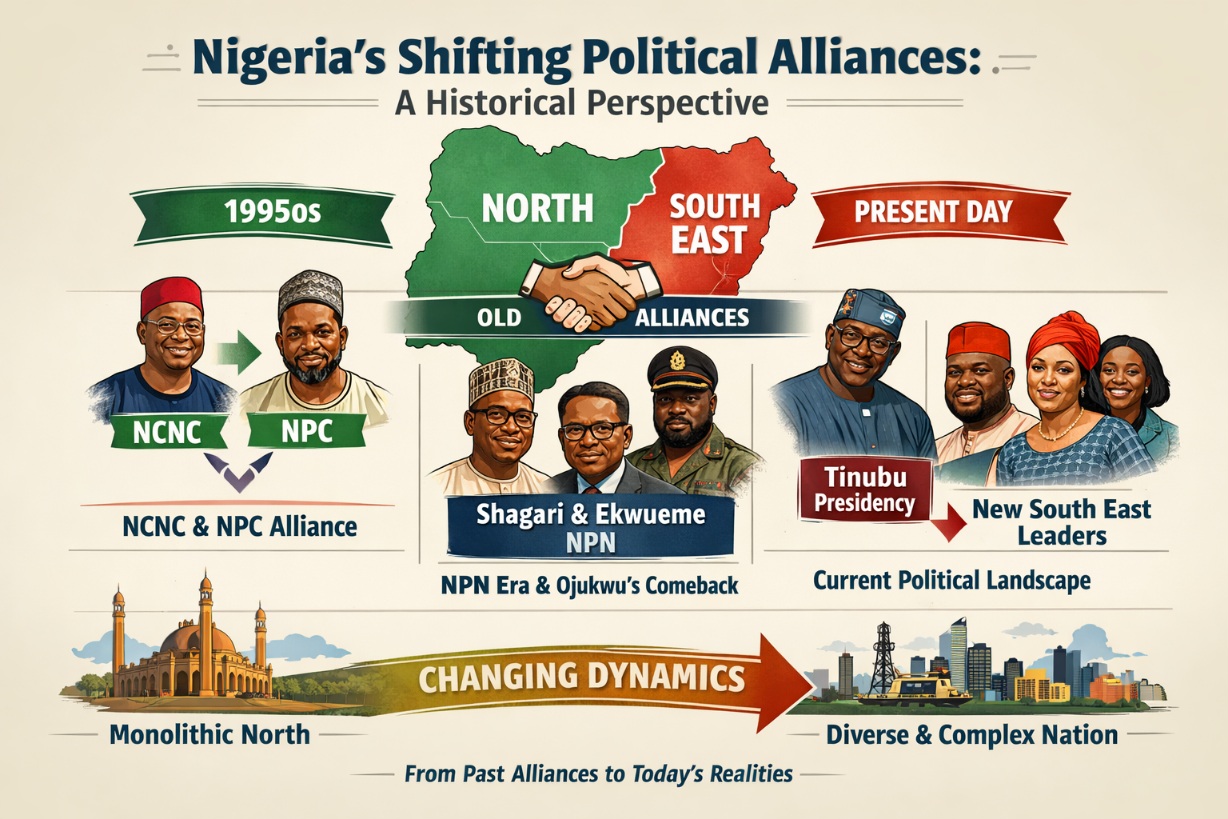
Dr. Kwankwaso recounted the history of cooperation between Northern Nigeria and South Eastern Nigeria, beginning from the late 1950s when the National Convention of Nigerian Citizens (NCNC), led by Dr. Nnamdi Azikiwe, and the Northern People’s Congress (NPC) allied to form a government after the 1959 general election, since no party commanded a clear majority in parliament.
He also cited the 1979 example when Dr. Alex Ekwueme was chosen by Alhaji Shehu Shagari as his vice-presidential running mate under the platform of the defunct National Party of Nigeria (NPN). Finally, he recalled that the late Ikemba Chukwuemeka Odumegwu Ojukwu, leader of the secessionist Republic of Biafra, was invited by Northern leaders to return from exile in Côte d’Ivoire to contest a senatorial seat in 1983.
However, there is a tinge of revisionism in Dr. Kwankwaso’s narration. The late Ikemba was indeed persuaded to return from exile, but to suggest that the Shagari government was a purely Northern government is inaccurate. The NPN was not a Northern party; it was a truly national platform with a strong presence across the country. President Shehu Shagari was from Northern Nigeria, but the party leadership and membership were diverse.
For instance, the National Chairman of the NPN was Chief Augustus Meredith Adisa Akinloye (1916–2007) from Ibadan in the old Oyo State (South West). Another influential member was Dr. Joseph Wayas (1941–2021) from the old Cross River State (South South), who served as Senate President from 1979 to 1983. Senator Joseph Sarwuan Tarka (1932–1980) from the old Benue State was also a key figure. Clearly, the NPN was not a Northern party, and the Shagari government was not a Northern government.
In fact, in the 1979 presidential elections, Shagari did not win in Anambra and Imo States (both in the South East), even though his running mate, Dr. Ekwueme, hailed from Anambra. It was only in the controversial 1983 elections that the NPN secured victories in those states.
Today, Mrs. Bianca Ojukwu, wife of the late Ikemba, serves as the Foreign Minister of Nigeria, representing the South East.
The NCNC itself was a party with national spread, particularly strong in the old Western and Eastern Regions, as well as the Southern Cameroons (then part of Eastern Nigeria until 1955). Therefore, using the 1959 alliance as a basis to canvass for a present-day coalition between the South East and Northern Nigeria is wishful thinking.
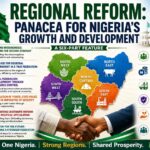
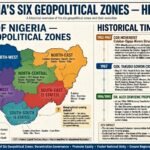
The monolithic Northern Nigeria of the 1950s and the Eastern Region no longer exist in their old forms. Northern Nigeria is now divided into 19 states plus the Federal Capital Territory, while the Eastern Region has been split into the South East and South South geopolitical zones, alongside the Mid-Western Region (now Edo and Delta States). Political alliances shift constantly, and the dynamics of the 1950s, 1960s, and 1970s differ fundamentally from today.
Presently, much of the old Eastern and Mid-Western Regions have coalesced around the presidency of President Bola Ahmed Tinubu. Thus, the proposed alliance between Northern Nigeria (as it once was) and the present South East appears impractical. Many of today’s leaders in the South East were either toddlers or not yet born during the era of Dr. Azikiwe, and too young to have experienced the turbulence of the 1960s.
Dr. Kwankwaso’s appeal to historical alliances between the North and South East reflects nostalgia rather than political reality. Nigeria’s political landscape has evolved, and alliances must be understood in the context of contemporary dynamics, not the anachronisms of the past.