

By Okoi Obono-Obla
Cultural Revivalism:
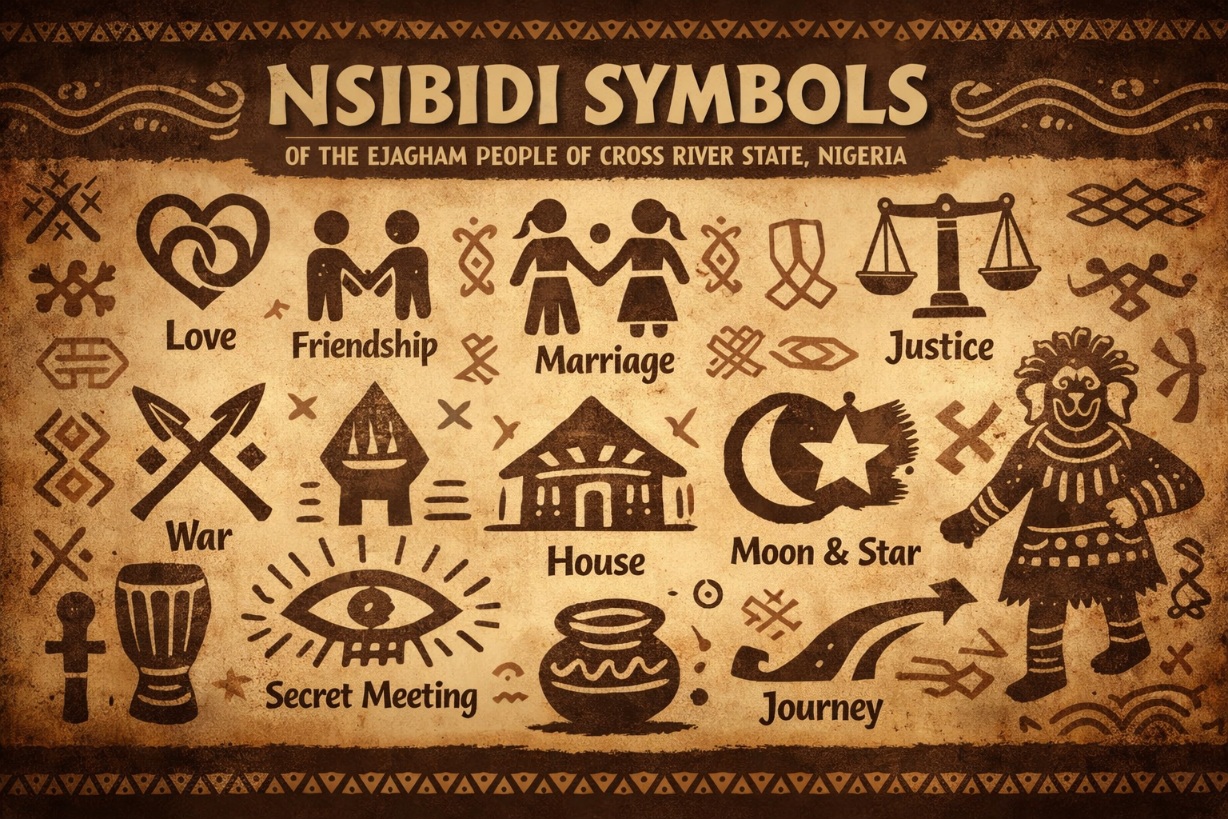
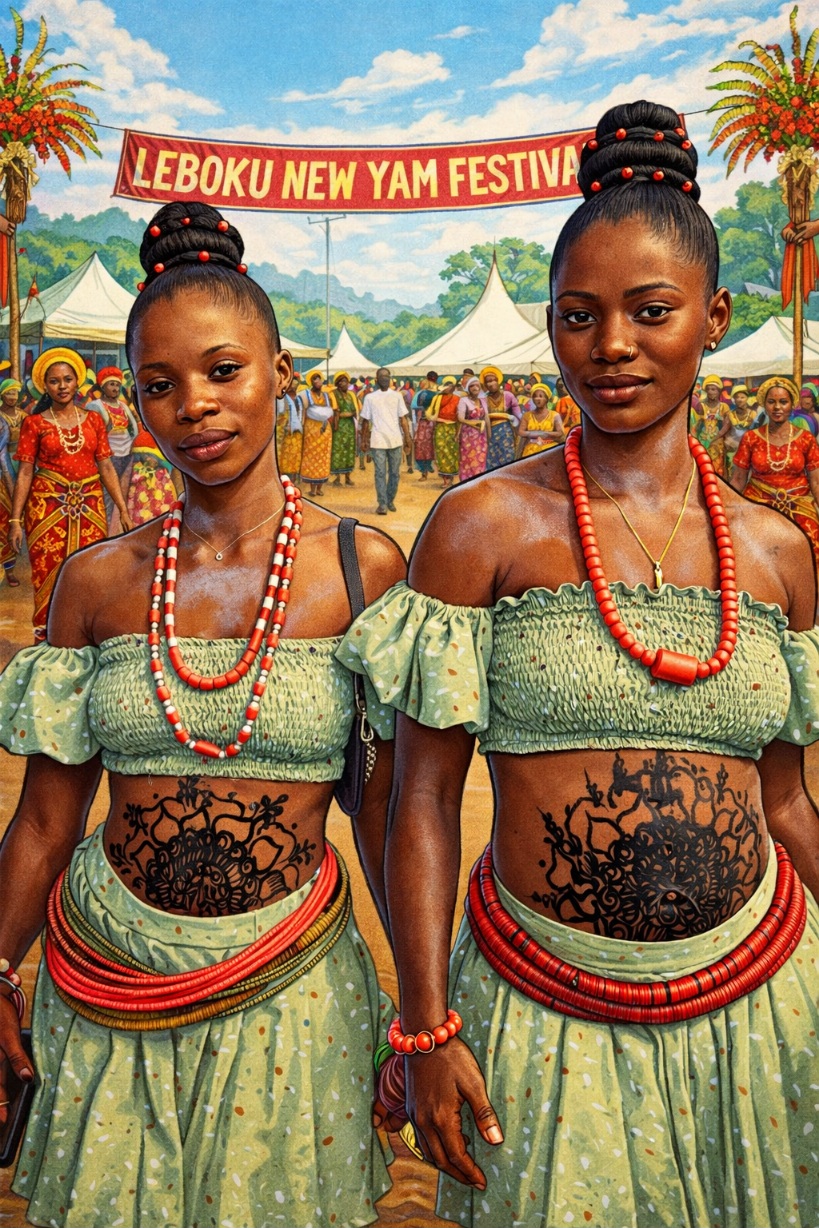
During the Ugep New Yam Festival known as Leboku in Yakurr Local Government Area of Cross River State, the bodies of maidens are beautifully adorned with intricate drawings that resemble tattoos. Many people are unaware that these markings represent an ancient writing system—Nsibidi—used by our ancestors for millennia before the advent of colonialism and Western education. What appears as decorative art on the maidens during Leboku is, in fact, Nsibidi writing.
It is therefore inaccurate to ascribe Nsibidi to any single ethnic group within the Cross River region or Cameroon. Nsibidi is an ancient African Bantu script, believed by some scholars to have originated from ancient Egypt. In Ugep, Nsibidi is employed by members of the Mkpe (Ekpe) society and used to beautify maidens during the Leboku (New Yam) Festival.
This writing system is a testament to the interconnectedness of cultures across the region—Ekoi/Ejagham, Efik, Ibibio, Oron, Annang, Arochukwu, Afikpo, Abriba—extending into Southwestern Cameroon, Gabon, DR Congo, and Equatorial Guinea. For instance, the name Obono, common among the Yakurr, is also widely used in Gabon. Likewise, names such as Ettah, Eyong, Eno, Bisong, Efa, Leko, Ete, and Ndem are shared among communities in Cameroon, DR Congo, and Gabon.
Through the Trans-Atlantic slave trade, Nsibidi traveled to Cuba, Venezuela, and Haiti, where it evolved into the Anaforuana and Veve symbols. Long before European adventurism and colonization reached West Africa, our people had already developed this sophisticated ideographic writing system.
Colonial historian and missionary Reverend J.K. Macgregor, in his work Some Notes on Nsibidi, observed:
“The use of Nsibidi is that of ordinary writing. I have in my possession a copy of the record of a court case from a town of Enion [Enyong] in Odukpani Local Government Area taken down in it, and every detail … is most graphically described.”
It is widely believed that Nsibidi has been in use in this region of Africa since as early as 400 CE, with archaeological evidence dating back to 2000 B.C. It was used to decorate skin, calabashes, sculptures, and clothing, and to communicate messages on houses. More importantly, Nsibidi served as a signal language among adherents of the Mkpe (Ekpe) society.
In Ugep, the Nsibidi writing known as Eblemi, uniquely practiced by women, is gradually fading. Yet, in Mkpani, women continue to preserve this tradition. Urgent action is needed to safeguard this cultural heritage before it disappears entirely.
Why the Obol Lopon of Ugep Must Ban Henna Tattoos in 2026:
I was startled, alarmed, and bewildered when I discovered that some maidens during the 2023, 2024, and 2025 Ugep Leboku New Yam Festivals painted their hands and bodies with the Hausa tattoo popularly known as Henna, instead of the Nsibidi (Eblemi) symbols which our glorious ancestors bequeathed to us.
When I confronted one of the maidens, she resignedly and nonchalantly explained that she had to use Henna because she could not find any woman alive in Ugep who could paint Nsibidi or Eblemi.
This is outrageous, unacceptable, and indeed sacrilegious. How can we simply close our eyes or look the other way while our culture and heritage are being bastardized?
Nsibidi (Eblemi) is one of the greatest legacies our illustrious ancestors handed down to us, and we are allowing it to slip into extinction. This is a challenge to our people in the fields of arts, humanities, social sciences, and even the sciences.
Something must be done—urgently and drastically—to revive Nsibidi (Eblemi). Otherwise, we risk losing it completely within the next twenty years.
As a temporary measure, the Obol Lopon of Ugep must issue a decree banning the use of Hausa Henna tattoos by maidens during the 2026 Ugep Leboku New Yam Festival, likely to come up in August 2026. It is deeply saddening that even in recent years, some maidens continue to use Henna instead of Nsibidi (Eblemi).
A Call for Cultural Preservation:
There is a pressing need to sponsor academic research on the cultures of the Ekoi-Ejagham people, particularly on the development of Nsibidi and other cultural materials. As one who aspires to serve as a senator, I am committed to supporting such initiatives to ensure that our heritage is documented, studied, and celebrated.
It is well said that a people without knowledge of their history, traditions, culture, and origin are like a tree without roots.
Conclusion:
The preservation and study of Nsibidi is not merely a cultural duty—it is a historical necessity. Nsibidi stands as a living testament to the creativity, interconnectedness, and resilience of African peoples across the continent and the diaspora. By investing in its research and revival, and by protecting it from dilution through foreign practices such as Henna tattoos, we ensure that future generations remain rooted in their heritage while contributing to global knowledge.