

By Okoi Obono-Obla
APC’s Dominance in Ekiti: A Litmus Test for 2027:
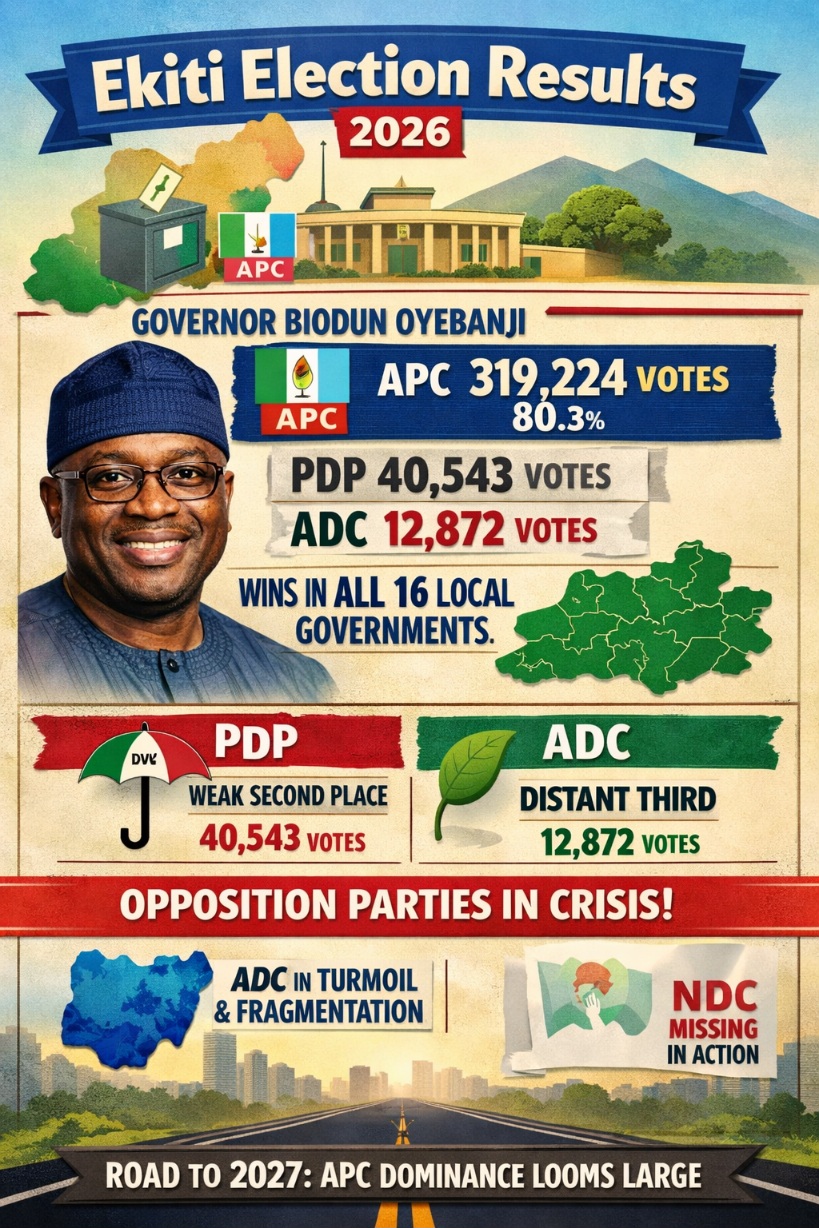
Ekiti State Governor, Biodun Oyebanji, has been declared by the Independent National Electoral Commission (INEC) as the winner of the Ekiti State Governorship election held on 20 June 2026. He won overwhelmingly in all 16 local government areas of the State.
The Ekiti State Returning Officer, Professor Adenike Oladiji, announced that Governor Oyebanji of the APC polled a total of 319,224 votes, representing over 80 percent of the total votes cast in the off‑cycle election. Professor Oladiji stated that Oyebanji, having satisfied the requirements of the law by scoring the highest number of votes, “is hereby declared the winner and returned elected.”

Dr. Wole Oluyede of the Peoples Democratic Party (PDP) came a distant second with 40,543 votes, while Oluwadare Bejide of the Africa Democratic Congress (ADC) trailed in third place with 12,872 votes. Governor Oyebanji overwhelmed both Oluyede and Bejide even in their respective strongholds of Ikere and Ekiti Southwest Local Government Areas.
The PDP’s performance was weak, while the ADC’s showing was even more dismal. The result of the Ekiti State governorship election serves as a litmus test for the presidential election scheduled for seven months from now. It clearly indicates that the ADC, currently mired in fragmentation and legal challenges including deregistration, is no match for the strength and dominance of the APC.
The struggling National Democratic Congress (NDC) was conspicuously absent, underscoring its lack of promise as a party capable of making an impact in the 2027 general elections. To win the presidential election, a candidate must secure geographical spread in at least 24 States of the Federation. From every indication, the ADC—if it eventually participates—may not be able to muster 25 percent of the total votes cast in the South West geopolitical zone, especially in States like Ekiti where APC dominance is total.
Similarly, the ADC may struggle in the South South geopolitical zone, particularly if the three factional presidential candidates, including Atiku Abubakar, fail to resolve their differences. Many in the South South subscribe to rotational presidency, which they believe should favor Southern Nigeria.
The NDC, still a fledgling party lacking structures across the country, may perform fairly well in the South East geopolitical zone. However, no electoral miracle or magic wand will enable ill‑prepared parties like the NDC to ruffle political feathers or achieve significant breakthroughs.
Conclusion:
The Ekiti governorship election underscores APC’s entrenched dominance and highlights the challenges facing opposition parties like the PDP, ADC, and NDC. Unless these parties resolve internal crises and build stronger national structures, the road to 2027 will remain steep and uncertain.