By John Ayodele
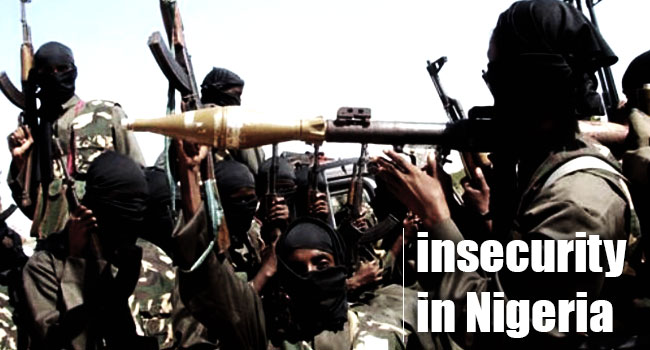
Many Nigerians, both at home and abroad, are increasingly concerned about the worsening security situation across the country. From communal conflicts to terrorism and banditry to kidnapping and communal conflicts, insecurity has become one of the defining challenges of today’s Nigeria. No government since 1999 has been without this challenge. Obasanjo was blamed for igniting the banditry when a leader of some particular Muslim fanatics was killed by the military in the North. Aside from that, his “I-know-it-all” non-action when states in the North established the Sharia Laws under his watch should be underlined as instrumental. He only mouthed his opposition but, for political reasons, chose to ignore it. Meanwhile, many said the establishment was done by state governments in the North to pacify hardened fanatics of religion who put the governors under pressure.
Until 1999, when Governor Sani Yerima of Zamfara expanded the scope of Islamic Sharia to include both criminal and civil matters in his state, the Sharia applied only to civil matters. Obasanjo has been said to pander to the whims and caprices of the North when in power, but with his almost desperate need to get a second term in 2001, he chose to ignore the ‘fire on the roof’. 11 other state governors in the North joined Yerima to establish Sharia law over their states, and the fanatics seemed to be on the ascendancy.
To keen observers of the developments, this was the impetus given to all manner of Islamic fundamentalists to start their forays into the country. The enthronement of Sharia law over the North East and North West gave positive signals to international Islamic hardliners from the Middle East to start having ideas about Nigeria. Who else to blame? The Federal Government of Obasanjo, which paid lip service to the clear tenets of the Nigerian Constitution on the country’s secularity, as against what Sani Yerima started, was quickly adopted by 11 other states in Northern Nigeria. The then president, Obasanjo, thought that the brouhaha following the establishment of Sharia law would fade away instead of asking the judiciary to interpret the constitution as related to state versus federal authority.

It is an eyesore that Obasanjo’s carelessness in tackling the Sharia law establishment in 12 states of the North should be underlined as the gateway to skirmishes in the North, starting from Zamfara, and later in Kano, and even extending to Shagamu in the Southwest. The mistake of not foreseeing serious problems coming with the establishment of the Sharia law eventually opened the gates for Boko Haram to sneak into the North. It is instructive to know that Obasanjo was the first president under the new Republic to say that insecurity was sponsored by some agents to scuttle his government. Who remembers that Obasanjo called the sponsors ‘agents of darkness ‘ and that he was not perturbed? He actually said “I dey kampe”. There were religious riots in Kaduna, Kano, Zamfara, and also in Shagamu involving Muslim fanatics against others, but Obasanjo saw these as attempts to bring his government down. Boko Haram was actually founded under the watch of Obasanjo, and every objective historian should note this.
It is always ironic that the former president gets a free pass, whereas his lackadaisical handling of the Sharia law establishment birthed Boko Haram and led to the advent of ISIS in Nigeria. Obasanjo has his good sides, but he many times played god, and he did so with his handling of the Sharia law and the gathering of zealots which followed his “it will fade away’ instead of dealing critically with the situation. If he had marshalled the federal force to control the beginning, Nigeria might have been saved the bloody brouhaha being faced now. When the Christians in the North were suffering from those who wanted Sharia to apply to all in the North, particularly in Plateau, Kaduna, and Kano, there were violent crises, and the Christians called out for help to the Federal Government of Obasanjo. That was when Obasanjo lambasted the Christian Association of Nigeria; in fact, he publicly called one of the Northern CAN leaders, a Pastor, an idiot!
Boko Haram came into existence in 2002 while Chief Olusegun Obasanjo was at the helm of affairs in the country. It was started by a Borno man named Mohammed Yussuf, according to Nigerian Newspapers. He opened his Islamic School to all kinds of downtrodden youths and others in the North. Before long, the graduates had become hardened, and the school expanded into Yobe State, and continued to spread its ideals across the North, into Plateau from Zamfara. This marked the start of various violent clashes between these tough graduates or believers and non-Muslims during this period. One would wonder what the intelligence agencies were doing and what information was passed to the president during this time.
Surprisingly, the former president has not been reminded of his inactions, which brought the country to the current dangerous cul-de-sac. The various news makers or the morning and evening news orchestra should know that insecurity was created from this time, and not in 2023 or in 2015 or 2011. Even if Obasanjo tarried then because of his need for a second term in office, he should have dealt firmly and forcefully with the growing menace between 2004 and 2006. What he failed to apply was the military force, and most West African neighbors have not wasted any time applying this against this menace in their territories.
Obasanjo said that insecurity was created to bring down his government. Who would benefit then if Obasanjo had fallen? Nigerians should ask: Who could be behind the insurgencies of that time, even though Obasanjo could not be absolved from his failure to nip it in the bud from the outset. It should be recalled that Obasanjo had a running battle with his number 2, Abubakar Atiku, before getting his second term.
Jonathan, who took over from Obasanjo, battled with the same insurgency that had grown bigger and which had become more empowered. Prisons were invaded by the hirelings from Boko Haram under the guidance of ISIS, and many schools were closed down as a result of incessant kidnapping of students by the mad dogs created in 2002. The whole world started paying attention when the Chibok girls were kidnapped, and a bombing by the religious warlords shook Abuja. Just like Obasanjo, the undertone was that the insecurity of the time was to get Jonathan out of office. Today, various commentators have agreed that the macabre insecurity helped in no small way to get Jonathan out of office.
As the 2027 elections approach, a growing number of citizens are asking difficult questions: Why does insecurity persist despite repeated government promises? Who benefits from the crisis? And what role does politics play in sustaining the problem?
Over the years, allegations have emerged that some politicians and influential individuals maintain relationships with armed groups for electoral or economic advantage. While not every claim has been proven, studies of political violence in Nigeria have identified elite manipulation, weak institutions, and the use of non-state actors as recurring factors in many conflicts. Should note be taken of the vituperations of a former secretary of state, Bachir Lawal, who openly called a presidential candidate ‘Kachalla,’ which we have been tutored to understand as ‘warlord’ in Fulani?. The former secretary added a stinger that the particular presidential candidate, Abubakar Atiku, had never criticized the killing activities of the notorious bandits, kidnappers, and terrorists, generally believed to be Fulani in Nigeria. During the time of the late President Buhari, it was alleged that the intelligence agents clearly identified the brains behind the activities of Fulani marauders who killed and maimed many people all over Nigeria. The government of Buhari failed to acquaint the country with the names of these people. Recently, the United States identified Sokoto as a haven for terrorists, and the place was a recipient of some American bombs to take out some of the bad guys. Nigerians continue to hope that the government will not only give names of those troubling the country but also take them out.
There is a widespread public perception among some Nigerians that certain political actors, criminal networks, or powerful interests benefit from insecurity and may indirectly or directly sponsor violence. However, broad claims that “the government” or a specific political party sponsors insecurity are generally difficult to prove and often remain allegations unless supported by credible evidence and court findings. At the same time, researchers and analysts have documented how political actors have sometimes used armed groups, militias, and thugs for political purposes, contributing to violence and instability.
Security experts have also pointed to broader, long-term causes of instability, including poverty, unemployment, weak governance, porous borders, corruption, and inadequate state presence in many communities. These conditions create an environment where criminal and extremist groups can recruit members and operate with relative ease. Many have come to concur that the country needs a state Police to have more boots on the ground to provide a round-the-clock watch in the states. This is not something that can be created with a fiat because it entails amending the constitution, and going through the National Assembly and the states, and finally getting the president’s assent. Before this, can the state governors improvise and provide some security for their states with the humongous security funds that they pocket from the federal treasury?
For many Nigerians, the 2027 elections have a lot to do with the increase in the tempo of banditry, kidnapping, and crimes being perpetrated all over the country. It will be a test of leadership, but the deep political division in the country has not been objective, but many times based on ethnic persuasions, and so very subjective. Nigerians surely need to demand concrete answers from candidates on how they intend to tackle terrorism, banditry, kidnapping, and other forms of violence. Beyond campaign promises, citizens will want evidence that political leaders are committed to strengthening institutions, improving intelligence gathering, improving the technical skills of anti-terrorism officers, securing borders, and holding sponsors of violence accountable regardless of their political status. The Nigerian voters need to check out the ‘seeds’ to predict what they will grow. Those candidates who have supported violent characters in the name of politics in recent years are well known, and these should be rejected at the polls. It is idiotic that some Nigerians rely just on promises without any evidence of past performance to support some candidates. You cannot build something out of nothing, thus says an Italian wise saying.
The challenge for the present government is that Nigerians need a clear, very visible action to defeat the criminal groups of murderers sucking the blood of Nigerians all over the country. The government also needs to educate all Nigerians as to what is going on and to explain its positions. Nigerians should remember that insecurity did not start in 2023, nor in 2015 or in 2011; it will not be fair to assume that it started recently. The journalists in the country should do their job of pointing out that the problem started in 2002 under the watch of Obasanjo. The present government owes all Nigerians a debt of not only defeating criminal groups but also restoring public trust. As long as citizens believe that powerful individuals benefit from insecurity, confidence in government institutions will remain weak. Ultimately, Nigerians are less interested in political rhetoric than in results.