By Okoi Obono-Obla
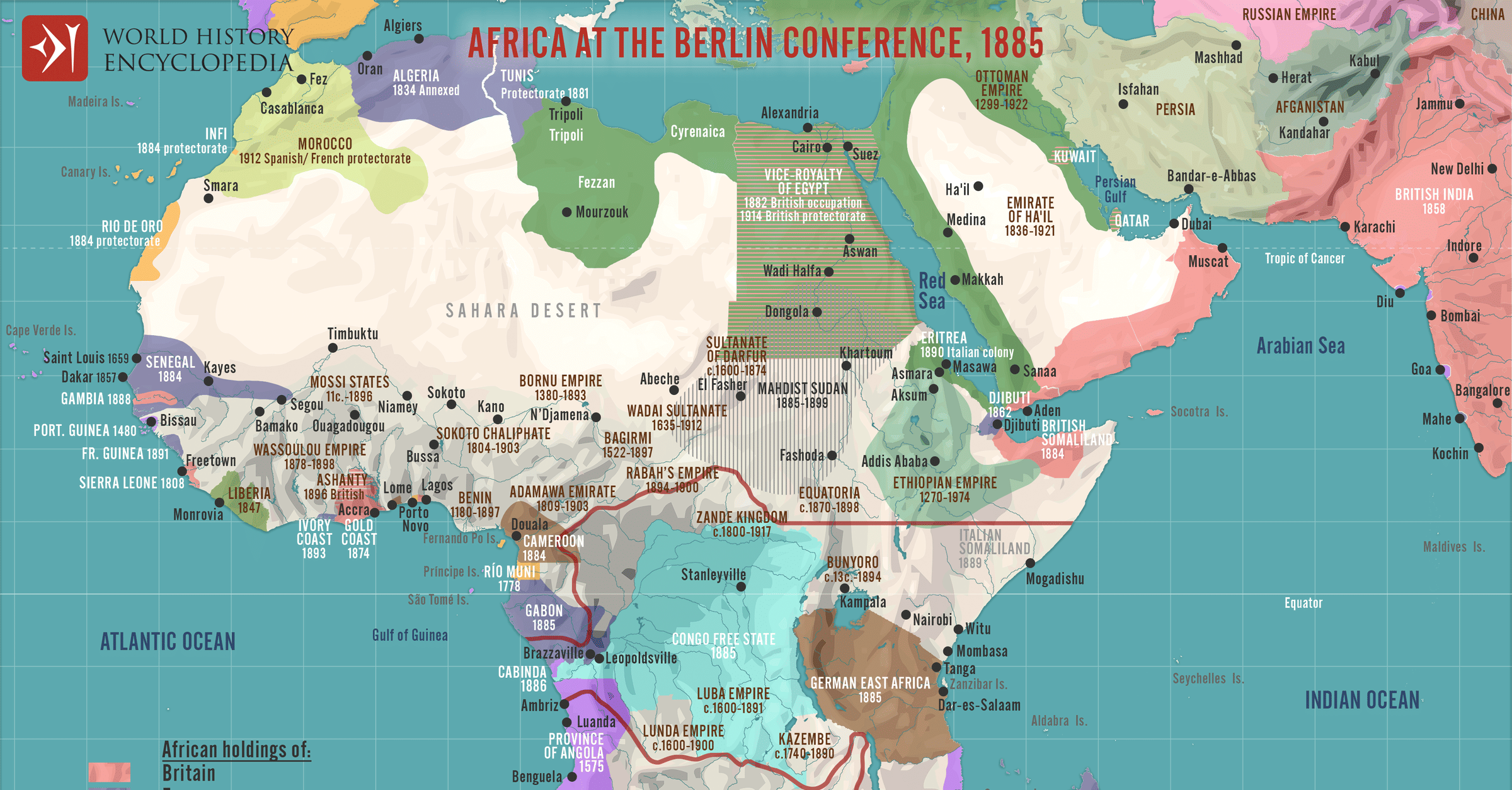
The European administrators, missionaries, and ethnographers who came to Africa paved the way for the convening of the Berlin Conference in 1884, where Africa was partitioned and shared among European powers. Their primary aim was to secure unfettered access to extract resources from African soil and transport them to metropolitan Europe. To achieve this, they devised fraudulent schemes under the guise of “civilizing” Africa. One such scheme was the attempt to draw an imaginary line between North Africa and what they termed Sub‑Saharan Africa, thereby dichotomizing these regions on superficial and imaginary racial lines—a notion that, in reality, is a farce.
Historically and archaeologically, such divisions did not exist before colonialism. Africa was not divided into countries with clear boundaries; rather, it was a borderless entity until the creation of the 54 countries following the Berlin Conference. Long before colonial intrusion, ancient trade routes linked West Africa to North Africa, including the Maghreb, through which Africans mingled, traded, and carried out diplomatic relations and exchanges. Africans also traveled to Arabia to fulfill their religious obligations through pilgrimage.
Indeed, most of the ethnic nationalities in West and Central Africa trace their genealogy to ancient Egypt and Nubia, both located in North Africa. This provides further evidence against the European scholars’ claim of a division between North Africa and Sub‑Saharan Africa. The Amazigh people, also known as the Berbers, are an ancient indigenous ethnic group found in both North and West Africa. Attempts to use racism to draw a wedge between the Amazigh and West Africa are fallacious, for the Amazigh are a reflection of Africa’s diverse phenotypes—diversity that European scholars and ethnographers often tried to mask.

Conclusion:
The notion of dividing Africa into North and Sub‑Saharan regions is a colonial construct, born out of European schemes to justify exploitation. Africa’s history, trade routes, genealogical connections, and cultural exchanges demonstrate that the continent was always interconnected, with its peoples sharing deep ties across regions. The colonial dichotomy is thus a fabrication, masking Africa’s unity and diversity.