

In my earlier works, especially Boko Haram: Peace Culture and the Quest for a United Nigeria (2012), I argued that insecurity in Nigeria is rooted not only in radical ideologies or the proliferation of arms, but in the deeper collapse of our civic imagination. When a nation fails to cultivate peace culture, it will pay for insecurity, whether in blood, in fear, or, as we now see vividly, in ransom.
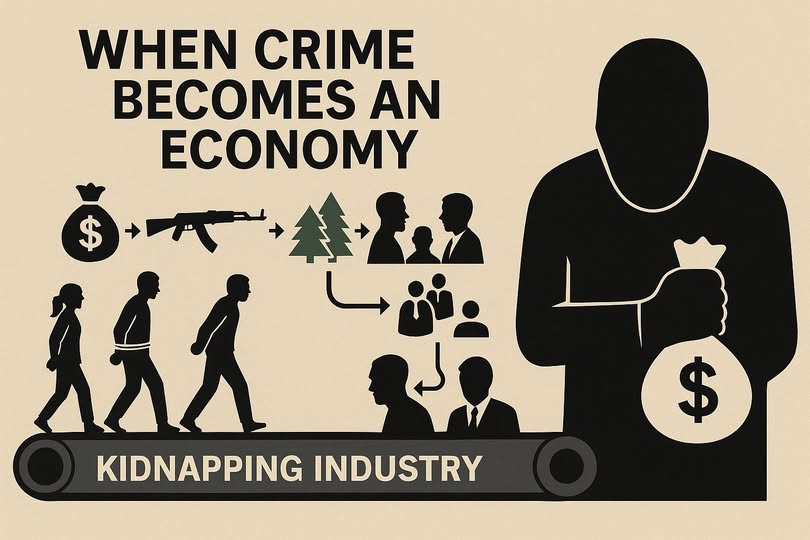
Today, a decade later, Nigeria confronts an even more troubling phase of insecurity: kidnapping as a full-fledged industry. What was once sporadic has become a structured, syndicated enterprise with financiers, informants, transborder collaborators, logistics networks, and, in some cases, political protection. Kidnapping is no longer random; it is organized, predictable in its unpredictability, and frighteningly profitable.
Worse still, kidnapping has become the most democratic of our national tragedies. It respects no region, class, religion, or ethnicity. From Kaduna highways to Lagos suburbs, Zamfara forests to Delta creeks, schoolchildren in the North to traditional rulers in the South, the geography of abduction now stretches across the entire Nigerian landscape.
Yet we remain trapped in a familiar mistake: the We vs They reasoning. Each abduction becomes an opportunity to blame a particular ethnic or religious group. Each attack becomes a sectional argument. But kidnappers do not operate with ethnic logic. They are driven by an economy of opportunity, one that is expanding because we remain too divided to respond meaningfully. Thus, our tragedy is double. First is the violence itself that is now so real and unrelenting. Second is our failure to see the crisis as a shared national affliction. The kidnapping industry today thrives precisely because Nigeria has become a patchwork of mutual suspicions. A fragmented polity cannot defeat a unified criminal enterprise.
Beyond the identity debates lies an even more troubling reality: the borders the state imagines are not the borders criminals encounter. Our security architecture still thinks in rigid territorial lines, but kidnappers move fluidly through forests, abandoned mining routes, ungoverned spaces, porous boundaries, waterways, and informal networks. In mobility, intelligence flow, and tactical improvisation, criminals are steps ahead of the state. This mismatch fuels the expansion of the kidnapping economy. When security is slow, criminals innovate. When institutions weaken, violent entrepreneurs emerge. When citizens lose trust in the state, criminal networks gain ground. The psychological cost is immense. Everyday life is now governed by caution. Travel begins with fear, not anticipation. Families pray and fast before and while journeying. Communities survive in whispers. Schooling, commerce, agriculture and social interaction contract under the weight of pervasive insecurity. Precarity has become the new normal.
But beyond the physical danger, there is a deeper threat: the shrinking of our civic imagination. Nigeria is losing the idea of collective belonging. Our capacity to think as one people beyond ethnicity, religion, and political alignment is weakening. Criminals understand what we too often forget: a fractured society is easy to prey upon.
To dismantle the kidnapping industry, force alone is not enough. Nigeria must restore peace culture, the deliberate nurturing of civic trust, institutional credibility and shared purpose. We must dismantle the We vs They narratives that fragment our moral universe. We must strengthen both territorial and civic borders: those that protect lives and those that bind us together.
Several urgent shifts are required: one, is to decentralize and modernize security. Abuja cannot police Nigeria effectively from the center. States and communities need structured empowerment within a national framework. Two, is to rebuild the social contract. Citizens will support security agencies only when they believe government is serious, transparent, and competent. Thirdly is the urgent need to invest in peace culture. Nations that refuse to build peace eventually fund violence. And finally, we must de-ethnicise our public discourses. Kidnapping is a national problem with no ethnic headquarters. Treating it otherwise weakens us further.
From a scholarly standpoint, Nigeria’s kidnapping industry reflects classical patterns of state fragility: when institutions lose legitimacy, non-state actors expand; when borders lose meaning, criminal entrepreneurs redraw authority; when trust collapses, cohesion disappears. Yet Nigeria is not beyond redemption. Nations have recovered from worse. What we need is clarity, courage, coherence, and a renewed commitment to rebuilding the civic imagination that once held us together.
Nigeria must wake up, together, before this wind blows more than we can bear.
Mo wi t’ẹmi o.
@yemiademowo@gmail.com

















Leave a comment