

IMF 2026 Growth Forecasts: Nigeria Is Back in the Global Conversation , But Growth Without Structure Means Nothing
By Chioma Amaryllis Ahaghotu
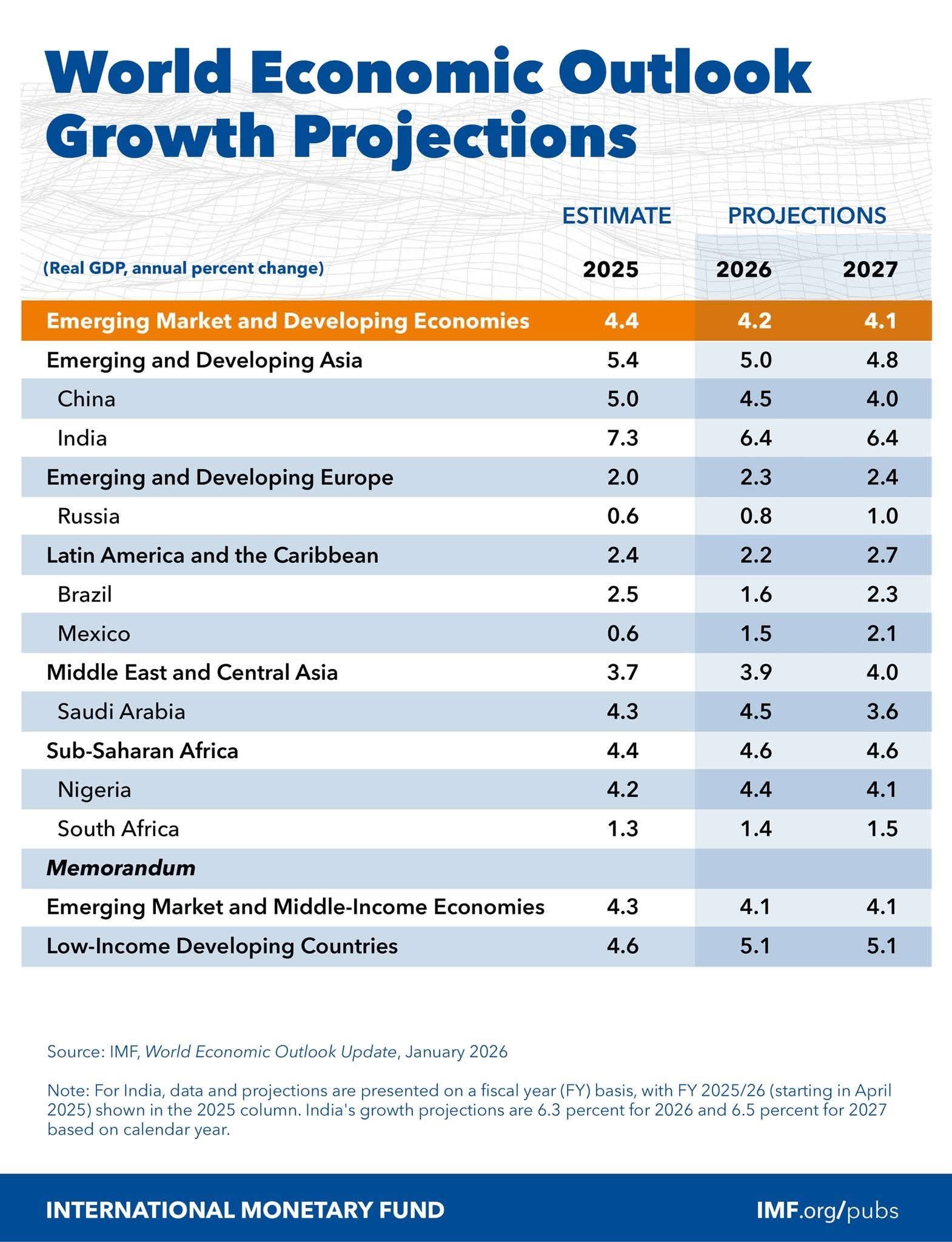
The IMF’s updated 2026 growth forecasts place Nigeria at approximately 4.4% real GDP growth.
That puts Nigeria above the global average and firmly among the faster-growing emerging economies.
On paper, this is good news. After years of stagnation, currency shocks, inflation spirals, and policy confusion, Nigeria is once again being priced into global recovery expectations.
But growth figures are not victory songs. They are invitations. And whether Nigeria accepts that invitation depends entirely on what happens next.
To understand where Nigeria sits, here is the global growth outlook for 2026 among major economies:
Projected Real GDP Growth 2026
• India — ~6.4%
• Indonesia — ~4.8%
• China — ~4.5%
• Saudi Arabia — ~4.5%
• Nigeria — ~4.4%
• United States — ~2.4%
• United Kingdom — ~1.6%
• Canada — ~1.5%
• France — ~1.1%
• Germany — ~1.0%
This means Nigeria is projected to grow faster than every major Western economy, and is sitting in the same growth bracket as China and Gulf oil states. That is not trivial. That is strategic territory.
But growth without structure does not translate to prosperity.
Nigeria has experienced growth cycles before. We have posted strong GDP numbers in the past. Yet inequality widened, infrastructure lagged, productivity stayed low, and institutions remained fragile.
Growth came , but it did not compound. It evaporated.
So what does this 2026 forecast actually mean for Nigeria?
First, the worst of macroeconomic distortion is beginning to correct. Exchange rate reforms, fiscal tightening, and subsidy removal have created short-term pain, but they are restoring economic credibility. Investors respond to predictability more than sentiment, and Nigeria is slowly returning to the realm of the predictable.
Second, Nigeria’s consumer market remains powerful. A population of over 200 million, rising urbanization, digital finance adoption, and youth-driven enterprise continue to generate internal momentum. Even in dysfunction, Nigerians build. That resilience is now being priced into forecasts.
Third, the global economy is repositioning. Supply chains are diversifying. Energy markets are recalibrating. Frontier markets with scale are becoming relevant again. Nigeria naturally sits in that category.
However , and this is the part most people will ignore , growth without structure does not equal development.
If Nigeria uses this growth window to:
• Fix power generation and distribution
• Strengthen manufacturing capacity
• Build logistics corridors
• Digitize government services
• Formalize informal enterprise
• Expand tax efficiency
• Invest in education and technical training
then this 4.4% becomes a foundation.
But if Nigeria treats growth as applause and hype rather than opportunity , if we return to policy reversals, rent-seeking, populist spending, and institutional neglect , then this forecast becomes another wasted cycle.
A forecast is not a destination.
It is a probability based on present behavior.
Countries do not become wealthy by growing once.
They become wealthy by building systems that keep growth compounding across generations.
Nigeria has re-entered the global conversation.
The question is whether we finally graduate from potential to performance.
Because the world is no longer impressed by potential.
Only execution remains.














Leave a comment