By Chioma Amaryllis Ahaghotu
I know some of you are hard of hearing, but perhaps you are also hard of seeing. Because at this point, I honestly don’t know what else you need to see before you understand that Nigerian presidential elections are a numbers game, not a popularity contest.
Instead of building political structures, you have spent the last three years convincing yourselves that Peter Obi was rigged out of a victory that Atiku Abubakar came second in, and he 3rd. Okay, let’s even entertain that argument. Which states did Obi win in the Core North that would make you arrive at the conclusion that he was the rightful winner of that election and was rigged our? Which states gave him the geographical spread required to win a presidential election? Till today, not one of you can answer that question without changing the subject to Lagos, Abuja, the international community or the supposed popularity of Obi.
Obi went to court. The election was challenged. The legal process required evidence, not online enthusiasm, not the number of people who attended rallies, not the volume of people who were convinced he was going to win. You had to demonstrate how the results were manipulated, establish the actual votes and prove that the constitutional requirements for winning had been met. You cannot substitute conviction for evidence, or substitute the number of people who love your candidate for the number of states in which he has the required electoral spread.
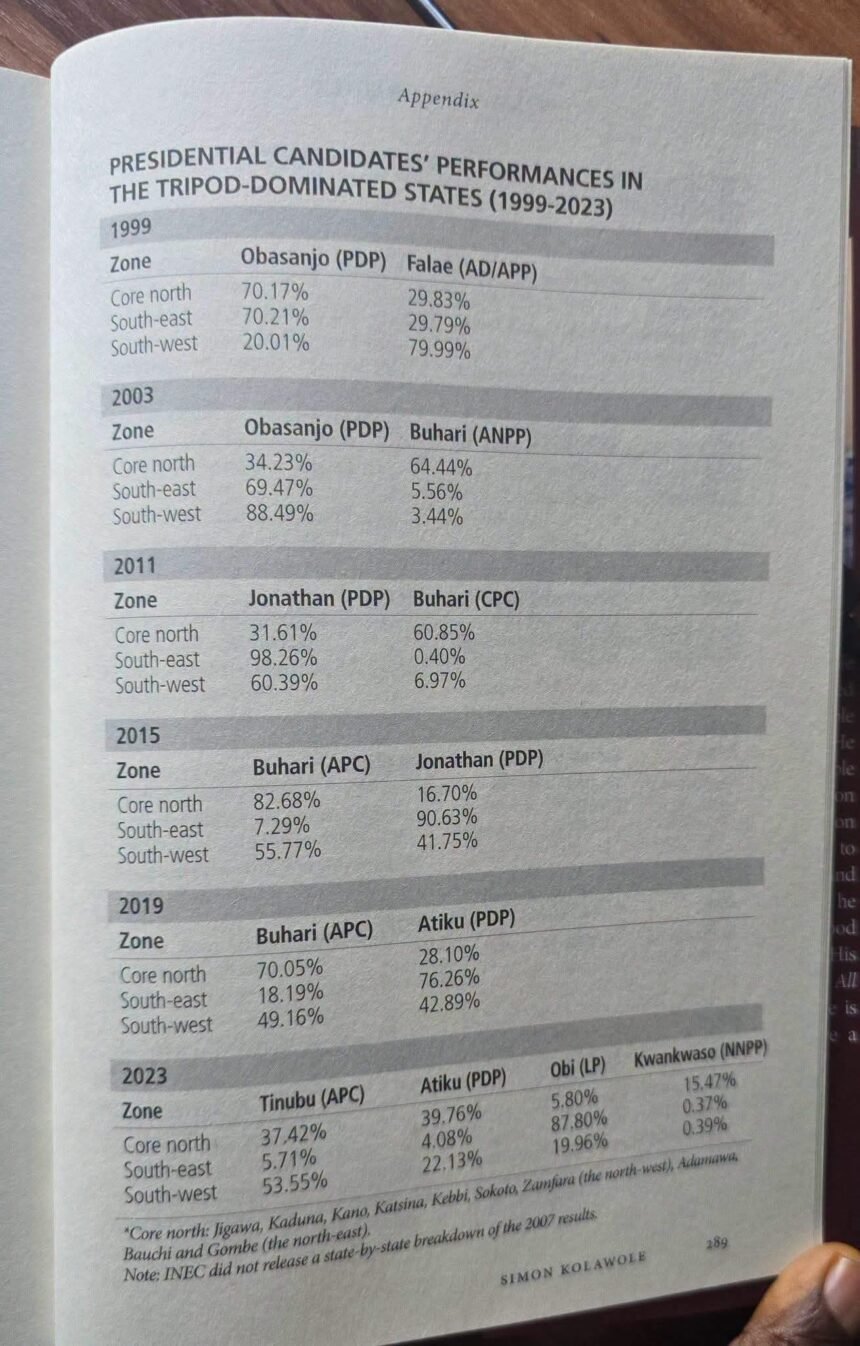
Look at the figures in this table. I will put my professional analyst hat on for this one.
In 1999, Obasanjo secured 70.21% in the South-East and 70.17% in the Core North. In 2003, he secured 69.47% in the South-East and 88.49% in the South-West. In 2011, Jonathan secured 98.26% in the South-East, but Buhari secured 60.85% in the Core North. In 2015, Buhari secured 82.68% in the Core North while Jonathan secured 90.63% in the South-East. In 2019, Buhari had 70.05% in the Core North, while Atiku had 76.26% in the South-East.
Now look at 2023. Tinubu secured 37.42% in the Core North, Atiku secured 39.76%, Kwankwaso secured 15.47%, while Obi managed 5.80%. In the South-East, Obi secured 87.80%, while Tinubu had 5.71% and Atiku 4.08%. In the South-West, Tinubu secured 53.55%, Atiku 22.13% and Obi 19.96%.
Do you see the pattern? Do you understand what these figures are telling you? Presidential elections in Nigeria have historically been driven by regional political structures, established party machinery, alliances and the ability to secure votes beyond one’s natural strongholds. The numbers are not a mystery. They are right there in front of you.
The problem with the Labour Party in 2023 was not that Obi lacked supporters or had a movement named after him. It was that the party lacked the national political machinery to translate that enthusiasm into votes across the country. You had an extraordinary concentration of support in the South-East, some impressive performances in the South-South and parts of the North-Central, but that was not enough to establish the kind of nationwide electoral spread required to win the presidency.
And instead of confronting that weakness, many of you chose to turn it into a moral argument. Anybody who questioned your electoral mathematics was a hater. Anybody who pointed out the absence of political structures was working against Igbo people. Anybody who suggested that Obi needed to build a formidable party or take over the structure of an existing one was accused of being threatened by his popularity.
Three years later, what has changed?
Instead of consolidating the Labour Party, nurturing the people who contested elections under its platform, strengthening its elected representatives, building local government structures and turning the 2023 movement into a permanent political institution, Obi abandoned the platform and moved towards another coalition arrangement. A coalition he was number 2 in! The people who won elections under Labour riding his coat tails, did he systematically consolidate their political influence into a formidable national structure to push internal, systemic opposition from WITHIN the system so can build on the electoral capital of 2023? Where is the institutional machinery that should have been growing since that election?
Now it is NDC, another political vehicle, with an even bigger question about its national reach, particularly in the Core North.
Kwankwaso may or may not deliver Kano. That is a separate calculation. But even if he does, Kano is not the entire Core North. And with Atiku potentially on the ballot, there is an established northern political constituency that cannot simply be wished away. You cannot assume that Kwankwaso’s political influence automatically translates into votes across Jigawa, Kaduna, Katsina, Kebbi, Sokoto, Zamfara, Bauchi, Gombe and the other northern states.
And before the usual fact-challenged crowd comes here shouting that Obi won Lagos and Abuja, please understand that winning a cosmopolitan state or the FCT is not the same thing as establishing the constitutionally required geographical spread. Section 134 of the Constitution is not a multiple-choice question. A presidential candidate must secure the highest number of votes and at least one-quarter of the votes cast in each of at least two-thirds of all the states of the Federation and the FCT. That is an electoral requirement, not an opinion poll. For those who hate math 24/36 with at least 25% spread.
You have approximately 60 days to the election, and instead of addressing the enormous structural disadvantage of running against an incumbent with an established nationwide political network, an APC controlling 33 states according to the figures you are working with, and an NDC that still has to demonstrate its organisational depth at the grassroots, Obi is in the diaspora selling you another round of emotional possibilities.
What exactly are you expecting the diaspora to do? Besides donations, remittances, social media amplification and massaging one another’s egos about how much better you understand Nigeria from abroad, what is the actual electoral strategy?
Some of you have lived abroad for decades. You have not been able to influence the political structure in your own villages. You cannot even speak your native languages to your children, yet somehow you have convinced yourselves that you possess the magic formula for fixing Nigeria’s electoral politics. You have mistaken geographical distance for political enlightenment and nostalgia for an actual understanding of the political realities on the ground.
There is a difference between having ideas about how a country should work and understanding how to win power in that country. Politics is power acquisition, you have to first acquire the power to go do whatever magic you imagined.
A coach doesn’t design a play during half time on what the players practiced, he designs it based on the match in front of him. Your opponents playbook doesn’t change because you refuse to revise yours!
There is a difference between being popular and having the machinery to convert popularity into electoral victories. There is a difference between having millions of supporters online and having ward executives, polling unit agents, local government coordinators, state-level alliances and a national coalition that can actually deliver votes.
And this is where the tragedy of the Obidient movement lies. You had an opportunity to turn a remarkable political awakening into a permanent political institution. Instead, you spent years defending the mythology of 2023 and daydreaming rather than learning from its limitations.
Obi is not even giving you a convincing reason to believe that the structural problem has been solved. Changing party platforms does not automatically create political structures. Announcing coalitions does not automatically create electoral alliances. Having supporters in every major city does not mean you control the political machinery in those states.
And I suspect that many of you have already prepared your excuse for 2027. If Obi loses, you will simply say the election was not free and fair. If he does not meet the constitutional spread, you will say the results were manipulated. If the numbers do not favour him, you will tell yourselves that the real winner has been denied his mandate. You have already created an ideological escape route that allows you to avoid confronting the actual electoral weaknesses of his campaign.
But you cannot keep running away from arithmetic.
You cannot keep expecting the same electoral geography to produce a different outcome simply because you have spent three years shouting louder on social media.
A presidential election is not won by how badly you want your candidate to win. It is won by how effectively you organise, negotiate, build alliances, secure votes and establish political relevance across the country, beyond his strong holds.
The numbers were there in 1999. They were there in 2003, 2011, 2015 and 2019. They were there in 2023. They have not suddenly disappeared because you discovered Peter Obi.
At some point, you must stop asking Nigerians to validate your preferred outcome and start asking your candidate why he has not built the machinery to achieve it, considering he is your last and only hope.
Because Nigeria does not owe anybody a presidency. And the Constitution does not award one for enthusiasm.
Class dismissed.
By Chioma Amaryllis Ahaghotu