


By Okoi Obono-Obla
INTRODUCTION
In the first essay, titled THIS ESSAY OR ARTICLE DEALS WITH THE CENTRAL EVIDENTIAL FAILURE IN THE DEFENCE OF SENATOR DAVID MARK IN SUIT NO. FHC/ABJ/CS/1819/2025, it was stated that if Mark produces the documents concerning his membership and qualifications, he may succeed to debunk the allegations of Nafiu Bala Gombe against him.
That statement must now be corrected and confined to its proper place. It was a statement of what Mark had to do at trial. It was not a statement of what he can do on appeal.

This second part deals only with the appeal. It deals with two questions, and with nothing else.
First, if Mark seeks on appeal to tender the Ward register, the receipt, the proof of resignation from his former party, or the proof of election, how will the Court of Appeal deal with him.
Second, if those documents are not before the Court of Appeal, how will the Court of Appeal treat the evidence evaluated by Justice Peter Odo Lifu, and the findings of fact he made on that evidence.
1. THE COURT OF APPEAL IS NOT A TRIAL COURT
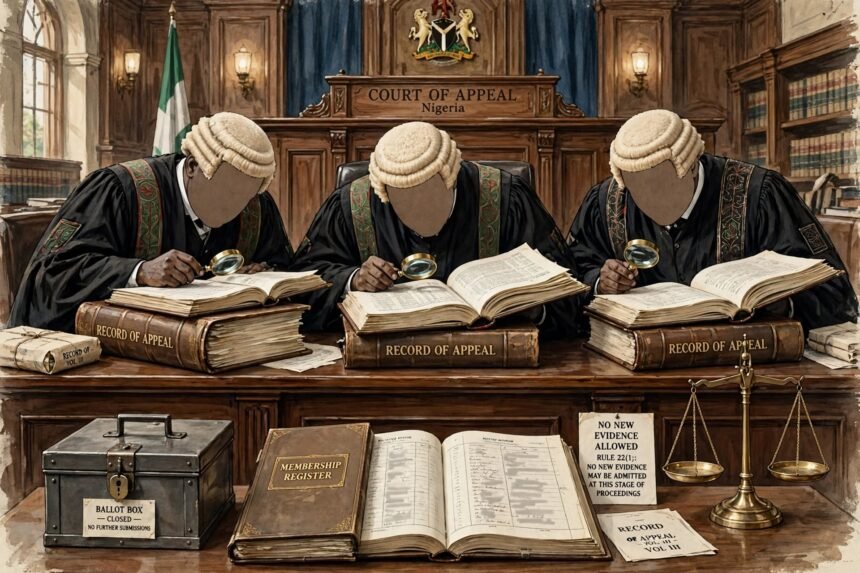
The Court of Appeal does not hear the case afresh. It does not call witnesses. It does not receive documents in the way a trial court receives documents. It does not evaluate evidence for the first time.
Its function is review. It looks at the record of the trial court. It looks at the pleadings, the evidence adduced by both parties, the evidence admitted by the trial judge, and the judgment pronounced on that evidence. It then asks whether the judgment is correct in law, and whether the findings of fact are supported by the evidence.
That is why a party is not allowed to bite at the cherry twice. Mark had his trial. He was put on notice of Bala’s allegation. He knew what he had to prove. He had the opportunity to tender the documents. He did not tender them. He cannot ask the Court of Appeal to give him a second trial, with a second opportunity to tender what he failed to tender the first time.
2. MARK CANNOT TENDER THE DOCUMENTS ON APPEAL AS OF RIGHT
If Mark attempts on appeal to tender the Ward register entry, the membership card, the receipt for registration fee and dues, the proof of resignation from the Peoples Democratic Party, or the record of a democratic election, the Court of Appeal will not receive those documents as of right.
An appeal is argued on the record. A document that was not tendered at trial is not part of the record. A document that is not part of the record cannot be used to attack a judgment that was based on the record.
Mark would have to apply for leave to adduce fresh evidence. That application is exceptional. It is not granted because a party now realises that his case at trial was weak. It is not granted because a party now has a document he could have produced before.
To succeed, Mark would have to satisfy the court on three conditions, taken together.
First, that the evidence could not, with reasonable diligence, have been obtained for use at the trial.
Second, that the evidence, if given, would probably have an important influence on the result of the case, though it need not be decisive.
Third, that the evidence is apparently credible, though it need not be incontrovertible.
Mark cannot satisfy the first condition. The Ward in which he claims membership, the register kept at that Ward Secretariat, the receipt for his own payment, the letter of his own resignation from his former party, and the record of the election in which he claims to have been elected, were all matters within his own knowledge and custody at the time of trial. If those documents existed, he could have produced them with reasonable diligence at trial. He did not. The Court of Appeal will treat that failure as his own, not as an accident of discovery.
The Court of Appeal will therefore refuse to receive the documents. It will decide the appeal on the record as it stands.
3. IF THE DOCUMENTS ARE NOT BEFORE THE COURT OF APPEAL, THE COURT WILL TEST THE FINDINGS AGAINST THE EVIDENCE
Where the documents are not before the Court of Appeal, the Court will not ask whether Mark can now prove his case. It will ask whether Justice Lifu was right on the evidence that was before him.
The test is consistency. The Court of Appeal will examine whether the findings of fact made by Justice Lifu align with, and are consistent with, the evidence adduced and admitted by him.
If the findings align with the evidence, the Court of Appeal will normally be wary and cautious about interfering with them. It will not interfere merely because it might have found differently. It will not interfere merely because another view of the evidence is possible.
If the findings do not align with the evidence, the Court of Appeal will interfere. It will adjudge the findings perverse, or not based on the evidence adduced before the trial court, and it will set them aside.
A finding is perverse where it is not supported by any evidence, where it is based on evidence that was not before the court, where it is based on speculation, conjecture, or extraneous matters, where no reasonable tribunal could have reached it on the evidence, or where it is internally inconsistent.
The burden of showing perversity lies on the appellant. Mark must point to the specific finding, point to the specific evidence, and show that the finding cannot stand on that evidence. It is not enough for him to say that the judge was wrong. He must show that the judge had no evidence on which to find as he did.
4. HOW THAT TEST APPLIES TO THE THREE FINDINGS IN THIS CASE
The test must be applied separately to each of the three central findings. Mark cannot succeed in general. He must succeed on each finding he seeks to displace.
First, the finding on the signature of Nafiu Bala Gombe and on his alleged resignation.
Justice Lifu compared the signature on Exhibit ADC-1 with the signatures on the witness statements on oath deposed to by Bala. He found that they are materially different and cannot reasonably be regarded as one and the same signature. On that basis, he rejected Exhibit ADC-1 as reliable proof of resignation.
On appeal, Mark cannot tender a new specimen of Bala’s signature, or a new expert report, to show that the judge was wrong. The Court of Appeal will look only at the specimens that were before the trial judge. It will ask whether, on those specimens, a reasonable trial judge who saw the originals could have found that the signatures are materially different.
This finding is particularly difficult to displace. It is based on the direct visual comparison made by the trial judge who had the original documents before him. The Court of Appeal did not see the originals in the same way. It will be wary of substituting its own view of a signature for the view of the judge who examined it. Unless Mark can show that the judge relied on a document that was not tendered, or that he applied a wrong principle of law, or that no reasonable judge could have found material difference on those specimens, the Court of Appeal will not interfere.
Second, the finding on the failure of Mark to prove his membership at Ward level and his status as a financial member.
Justice Lifu found that Mark did not tender a Ward register, a membership card, a receipt, or evidence of resignation from his former party. He found that Mark proved a meeting, but did not prove membership.
On appeal, Mark cannot cure that finding by tendering the register or the receipt for the first time. The Court of Appeal will look at the record and ask a simple question: was there, on the record before the trial judge, any evidence of Ward membership and financial status. If the answer is no, then the finding that Mark did not prove membership is not perverse. It is the only finding the evidence could support.
Mark’s argument that the NEC meeting and INEC monitoring proved his membership will be tested against the same record. The Court of Appeal will ask whether proof of a meeting is proof of membership, whether proof of notice is proof of registration, and whether proof of monitoring is proof of payment of dues. If those questions are answered in the negative, as Justice Lifu answered them, the Court of Appeal will not disturb the finding.
Third, the finding on whether, after the 99th NEC meeting, a democratic election was conducted to elect the new executives.
Justice Lifu found that there was no evidence establishing that the emergence of Mark and Ogbeni Rauf Aregbesola was preceded by, or resulted from, a democratic election conducted in accordance with Section 82(3) of the Electoral Act, 2022.
On appeal, Mark cannot tender for the first time a list of delegates, a result sheet, or a declaration of election. The Court of Appeal will look at Exhibits ADC-6 and ADC-8, and at the rest of the record, and ask whether there is any evidence of convention, congress, delegates, voting, results, or declaration. If there is none, the finding of no evidence is not perverse. It is a finding of absence of evidence, and it can only be displaced by pointing to evidence that was before the trial judge and that the judge overlooked.
The fact that INEC was notified and monitored the meeting does not, without more, supply that evidence. Notice under Section 82(1) is a distinct obligation from democratic election under Section 82(3). The Court of Appeal will apply that distinction in the same way, because it is a question of law on which it is in as good a position as the trial judge, and because Justice Lifu applied it correctly.
5. THE CONSEQUENCE FOR MARK ON APPEAL
The consequence follows directly.
If Mark seeks to tender the documents on appeal, the Court of Appeal will refuse to receive them, because they could with reasonable diligence have been tendered at trial.
If the documents are not before the Court of Appeal, the Court will decide the appeal on the record as it stands. On that record, each of the three findings is a finding that is consistent with the evidence, or with the absence of evidence, before the trial judge. None of them is shown, on the record, to be perverse.
Mark must therefore do on appeal what he did not do at trial, but he must do it without new evidence. He must show, from the record alone, that Justice Lifu went outside the evidence, relied on extraneous matters, decided an issue that was not raised, or applied a wrong principle of law that affected the outcome. Until he does so, the findings stand.
6. CONCLUSION: LAW AS SCIENCE, NOT AS ART
You can see from this that law, which a lot of people thought is an art, is actually a science, and is certain. It is analytical and logical.
The trial judge digests the evidence presented by both sides. He resolves each piece of evidence for and against each side of the divide. He makes findings that must align with that evidence.
The appellate court then digests the judgment. It resolves each finding against the evidence. It interferes only where the finding does not align with the evidence.
There is no second trial. There is no second bite at the cherry. There is only the record, tested by logic.