


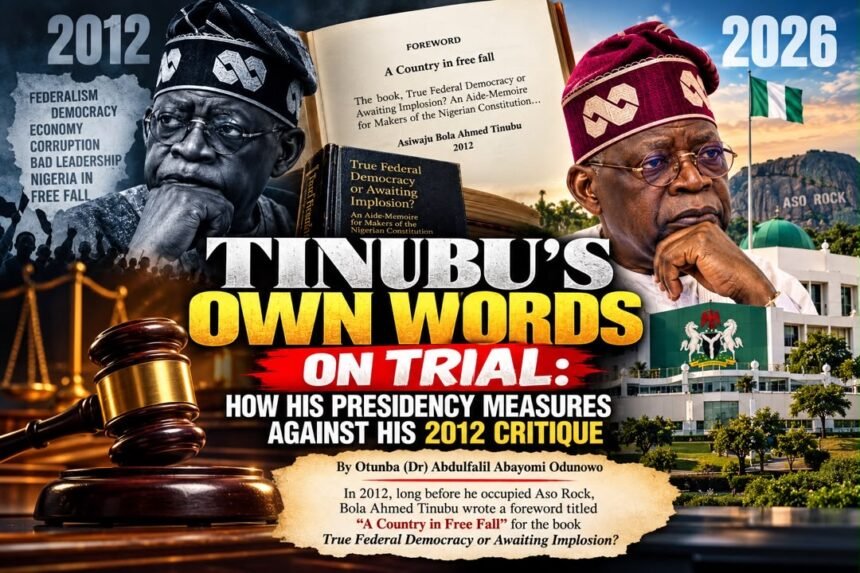
By Otunba (Dr) Abdulfalil Abayomi Odunowo
In 2012, years before moving into Aso Rock, Bola Ahmed Tinubu wrote the foreword to *True Federal Democracy or Awaiting Implosion?*, under the title “A Country in Free Fall.”
In that foreword, he described Nigeria’s central problems with striking directness: the manipulation of democracy by elites, the blockage of genuine federalism, the centre’s choking control of resources, and the divide between constitutional language and the realities citizens actually live with. He ended on a note of defiance: “Nigeria is possible. This house can be made to stand.”
Almost three and a half years into his presidency, those words now provide an obvious benchmark for accountability. This is not because any president can repair every inherited failure within a single term, nor because political beliefs never evolve. It is because a leader who once identified the illness so precisely must also be assessed by the treatment he applies when he is the one holding the scalpel.

**Federalism: courtroom success, political delay**
Tinubu’s position on federalism has for years been clear and consistent. As governor of Lagos, he confronted the centre over the creation of local governments and over resource control. In 2011, he maintained that states and local governments should receive at least 70 per cent of federally collected revenue. At the Daily Times 91st anniversary in 2017, he denounced “unitary federalism,” argued for the transfer of items from the Exclusive List, and said the federal government had assumed too many responsibilities. The APC’s 2015 platform and those that followed repeated the same position.
As president, his administration recorded a major legal breakthrough. On 11 July 2024, the Supreme Court, in the case filed by the Attorney-General of the Federation, upheld the financial autonomy of the 774 local government councils and directed that their allocations be paid straight to them rather than through state joint accounts. The court also prohibited the use of unelected caretaker committees.
Still, by late 2026, that ruling has been only partly implemented. Investigations by *The Punch* and other outlets, along with FAAC data, indicate that substantial sums remain effectively withheld or delayed by state governments. Reports estimate cumulative allocations in the trillions of naira since the judgment, with notable amounts still not reaching councils as truly independent bodies. Tinubu has publicly cautioned governors and suggested he could issue an executive order. There has been measurable progress, but not full execution. The same man who long criticised the centre’s financial overreach must now confront the more difficult challenge of compelling the states, many governed by his own party, to loosen their hold.
**Economic justice: macro improvement, household strain**
The 2012 foreword pointed to unemployment, economic fragility, and elite failure. Tinubu’s presidency has been shaped by two bold and risky reforms: the sudden removal of the petrol subsidy and the unification of the foreign-exchange market. Both addressed longstanding distortions that had become fiscally unsustainable.
The World Bank’s *Nigeria Development Update* of October 2026 outlines the outcome. Real GDP expanded by 4.2 per cent in the first half of 2026, compared with 3.9 per cent in the same period of 2025. In real terms, federation revenues rose sharply between 2023 and 2025. States gained the most and increased capital expenditure, especially on infrastructure. External reserves improved. The poverty rate, for the first time since 2019, stabilised.
But stabilisation does not amount to recovery for ordinary households. The same report, along with later analyses, shows that poverty remains high at around 60 per cent or more depending on the measure, while food inflation continues to bear heavily on the poor, who spend most of their income on food. Higher revenues across the three tiers of government have still not produced enough visible improvement in jobs, primary healthcare, working schools, or food affordability relative to income. Growth that does not yield broad welfare gains is precisely the gap Tinubu once faulted in other leaders.
**Constitutionalism and elite power**
The 2012 text cautioned against allowing political elites to turn democratic institutions into tools of private and sectional interest. For any president, the real test is whether he reinforces limits on power even when those limits constrain his own administration.
Tinubu signed the Electoral Act 2026 in February 2026. The law gives stronger statutory support to the electronic transmission of polling-unit results, while still allowing a manual fallback where technology fails. Supporters regard this as incremental progress. Critics view it as a compromise that still leaves space for the opacity that has marred earlier elections. The broader issues, institutional independence, credible enforcement of judicial rulings, and a political culture that accepts opposition as legitimate rather than disloyal, remain unresolved.
On state policing, the administration has pushed constitutional amendments that would permit states to create their own police services. By October 2026, several state assemblies had approved the relevant bills, and a presidential working group had prepared draft legislation. Security decentralisation follows naturally from a federalist vision. Even so, it remains incomplete without strong protections against political misuse, unlawful detention, and the capture of these new forces by state-level elites. Moving power does not by itself ensure that power will be restrained.
**The mirror**
Tinubu did not create every structural defect built up over decades. Three years and five months is a brief period in which to undo deep institutional damage. But once presidential power is in hand, the standard changes. An opposition figure can call for restructuring; a president must work through the constitutional, legislative, and political barriers to achieve it. An advocate can demand economic justice; a president must balance fiscal sustainability against immediate pressure on household welfare.
A critic can denounce elite capture; a president must construct institutions able to resist it, including when those institutions examine his own appointments, contracts, and political alliances.
What the evidence currently shows is movement toward the directions Tinubu once prescribed: efforts to secure local-government financial autonomy, action against macroeconomic distortions, and progress on state-police reform. It also shows incomplete execution, continuing hardship for ordinary Nigerians, and the persistent challenge of converting elite criticism into elite self-restraint.
The most meaningful comparison is not Tinubu against his political rivals. It is the Nigeria he described in 2012 measured against the Nigeria his administration had produced by October 2026. History is entitled to ask whether the house now stands on firmer ground. That answer must come from evidence, not rhetoric. The standards by which a leader once assessed his country’s government remain open for citizens to apply to him as well.
**Objective assessment**
A fair reading of the record suggests partial consistency, not full delivery. Tinubu has acted on several of the structural failings he identified in 2012: he won a Supreme Court ruling on local government financial autonomy, tackled major economic distortions, and moved state police reforms forward. Macroeconomic indicators have improved, revenues have increased, and growth has strengthened.
Yet the gaps in implementation remain serious. More than two years after the Supreme Court judgment, local government autonomy is still incomplete. Household hardship continues despite rising public revenues. Poverty has stabilised, but it remains severe. And the conversion of elite critique into restrained elite conduct, transparent appointments, competitive procurement, and institutions willing to check power even when inconvenient, has been limited.
Put simply, the president has moved along the path the 2012 critic set out, but the gap between diagnosis and lasting institutional change is still large. The house has not fallen, but neither has it been made to stand with the firmness that earlier conviction demanded. The evidence justifies recognising progress while also insisting that the work left undone remains substantial.
As President of Nigeria, he has now introduced policies aimed at tackling several of those long-standing issues.
So the issue before Nigerians is not merely whether the reforms have created hardship. It is whether they are confronting the structural problems that successive governments have found difficult to solve, and what it would take to carry them through successfully.
There are strong reasons to support policy continuity, institutional stability, and giving reforms enough time to deliver measurable results. At the same time, those reasons have to be weighed against the costs of reform, the obligations of government, and the democratic right of Nigerians to consider other approaches.
Otunba (Dr.) Abdulfalil Abayomi Odunowo
National Chairman AATSG.
writes on national development, governance and public accountability.