By Otunba (Dr.) Abdulfalil Abayomi Odunowo
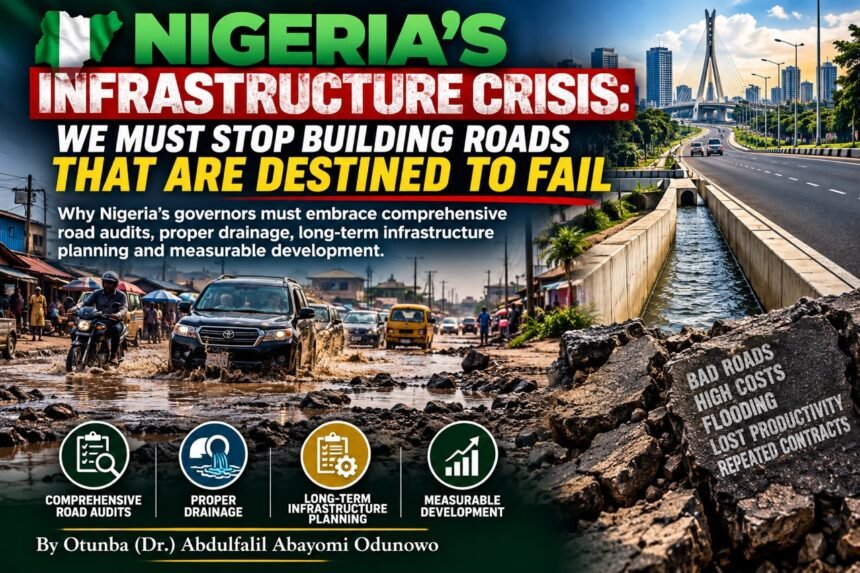
Why Nigeria’s governors need to adopt comprehensive road audits, proper drainage, long-term infrastructure planning, and measurable development.
Something is deeply wrong in a country where millions of hardworking people live in neighbourhoods without motorable roads or functional drainage, yet governments still celebrate the commissioning of roads that, in some cases, begin to break down within months.
This pattern is painfully familiar across Nigeria—from Lagos to Kano, Ibadan to Port Harcourt, Abeokuta to Benin City, and Ijebu-Ode to Onitsha. When it rains, residential streets turn into streams. Potholes damage vehicles. Children find it difficult to get to school. Traders lose productive time trying to pass through bad roads, while homeowners sometimes dip into their own pockets to fix public infrastructure that government should have provided.

These are not isolated hardships. They reflect decades of weak urban planning, poor engineering standards, inadequate maintenance systems, and a political culture that too often prizes commissioning ceremonies above sustainable development.
Nigeria’s infrastructure crisis is tragic not only because of limited resources. It is also a failure of priorities, institutional continuity, and accountability.
The question before us is straightforward: why should a road built with public funds become a major reconstruction project again after just two or three rainy seasons?
More troubling still, why have governments not created comprehensive, publicly accessible inventories of every road and drainage system, indicating their condition, maintenance needs, planned rehabilitation dates, and the estimated cost of those works?
The forgotten majority: Where ordinary Nigerians live
Estimates published in the Federal Road Safety Corps’ 2020 Annual Report indicate that Nigeria had about 204,000 kilometres of roads. Of that figure, roughly 34,680 kilometres were federal roads, 32,640 kilometers were state roads, and about 136,680 kilometres fell under local governments.
Put differently, around 67 per cent of Nigeria’s road network consisted of local government roads.
That is a striking figure, and it should reshape how we talk about infrastructure in this country. Public debate is dominated by federal highways, bridges, and expressways, yet most of the road network serves communities, residential areas, markets, agricultural zones, and local economic activity.
These are the roads that decide whether a family can get to a hospital in an emergency, whether a trader can move goods to market, and whether children can reach school during the rainy season.
Yet they are often given the least political attention.
We may not currently have a sufficiently reliable national audit to determine the exact percentage of urban residential streets that lack adequate roads and drainage. Even so, the visible decay across Nigerian communities makes the need for such an audit impossible to deny. The World Bank has repeatedly identified poor road conditions, weak maintenance, and infrastructure financing gaps as major barriers to Nigeria’s economic development over the years.
The effects go far beyond inconvenience. Bad infrastructure raises transport costs, damages vehicles, lowers productivity, discourages investment, and pushes up the cost of living. No country can realistically hope to become globally competitive while leaving large parts of its residential and commercial communities without basic infrastructure.
The Fashola example: The difference between projects and planning
Any discussion of forward-looking infrastructure governance in Nigeria should, in my view, give serious attention to the administration of former Lagos State Governor Babatunde Raji Fashola, SAN.
From 2007 to 2015, Fashola’s government approached infrastructure development within a wider framework of urban planning, institutional reform, and long-term development goals.
His administration carried out road rehabilitation, expanded transport infrastructure, tackled drainage issues, and advanced the planning framework that led to the Lagos State Development Plan 2012–2025.
That plan acknowledged the need for coordinated infrastructure investment, drainage management, transportation development, and urban sustainability.
Fashola did not resolve all of Lagos State’s infrastructure challenges, and no responsible assessment should claim that he did. Lagos still faces flooding, traffic congestion, and inadequate neighbourhood infrastructure.
Even so, his administration illustrated an important principle: infrastructure programmes should be driven by identifiable plans, institutional coordination, and long-term goals, not by political improvisation. Other governors in Nigeria may also have carried out road inventories and development plans, and their records should be assessed on their own merits.
But the principle is what matters most.
A governor should inherit an infrastructure development programme, strengthen it, implement it, and pass on a better system to the next administration. Development should not restart from zero every four or eight years.
Why do our roads fail so quickly?
A road that is properly designed and built should deliver years of dependable service under the traffic and environmental conditions for which it was intended. How long it lasts depends on several factors, including subsoil conditions, pavement thickness, the quality of materials, traffic load, drainage design, construction supervision, and routine maintenance.
Depending on its engineering specifications, a road may be designed for a service life of 15 to 20 years, or another appropriate design horizon, with maintenance and periodic rehabilitation built into its lifecycle. Yet in Nigeria, some roads begin to fail well before their reasonable design life should have ended.
Why?
Sometimes drainage is inadequate or missing altogether. In other cases, premature failure stems from poor construction materials, insufficient pavement thickness, weak foundations, overloaded vehicles, or inadequate supervision. In some instances, roads are built without enough consideration for surrounding development, floodwater discharge, or changing traffic patterns.
The outcome is entirely predictable.
Water seeps into the pavement. Foundations lose strength. Potholes emerge. Sections give way. Government returns with another contract. The taxpayer ends up paying twice, and sometimes three times, for infrastructure that should have lasted much longer. We must start treating premature road failure as an issue that demands technical investigation and public accountability. Who designed the road? Who approved the specifications? Who supervised the construction? Were independent materials tests carried out? Were the drainage facilities adequate? What contractual safeguards existed against defective work?
These questions should become routine whenever a publicly funded road fails before its time. Every governor must undertake a comprehensive infrastructure audit, I believe the moment has come for every Nigerian state government to carry out a comprehensive, georeferenced audit of its road and drainage infrastructure. This should be done in partnership with local governments, relevant federal agencies, engineering professionals, and community representatives.
Every road should be identified, mapped, classified, and assessed. Government should know the length, width, condition, pavement type, drainage availability, traffic significance, flood exposure, and maintenance history of its roads. It should also know which residential communities have never had properly constructed access roads. Without that information, how can any government objectively decide which roads should come first?
How can budgets be prepared intelligently?
How can maintenance costs be projected?
And how can citizens hold leaders accountable for promises that are neither properly documented nor independently measurable?
You cannot manage what you have not measured.
I therefore propose that every state complete a full road and drainage infrastructure inventory within 12 months, and then publish a rolling ten-year infrastructure development programme within the next six months. That programme should be reviewed every year and backed by realistic budgets, clear priorities, and publicly accessible progress reports.
Drainage must come before asphalt
One of the most damaging mistakes in Nigerian road development is the treatment of drainage as optional rather than essential to road engineering. In many communities, roads are built without properly connected drainage channels or suitable discharge outlets. Once the rains come, water gathers, erodes road shoulders, and weakens pavement foundations. The result is recurring deterioration and costly reconstruction.
It makes very little economic sense to spend hundreds of millions of naira resurfacing roads while neglecting the water-management failures that cause them to break down.
Drainage planning must therefore come before, or at least accompany, road construction. It must also be integrated with flood-risk assessments, urban development controls, and waste-management systems. A road without proper drainage may look impressive on the day it is commissioned, but appearance is no substitute for sound engineering.
Ogun State should provide a model
Consider Ogun State.
From Abeokuta to Ijebu-Ode, Sagamu, Ota, Ilaro, and other fast-growing communities, thousands of residential streets need different levels of intervention. Some require routine maintenance. Others need rehabilitation, complete reconstruction, new drainage systems, or entirely new roads. The Ogun State Government should be able to produce a comprehensive, publicly accessible register showing these needs across its 20 local government areas.
Residents should be able to see the condition of their roads, the authority responsible for them, the intervention being proposed, the estimated budget, and the expected implementation period. Rather than merely announcing that a certain number of roads will be constructed, government should explain why those roads were chosen and how they fit into a wider development programme. This is not a criticism aimed only at Ogun State. It is a benchmark every state should be expected to meet.
Infrastructure must become measurable
Nigeria must stop judging governors by how many roads they commission. We should assess them by the percentage of roads in good condition, the number of communities that gain reliable access, the reduction in flooding, the durability of completed projects, and the efficiency of maintenance spending. Every state should publish an annual infrastructure performance report showing completed projects, outstanding commitments, construction costs, road conditions, and maintenance backlogs.
Major road projects should be subjected to independent quality verification, with enforceable contractual provisions requiring correction of defects caused by poor construction. Communities, professional engineering bodies, and civil society organisations should also have opportunities to take part in monitoring. We should likewise strengthen local government capacity, especially after the Supreme Court’s landmark July 2024 judgment on local government financial autonomy.
The constitutional and financial responsibilities of the different tiers of government must be respected, but cooperation among them is equally necessary. A road does not become less important to the citizen simply because responsibility for it lies with a local government rather than a state or federal ministry.
The real meaning of visionary leadership
Nigeria does not suffer from a shortage of ambitious politicians. What the country urgently needs are more leaders willing to build institutions that will keep working after they leave office. A visionary governor should not only ask, “How many roads can I commission before the next election?” The more important question is, “What infrastructure system can I put in place that will serve my people for the next 20 or 30 years?”
That is the distinction between political performance and sustainable development.
We must begin to support—and demand—leadership that is properly planned, strategically coordinated, professionally executed, transparently measured, and continuously improved. The hardworking Nigerian who pays taxes, raises a family, runs a business, and contributes to the economy deserves more than campaign promises and ceremonial road commissioning.
That citizen deserves a motorable street, functional drainage, reliable access to essential services, and a government that can explain when outstanding infrastructure needs will be met. The real test of a governor’s infrastructural achievement is not how many roads are commissioned during an administration, but how many remain functional long after that administration has ended. We must stop using tomorrow’s resources to rebuild yesterday’s failures.
We must stop mistaking construction spending for genuine development.
And we must stop treating infrastructure as a political favour instead of a basic duty of government. Nigeria’s cities must be developed deliberately, not accidentally.
Our roads must be built to endure, not built for repeated reconstruction. Our infrastructure must be planned for generations, not election cycles. Above all, the communities where ordinary Nigerians live must no longer remain the neglected foundation of national development.
Otunba (Dr.) Abdulfalil Abayomi Odunowo
National Chairman AATSG
Public Affairs Commentator and Governance Advocate
Historical reference points: Federal Road Safety Corps, 2020 Annual Report; Lagos State Development Plan 2012–2025; World Bank assessments of Nigeria’s road infrastructure; Supreme Court judgment on local government financial autonomy, July 2024. The proposed audit deadlines and performance standards are the author’s policy recommendations.