
By Otunba (Dr.) Abdulfalil Abayomi Odunowo
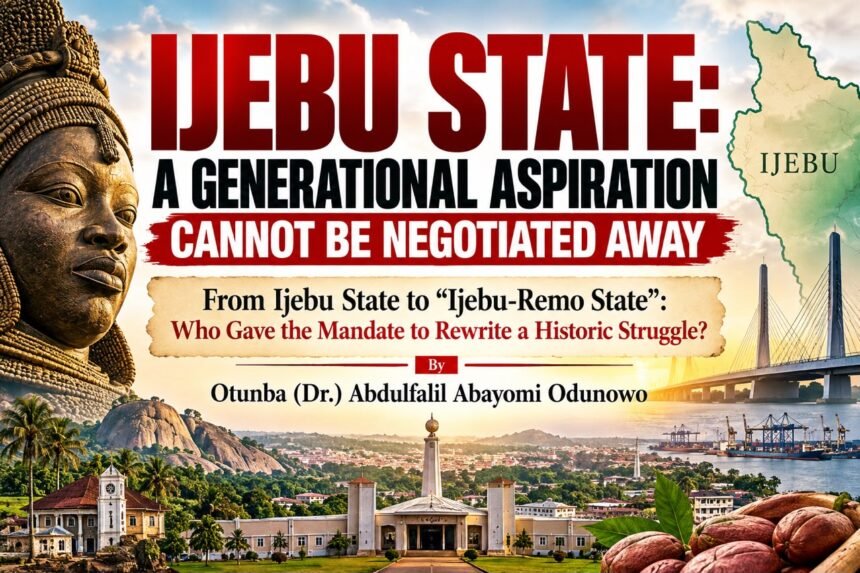
From Ijebu State to “Ijebu-Remo State”: Who Approved the Recasting of a Historic Demand?
The discussion about creating a new state out of Ogun State cannot be reduced to political expediency or the argument that any attainable outcome should be accepted. The central issue is specific: when, by what process, and under whose authority did the long-standing campaign for Ijebu State become a campaign for Ijebu-Remo State?
This is neither an attack on the Remo people nor a personal crusade against Senator Otunba Gbenga Daniel. It is a defence of history, demographic fact, representation, and the right of a people to determine whether a demand carried across generations can be materially changed in their name.
A Historically Grounded Demand
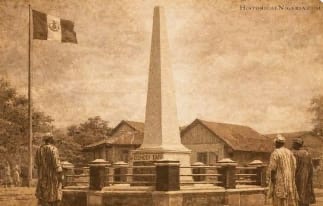
The quest for Ijebu State did not start with the present National Assembly. The colonial-era Ijebu Province, one of the administrative provinces created in the early 20th century, remains the only major old province yet to attain statehood. Comparable provinces such as Oyo, Sokoto, Ondo, Benin, and others were split into multiple states through successive rounds of state creation. Traditional rulers, including the late Awujale and Paramount Ruler of Ijebuland, Oba Sikiru Kayode Adetona, who reigned for 65 years until his death in July 2025, as well as generations of political leaders, repeatedly pointed to this as an unresolved anomaly.
In 2012, during the Ojude Oba festival, then-Senate President David Mark openly expressed support for Ijebu State, stressing the importance of bringing government closer to the people. For decades, memoranda and declarations of interest have been submitted through constitutional conferences and National Assembly review exercises. The late Awujale consistently described the demand as a matter of historical justice: among its peers, Ijebu Province remained the last without statehood.
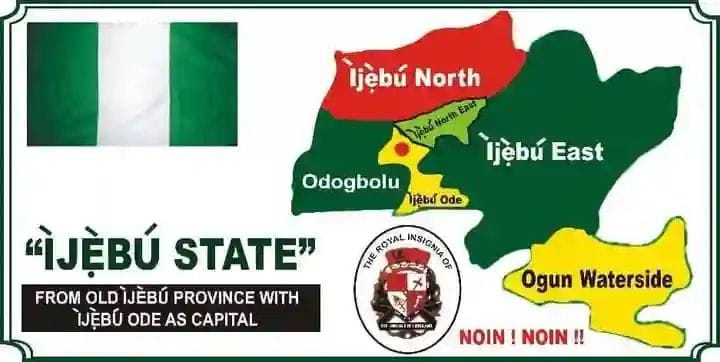
That old province consisted of two divisions Ijebu and Remo. In today’s structure, those divisions correspond to the nine local government areas in Ogun East Senatorial District: six predominantly Ijebu LGAs Ijebu North, Ijebu North East, Ijebu Ode, Ijebu East, Odogbolu and Ogun Waterside and three Remo LGAs Sagamu, Ikenne and Remo North.
Demographic and Structural Facts
Based on the most recent official census figures from 2006, the six Ijebu LGAs had a combined population of about 815,000–820,000, while the three Remo LGAs had roughly 435,000. Growth projections since that time indicate expansion across the district, but the comparative demographic balance remains evident. Any proposed arrangement should therefore be assessed in light of population, landmass, economic strength, infrastructure, and historical identity not only political negotiating leverage.
Names are not mere labels. They carry history and identity. For that reason, changing a demand that has stood for decades from “Ijebu State” to “Ijebu-Remo State” is not a minor adjustment; it is a substantive alteration that requires open, documented consent, not simply the approval of a negotiating committee.
Senator Daniel’s Responsibility and the Question of Accountability
In November 2024, Senator Gbenga Daniel, who represents Ogun East, sponsored a bill for the creation of Ijebu State. As the elected representative of the entire senatorial district, he is obliged to ensure that any later compromise commands broad and verifiable support across both Ijebu and Remo communities. Efforts at reconciliation are legitimate; a unilateral or opaque redefinition of a historic demand is not.
Traditional rulers remain indispensable custodians of heritage, and their consultation is necessary. But consultation does not automatically amount to a popular mandate. If a generational aspiration is to be fundamentally recast, the people are entitled to know the exact terms, the options that were considered, and the reasons advanced for the change.
Equity Must Work Both Ways
In Nigeria’s difficult state-creation process, compromise is often unavoidable. That process requires two-thirds majorities in the National Assembly, approval by a prescribed number of state Houses of Assembly, and other constitutional thresholds. Even so, equity cannot be expected to flow in only one direction. Ijebu people have the right to insist that their historical identity remain intact, and that insistence should not be dismissed as rigidity. If stakeholders in Remo prefer a separate identity or a different formulation, that preference deserves respect, but it does not automatically cancel Ijebu’s own claim.
For that reason, the option of a six-LGA Ijebu State deserves serious and public scrutiny: its population viability, internally generated revenue prospects, agricultural and industrial resources, educational and tourism infrastructure, maritime potential, and the exact constitutional route. These are factual questions for constitutional lawyers, economists, and demographers—not matters to be settled by slogans.
A Workable Way Forward
Sentiment alone is no longer enough. What is needed is an organised process grounded in evidence:
1. **Set up an independent, non-partisan technical committee** made up of representatives from the six Ijebu LGAs and the wider Ijebu diaspora, including constitutional experts, economists, historians, and community representatives. Its assignment should be to produce evidence, not communiqués.
2. **Commission a public viability and constitutional study** addressing population, revenue base, infrastructure, assets, and the complete requirements of Section 8 of the 1999 Constitution (as amended).
3. **Compile and publish the historical record** of earlier memoranda, proposed boundaries, and commitments made over the decades.
4. **Convene a representative Ijebu People’s Conference** to consider the alternatives Ijebu State on a six-LGA basis, Ijebu-Remo, or any other constitutionally viable option and adopt a clearly documented position.
5. **Insist on full transparency in existing harmonisation processes**: who represented whom, what mandates they held, what compromises were made, and why the name was changed.
6. **Establish a permanent, professional secretariat** for documentation, research, legislative monitoring, and institutional memory.
7. **Mobilise Ijebu expertise** in law, economics, strategy, and communications across Nigeria and the diaspora.
8. **Require public, on-the-record positions** from elected representatives and major stakeholders.
9. **Pursue the cause strictly by peaceful and constitutional means**, without hostility toward any community.
A realistic 90-day beginning would look like this: within 30 days, set up the technical committee and start archival work; within 60 days, release preliminary assessments of both the six-LGA option and the combined option; within 90 days, convene the People’s Conference. The position that emerges should then form the basis for sustained engagement with the National Assembly, Ogun State institutions, and the broader Nigerian public.
History Is Watching
Every generation is tested on whether it will preserve what it inherited or exchange it for temporary convenience. Ijebu State is one of those tests. Negotiation, coalition-building, and respectful engagement with Remo stakeholders and traditional institutions are still necessary. What cannot be accepted is the quiet alteration of a historic demand without documented popular consent.
Who approved the shift from Ijebu State to Ijebu-Remo State? What, precisely, did Ijebu gain? Which alternatives were considered and then set aside? These are questions of history, equity, and democratic accountability not expressions of hostility.
Ijebu State is bigger than any politician, committee, or individual. It belongs to those who came before, those living now, and those yet unborn. Unless the Ijebu people themselves knowingly decide otherwise, the original aspiration deserves to remain alive and to be pursued with facts, organisation, and constitutional rigour.
Otunba (Dr.) Abdulfalil Abayomi Odunowo
Ijebu Lokan Fun Itesiwaju Ijebu Movement
5 October 2026