By Okoi Obono-Obla
360 vs a Divided Field — How APC’s nationwide presence, northern turnout, and the law against last-minute alliances are shaping 2027 before a single vote is cast.
Nigeria’s 2027 general election is taking a familiar shape: a ruling party with a truly national footprint against a fragmented opposition.
Candidate Distribution and the Cost of Fragmentation
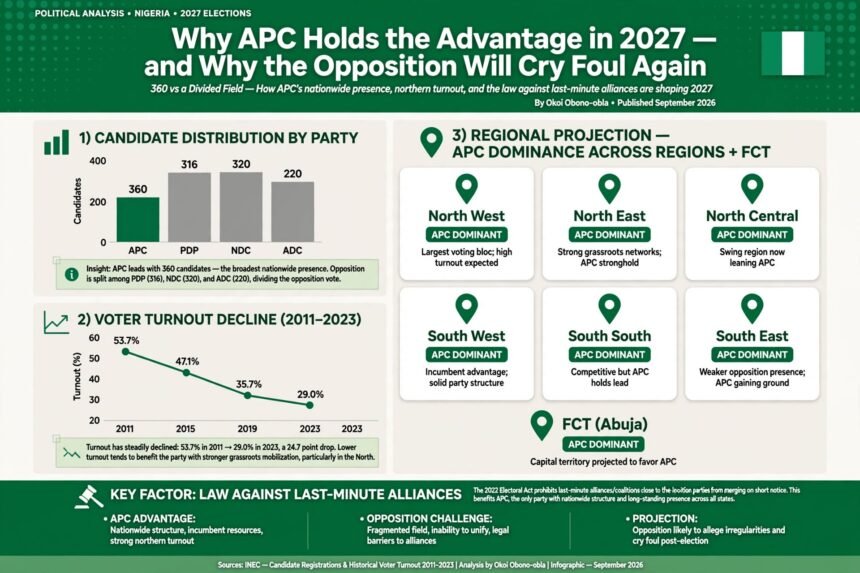
The All Progressives Congress (APC) achieved a perfect slate, fielding 360 candidates — one for every constituency in the House of Representatives. No other party managed that.
The Peoples Democratic Party (PDP) nominated 316 candidates, the National Democratic Congress (NDC) expanded from 219 to 320, and the African Democratic Congress (ADC) fielded 220. The Labour Party (LP) maintains a modest footprint.
This imbalance is more than a statistic. With legislative and presidential elections scheduled for the same day, opposition fragmentation will have far-reaching consequences. Instead of consolidating the anti-incumbent vote, multiple opposition candidates will be splitting it constituency by constituency.
Voter Turnout Trends: The Silent Advantage
Nigeria’s voter turnout has declined steadily over four cycles:
2011: 53.7%
2015: 47.1%
2019: 35.7%
2023: 29% — the lowest in history
Beyond the national decline, regional patterns matter. The North consistently records higher turnout than the South, while Abuja (FCT) averages around 30%. This structural trend favours the APC, whose most entrenched political machinery remains in the North. Where the APC is strongest, more people vote; where the opposition is strongest, fewer do.
Regional Projections Region | APC | PDP | NDC | ADC | Turnout Context | Projection
North West | 58 | 48 | 50 | 26 | ∼32-41% | APC dominance likely; NDC erodes PDP’s base.
North East | 42 | 40 | 55 | 19 | ∼30-35% | NDC surge splits the opposition, aiding APC.
North Central | 41 | 38 | 52 | 34 | ∼30-40% | Highly competitive; alliances could shift outcomes.
South West | 58 | 42 | 36 | 25 | ∼27-33% | APC entrenched; opposition vote fractured.
South South | 42 | 55 | 50 | 19 | ∼16-23% | PDP stronghold weakened by low turnout and NDC challenge.
South East | 29 | 41 | 37 | 15 | ∼22% | Opposition strong but divided; APC benefits from split.
FCT Abuja | 2 | 2 | 2 | 1 | ∼30% | True battleground; fragmentation favours APC.
Why Alliances Won’t Save the Opposition: The Electoral Act
In Nigeria’s presidential system, alliances do not automatically translate into votes. Every candidate must be sponsored by a political party. For opposition parties to consolidate behind a single candidate, they would need massive, coordinated withdrawals of nominees.
That path is blocked by law. Section 33 of the Electoral Act 2026 allows substitution of a candidate only in cases of death or voluntary withdrawal, and requires such substitution to be made within 14 days of withdrawal — not 90 days as is sometimes speculated.
This legal framework makes a last-minute grand opposition alliance highly unlikely, leaving the APC structurally advantaged.
A Familiar Script
Since 1999, a pattern has repeated itself: whenever the ruling party secures victory, the opposition alleges rigging and accuses INEC of compromise. The narrative persists regardless of the margin of defeat.
The 2027 elections are likely to follow the same trajectory. The APC’s 100% House coverage, higher turnout in its strongholds, and legal barriers to opposition consolidation give the ruling party a decisive edge.
Outlook for 2027
The coming election will highlight the contrast between the APC’s unified national machinery and the opposition’s fragmented approach. Unless opposition parties undertake mass withdrawals and comply strictly with Section 33 of the Electoral Act, APC’s dominance is likely to translate into both legislative control and presidential victory — followed, as history suggests, by opposition claims of rigging rather than a reckoning with fragmentation and turnout.