By Okoi Obono-Obla
The South‑East Battleground
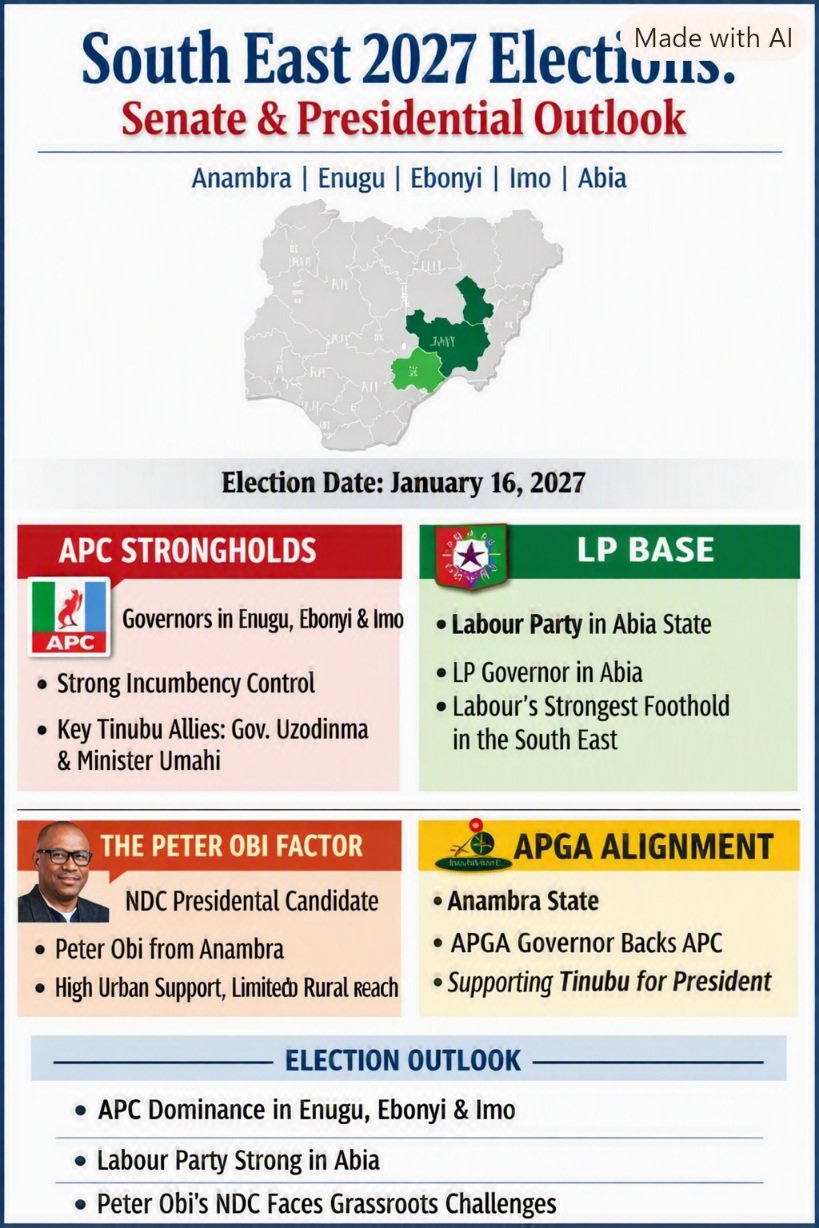
The South‑East enters the 2027 general elections with a complex political landscape. On 16 January 2027, both the Presidential and Senate elections will be held simultaneously. The region’s outcome will be shaped by governors’ leverage, party structures, and the Peter Obi factor.
This analysis draws from the final list of Senate candidates released by INEC on 12 September 2026, which provides the baseline for understanding how the APC, LP, ADC, NDC, and APGA are positioned in the South‑East.
Governors as Power Brokers
Governors remain the commanders of grassroots mobilization in Nigerian politics. They control local governments, influence traditional rulers, and deploy state resources to secure electoral outcomes.
– APC controls Enugu, Imo, and Ebonyi. These governors are staunch backers of President Tinubu, with Ebonyi’s Minister of Works, David Umahi, wielding additional influence.
– Labour Party (LP) controls Abia State, giving it a foothold in one of the region’s most politically active states.
– APGA controls Anambra, but the governor has declared support for APC in the presidential race, effectively strengthening Tinubu’s hand.
“Governors’ grip on local governments and traditional rulers remains the decisive lever in South‑East politics.”
The Peter Obi Factor
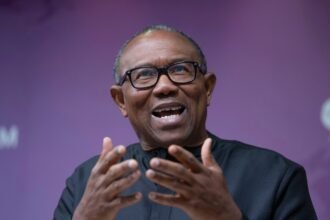
The Nigeria Democratic Congress (NDC), newly registered in May 2026, fields Peter Obi as its presidential candidate. Obi’s candidacy resonates strongly in the South‑East, given his Anambra roots and prior national momentum. However:
– NDC lacks grassroots presence in many local governments.
– Its organizational structures are embryonic compared to APC and LP.
– Obi’s personal popularity may drive urban enthusiasm, but translating that into Senate victories requires deeper ward‑level machinery.
Thus, while Obi’s candidacy energizes voters, the absence of entrenched NDC structures limits its ability to convert sentiment into widespread senatorial wins.
-State‑by‑State Dynamics
| State | Governor’s Party | Senate Candidate Landscape (INEC list, Sept 2026) | Likely Dynamics |
|—————-|—————-|——————————–|—————-|
| Anambra | APGA (aligned with APC) | APC, LP, NDC, ADC, APGA all fielded candidates | Obi’s home state, but APGA’s pro‑APC stance strengthens Tinubu; Senate races tilted by APC‑APGA alignment |
| Enugu | APC | Full coverage by APC, LP, NDC, ADC | APC governor ensures strong grassroots mobilization; opposition faces structural hurdles |
| Ebonyi | APC | APC, LP, NDC, ADC candidates | APC dominance reinforced by Umahi’s influence; Senate contests likely mirror gubernatorial strength |
| Imo | APC | APC, LP, NDC, ADC candidates | APC governor is a staunch Tinubu ally; Senate races heavily tilted by incumbency |
| Abia | LP | LP, APC, NDC, ADC candidates | LP governor provides Labour with its strongest base; Senate contests here may reflect LP’s grassroots presence |
Cultural and Electoral Timing
The simultaneous presidential and senatorial elections will reinforce party loyalty. Nigerian voters often align their Senate choices with their preferred presidential candidate. In this context:
– APC governors will act as regional campaign generals, ensuring cohesion between local and national efforts.
– LP’s Abia governor provides a counterweight, ensuring Labour remains competitive in that state.
– Obi’s candidacy will energize voters, but without robust grassroots structures, NDC faces difficulty converting enthusiasm into Senate seats.
“On 16 January 2027, the South‑East will be a test of whether personal popularity can overcome entrenched gubernatorial machinery.”
Outlook
The APC’s incumbency advantage across Enugu, Imo, and Ebonyi, combined with APGA’s alignment in Anambra, gives Tinubu’s party a strong Senate and presidential foothold in the South‑East. Labour Party’s Abia governor provides a counterweight, ensuring LP remains competitive in that state.
The Peter Obi factor will energize voters, particularly in urban centers, but without entrenched grassroots structures, NDC’s Senate prospects remain limited.
Ultimately, the governors’ control of grassroots mobilization — through local governments, traditional institutions, and resource deployment — will remain the decisive factor in shaping the South‑East’s Senate and Presidential outcomes.