

By Okoi Obono-Obla
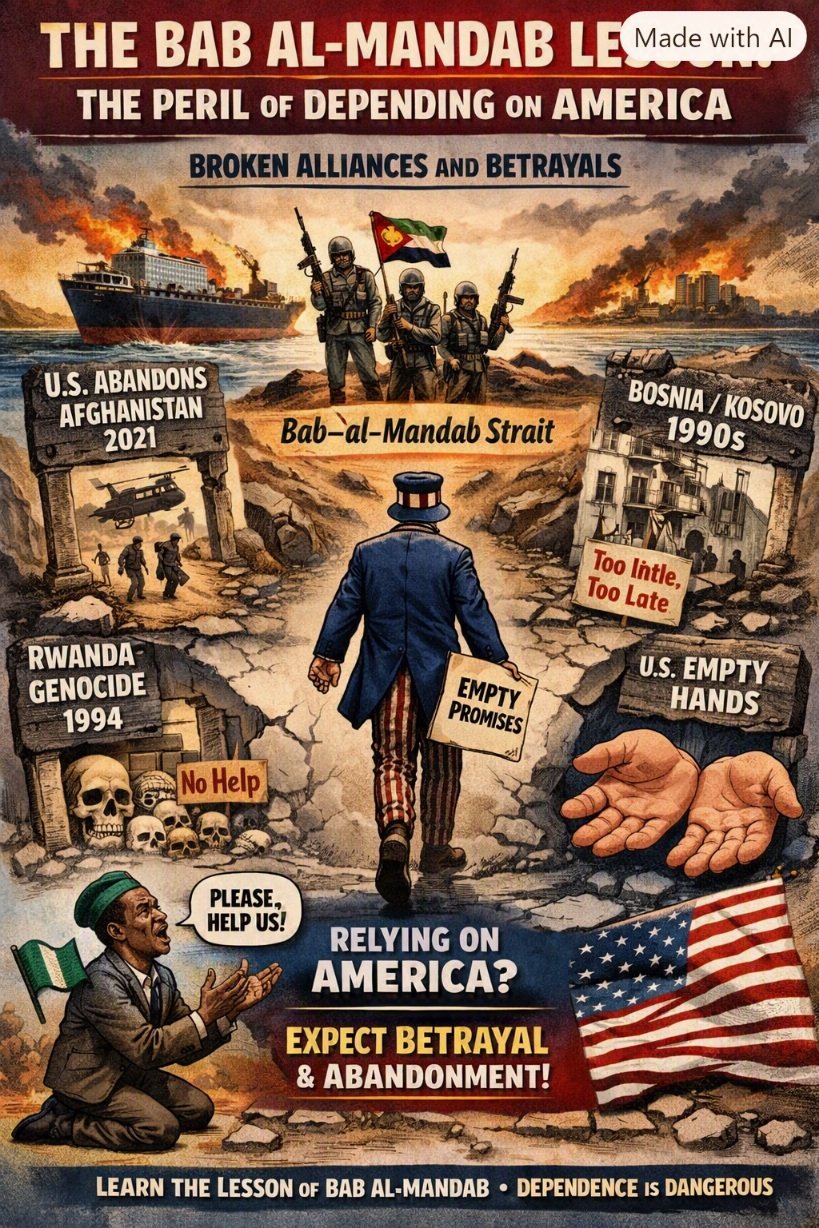
The capture of Mocha and Perim Island on 11 September 2026 by Houthi rebel forces, resulting in the occupation of the Bab al-Mandab gateway, has once again exposed the folly of depending on the United States. It is further evidence of the historic unreliability of America.
This is not new. History is replete with examples:
In Afghanistan (2021), after 20 years of promises to build a democratic state, Washington announced a total withdrawal. The announcement destroyed the morale of the Afghan National Security Forces who depended on US air power and contractors. The government collapsed within weeks, the Taliban took Kabul on 15 August 2021, and the State Department itself admitted insufficient preparation for the worst-case scenario.
In Rwanda (1994), during a 100-day genocide that killed some 800,000 people, the United States deliberately avoided intervention. Declassified documents show the Clinton administration knew a systematic genocide was planned but buried the information to justify inaction, shaped by the failure in Somalia in 1993. The US blocked reinforcement of UN peacekeepers and refused to use the word “genocide” to avoid any legal obligation to act.
In Vietnam (1975), the Nixon administration promised South Vietnam decisive aerial intervention if the North renewed war. When the final offensive came in March 1975, after Congress cut off military aid, the United States stood aside as the South collapsed. Saigon fell on 30 April 1975, a textbook case of abandonment after assurance.
In Serbia / Bosnia and Kosovo (1992-1999), Washington first refused to intervene during ethnic cleansing in Bosnia, and later led a NATO bombing campaign against Serbia over Kosovo that was initially derided as inadequate. The inconsistent policy left all sides convinced that American support was transactional and unreliable.
The same pattern played out in Mocha. Yemeni government sources reported that promised air support never came before the city fell.
Therefore, I pity Nigerian politicians and opposition figures who make it a habit to have recourse to the United States for everything under the sun in Nigeria. When faced with challenges arising from their own poor organizational ability and glaring lack of focus, or their failure to put their own house in order, they cry wolf and write troves of baseless petitions to the USA on purely domestic and internal issues, in the hopeless hope that America will intervene and come to their rescue.
Any nation or political group that outsources its survival to Washington does so at its own peril.