By Okoi Obono-Obla
Today, 21st August 2026, the Ugep Leboku — the New Yam Festival — was ushered in by Okondel, the Midnight Fire. This sacred fire rite ushers in Mblemi, a celebration that is essentially of the womenfolk and is deeply intertwined with the matrilineal culture of Ugep in Cross River State Nigeria.
Mblemi is the name given to Nsibidi, a cartographical sign language that traverses the various cultures and traditions of the Cross River Basin to South-Western Cameroon, the Democratic Republic of Congo, Equatorial Guinea, and Gabon. Among the Yakurr people, Nsibidi is a feminine heritage, even though it is also the language of the seemingly patriarchal Ekpe society. Some traditional accounts even claim that Nsibidi was founded by women.[Ngbe]
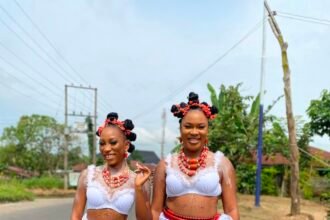
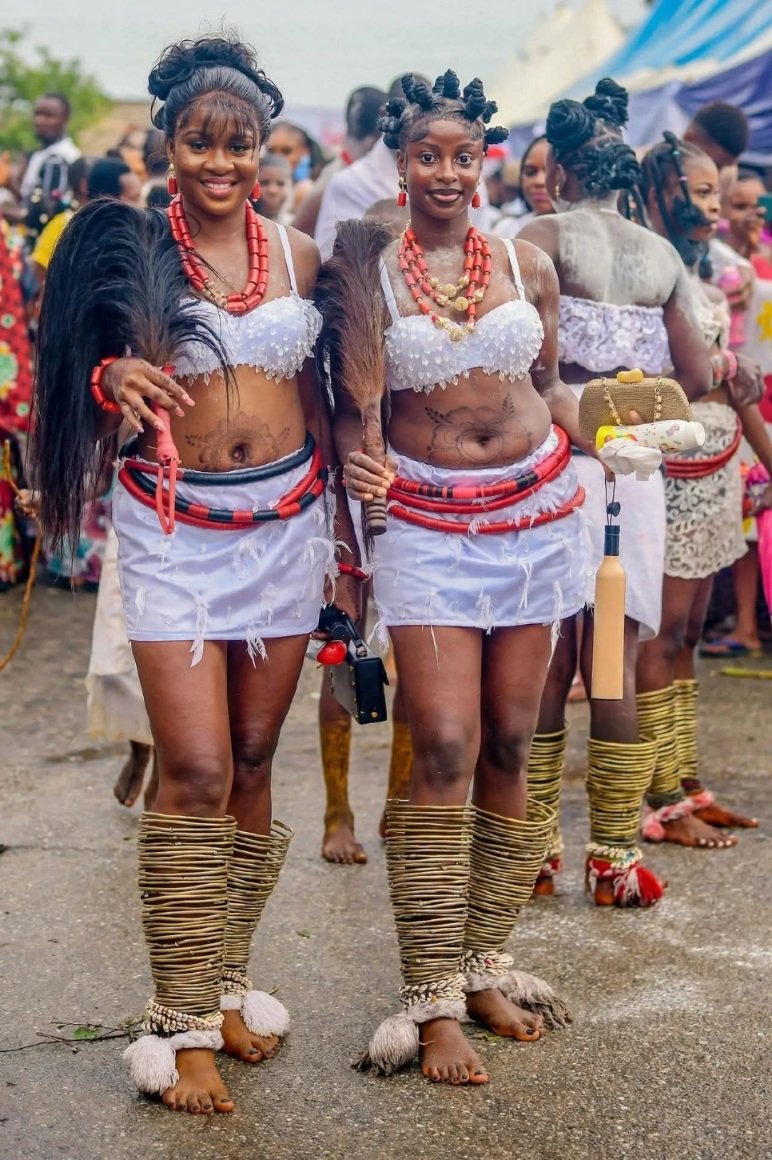
Every year during the Leboku Festival — Ugep-Yakurr’s vibrant New Yam celebration — maidens parade in stunning body decorations that resemble tattoos. These markings are not merely for beauty; they are Nsibidi — an ancient African visual language and writing system of deep cultural significance. Far more than cryptic symbols used by the Ngbe society, Nsibidi is embedded in everyday ritual, celebration, and identity across the region.[Ekpe]

Janenboku: Women’s Day and the Essence of Mblemi
The activities lined up for today, which is Janenboku — Women’s Day — resonate profoundly with Mblemi, which is dedicated to women. The day’s events include farmers parading through the town with New Yams, the traditional drying of the Ekoi drums which are beaten only once a year at exactly 12 a.m. on 22nd August 2026, and the exchange of visitations and gifts to loved ones and well-wishers.
This convergence of Janenboku and Mblemi is no coincidence. It affirms that in Yakurr, the feminine holds the cultural code.
Nsibidi: More Than a Secret Society Script
Historically associated with secrecy and spirituality, Nsibidi transcends those boundaries. In Ugep, the heart of Yakurr land, Nsibidi symbols adorn the bodies of festival-goers, blurring the line between aesthetics and ancestry. This ancient form of writing, possibly with origins in Ancient Egypt, flourished among the Bantu peoples and spread widely across Nigeria, Cameroon, Gabon, Equatorial Guinea, and the DR Congo.
Its use today — whether in ceremony or art — points to something deeper: an interconnected heritage among diverse peoples such as the Ejagham, Efik, Ibibio, Annang, Oron, and the Cross River Igbo. Nsibidi, like a tattooed map across generations, connects peoples and places that modern borders cannot divide.[Ekoi][Arochukwu][Afikpo][Abriba]
The use of Nsibidi in modern festivals, the fluidity of names across nations, and the deep shared structures of regional languages all speak to a unified heritage that predates colonial boundaries. Every symbol, word, and tradition is part of a much larger mosaic — a story of people who moved, mingled, and left messages behind not just on stone, but on skin, in song, and in speech.
Culture is not confined — it travels. And it is alive today in the sounds we speak, the stories we tell, and the symbols we celebrate.
Nsibidi is one of the greatest legacies our illustrious ancestors handed down to us, and we are allowing it to go into extinction. This is a challenge to our people in the fields of arts, humanities, social sciences, and even the sciences.[Eblemi]
The culture of Mblemi in Ugep is almost dying, as the elderly women who are its repositories are fast passing away and the younger women, caught in the frenzy of westernization, show little enthusiasm to learn it. Gladly, in Mkpani, which is a twin offshoot of Ugep, there are still women who write Mblemi.