By Eneojo Herbert Idakwo
- The FAAC Dependency Problem
- The Entrepreneurial Desert
- The Poverty Beneath the Political Class
- Ajaokuta and the Cost of Industrial Failure
- Obajana Shows What Is Possible
- The Cashew Economy Kogi Has Yet to Industrialise
- Agriculture Without Value Addition Is Still Extraction
- Oil Should Finance the Transition
- Why Governors Become Economic Demigods
- The Contrast With Nigeria’s Entrepreneurial States
- The Political Dutch Disease
- The Next Governor’s Real Assignment
- The Decade That Will Decide Kogi
- The Choice Before Kogi
There is a strange economic paradox unfolding in the heart of Nigeria.
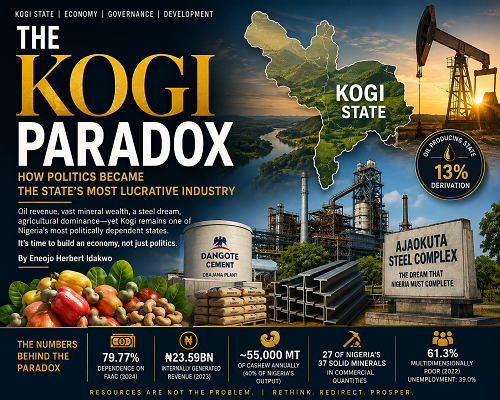
Kogi State has oil. It receives the constitutional 13 per cent derivation associated with oil-producing states. It has extensive deposits of iron ore, limestone, coal and other solid minerals. It hosts the Ajaokuta Steel Complex, one of Nigeria’s most ambitious industrial projects, the Dangote Cement plant at Obajana, the Geregu Power Plant and a large agricultural economy.
It is also Nigeria’s leading cashew-producing state, accounting for an estimated 40 per cent of national cashew output, according to recent state and federal government sources.

Kogi sits at the confluence of the Niger and Benue rivers and occupies a strategic corridor linking northern and southern Nigeria.
Yet the state remains heavily dependent on public revenue, while private enterprise has struggled to develop at the scale its resources should permit.
This is the Kogi paradox.
The state possesses the assets of an industrial economy but continues to operate much of its economic life around government and political access.
Its greatest resource may therefore not be oil, iron ore, limestone, agriculture or even its strategic location.
It may be political access.
When Politics Becomes Economic Capital
There is a widespread perception in Kogi that a significant proportion of the state’s wealthiest political and business figures accumulated substantial wealth through proximity to government.
That assertion should not be presented as a statistical fact without a comprehensive study of wealth ownership and its origins. There is no credible dataset establishing that 90 per cent of wealthy Kogites acquired their fortunes through politics.
The structural argument, however, is difficult to ignore.
Government remains one of the largest sources of contracts, appointments, procurement, infrastructure spending and commercial opportunity. Where the private sector is weak, access to government can become a form of economic capital.
That changes incentives.
A young entrepreneur deciding whether to put ₦20 million into a business facing expensive finance, inadequate infrastructure, limited purchasing power and regulatory uncertainty may conclude that political access offers a faster and more predictable return.
A government appointment can provide influence.
A contract can provide immediate cash flow.
A political connection can open doors that remain closed to an ordinary entrepreneur.
Over time, political ambition becomes intertwined with economic ambition.
That is how politics begins to displace enterprise.
The FAAC Dependency Problem
Kogi’s public finances reveal the scale of the challenge.
BudgIT’s 2024 State of States Report put Kogi’s dependence on FAAC at 79.77 per cent of total revenue, while its internally generated revenue in 2023 stood at approximately ₦23.59 billion.
But Kogi’s fiscal story has another important dimension.
The state is an oil-producing state and is entitled to the constitutional 13 per cent derivation associated with oil production. The Senate affirmed Kogi’s oil-producing status in February 2024 and noted that the state had been receiving the 13 per cent derivation since October 2022.
This distinction matters.
Kogi is not simply a state waiting for monthly federal allocations.
It has access to oil-derived revenue in addition to its share of federally distributed revenue.
That should provide an opportunity to finance infrastructure and productive investment.
The critical question is therefore what the state does with the additional revenue.
Does oil money finance infrastructure that attracts factories?
Does it build industrial parks?
Does it improve roads and energy supply?
Does it support agricultural processing?
Does it strengthen technical education?
Does it provide the infrastructure required to unlock private investment?
Or does it simply enlarge the pool of public resources around which political competition revolves?
The answer will determine whether oil becomes a development asset or another source of fiscal dependence.
The Entrepreneurial Desert
The weakness of Kogi’s entrepreneurial ecosystem makes the problem more difficult.
The FATE Foundation’s State of Entrepreneurship in Nigeria Report 2022 placed Kogi near the bottom of its entrepreneurship ranking, with particularly poor scores in business performance, innovation and technology adoption, and the enabling business environment.
The state’s score for the enabling business environment was especially weak.
That is not a minor statistic.
Entrepreneurs require predictable regulation, infrastructure, finance, markets, skilled labour, security and technology.
When those conditions are weak, businesses remain small.
Capital becomes cautious.
Young people migrate.
Formal enterprises struggle to survive.
Political connections become more valuable.
The cycle reinforces itself.
If the state wants to change its political culture, it must first change the economic incentives that sustain it.
The Poverty Beneath the Political Class
Kogi’s economic weakness is especially troubling because it exists alongside considerable natural wealth.
Nigeria’s Multidimensional Poverty Index has recorded significant deprivation in Kogi, including challenges involving living standards, education and health.
The contradiction is difficult to miss.
The state has resources capable of supporting large-scale economic activity, yet a substantial proportion of its citizens remain economically vulnerable.
The problem is not simply poverty.
It is the failure to convert natural and public resources into broad-based productive wealth.
Recent corruption allegations involving former Governor Yahaya Bello have intensified public discussion about the management of public resources.
The Economic and Financial Crimes Commission has accused Bello of financial crimes involving very large sums of public money and property transactions. Bello has denied wrongdoing and pleaded not guilty.
The allegations remain matters for judicial determination.
The wider policy question, however, is legitimate.
How effectively does Kogi protect public resources?
How much of its public expenditure becomes productive capital?
How much becomes infrastructure that supports private enterprise?
And how much economic value remains in the state after the political office-holder leaves?
Those are the questions that should dominate the conversation about Kogi’s future.
Ajaokuta and the Cost of Industrial Failure
Few assets demonstrate Kogi’s paradox better than Ajaokuta Steel Complex.
The project was conceived as a foundation for Nigeria’s industrialisation.
The logic was simple.
Steel would support machinery.
Machinery would support manufacturing.
Manufacturing would create jobs.
Industrial production would generate exports, technical skills and a broader tax base.
Ajaokuta was supposed to become one of the foundations of Nigeria’s industrial economy.
Instead, decades after construction began, the complex remains largely dormant.
The opportunity cost is enormous.
A functioning steel industry would have created demand for engineering services, fabrication, transport, maintenance, equipment manufacturing and other downstream industries.
It would have produced a network of companies around the primary plant.
Instead, Ajaokuta has become a symbol of Nigeria’s inability to convert massive public investment into sustained industrial production.
For Kogi, the loss is even greater.
The steel complex should have been the anchor around which an industrial city developed.
The state should have had steel fabricators, engineering firms, machine shops, equipment suppliers, logistics companies and technical training institutions operating around it.
That ecosystem never reached its intended scale.
The question now is whether Ajaokuta will remain primarily a political symbol or finally become a productive industrial asset.
Obajana Shows What Is Possible
The Dangote Cement plant at Obajana offers a contrasting story.
It demonstrates that large-scale industrial production is possible in Kogi when capital, infrastructure, markets and management are aligned.
The plant supports employment and supply chains while connecting Kogi to wider national markets.
Its importance extends beyond cement.
It demonstrates the difference between possessing a mineral resource and building an industry around it.
Government does not need to own every major enterprise.
Its role should be to create conditions in which serious private investors can operate successfully.
Reliable infrastructure, predictable regulation, security, access to land, skilled labour and transparent investment rules matter more to long-term investors than political announcements.
The Cashew Economy Kogi Has Yet to Industrialise
Perhaps nowhere is Kogi’s resource paradox more visible than in cashew.
Kogi is one of Nigeria’s largest cashew-producing states and is widely regarded as the country’s leading producer. Recent state development data put annual production at about 55,000 metric tonnes, representing approximately 40 per cent of national output.
That is not a minor agricultural statistic.
It is an industrial opportunity.
Cashew has an established global market and a value chain capable of supporting farmers, aggregators, processors, packaging companies, logistics operators, financial institutions, equipment suppliers and exporters.
Yet much of the economic opportunity remains concentrated around primary production and the movement of raw nuts.
This is the same structural problem that affects Kogi’s minerals.
The state produces the raw material but captures too little of the value created after production.
The farmer grows the cashew.
The aggregator buys it.
The raw nut leaves the state.
The processor elsewhere captures a larger portion of the value.
Kogi should reverse that structure.
If the state produces roughly 55,000 tonnes of cashew annually, the development question should not simply be how to increase production.
It should be how much of that production can be processed inside Kogi.
Cashew processing plants could support kernel production, cashew nut shell liquid extraction, cashew apple processing, packaging, warehousing and export operations.
Such an industrial cluster would create jobs far beyond the farm.
It would also create opportunities for equipment manufacturers, transport operators, financial institutions, technical workers and young entrepreneurs.
The Federal Government’s recent cashew industry strategy has recognised the wider problem facing Nigeria. More than 85 per cent of the country’s raw cashew nuts are exported without processing.
For Kogi, this represents both a weakness and an opportunity.
The state already has the production base.
What it lacks is sufficient industrial capacity around the commodity.
The real measure of success should therefore change.
Instead of asking how many tonnes of raw cashew leave Kogi each year, policymakers should ask how much value is retained inside the state.
That is the transition from agriculture to agro-industry.
Agriculture Without Value Addition Is Still Extraction
Cashew is only one example.
Kogi has significant potential in rice, cassava, maize, yam, livestock and other agricultural commodities.
But agricultural production alone does not guarantee prosperity.
Farmers become wealthier when production connects to storage, processing, finance, technology, transportation and markets.
A rice farmer should have access to a modern mill.
A cassava farmer should be connected to processors.
Livestock producers should have access to feed, veterinary services, cold-chain infrastructure and processing.
Agricultural communities should not merely supply raw materials to processors outside the state.
They should own or participate in the processing economy.
That is how agriculture becomes an industry.
Oil Should Finance the Transition
Kogi’s oil-producing status gives the state another opportunity.
But oil revenue must be treated as development capital rather than simply consumption revenue.
The experience of Nigeria’s oil-producing states provides a warning.
Resource revenue can increase government income without necessarily creating a diversified economy.
Kogi should therefore use oil-related revenue to build the infrastructure required to reduce its dependence on rent.
The priority should be roads, energy, water, industrial parks, agricultural infrastructure, technical education, digital systems and investment facilitation.
Oil should help build the economy that eventually makes oil less important.
That should be the principle.
Why Governors Become Economic Demigods
The economic structure inevitably affects political behaviour.
When government controls a disproportionate share of economic opportunities, the governor becomes the most important economic actor in the state.
Contractors seek government patronage.
Businessmen seek political protection.
Young people seek appointments.
Political groups seek access.
Even wealthy individuals can become dependent on proximity to the government house.
This creates what can be called the “demigod economy”.
The governor becomes more than the chief executive of the state.
The office becomes a gateway to economic opportunity.
That is unhealthy for democracy and dangerous for economic development.
A governor surrounded almost entirely by political loyalists is less likely to receive honest criticism.
Policy becomes personalised.
Public debate becomes partisan.
Government performance becomes measured by political loyalty rather than economic outcomes.
The solution is not simply to find a governor who is less likely to encourage sycophancy.
The solution is to build an economy in which citizens do not need the governor to prosper.
The Contrast With Nigeria’s Entrepreneurial States
The experience of Anambra, Lagos, Ogun and Abia offers useful lessons.
Anambra has developed strong commercial and manufacturing centres around Onitsha and Nnewi.
Lagos has built a diversified economy spanning finance, trade, technology, entertainment, logistics, manufacturing and real estate.
Ogun has developed major industrial corridors and attracted manufacturing and logistics investment.
Abia’s Aba remains one of Nigeria’s most important indigenous manufacturing clusters, particularly in footwear, garments and other light industries.
These states have their own governance challenges.
But their economies contain multiple centres of private wealth creation.
That is the critical difference.
A trader in Onitsha does not need the governor to remain in business.
A manufacturer in Nnewi does not need political office to produce.
A factory in Ogun can continue operating after an election.
A technology company in Lagos can scale without a government appointment.
Kogi needs to build that kind of economic independence.
The Political Dutch Disease
Economists use the term “Dutch disease” to describe a situation in which dependence on a dominant source of easy revenue weakens other productive sectors.
Kogi’s condition is not a textbook case.
But the concept of a political Dutch disease helps explain the state’s incentive structure.
The dominant rent is political access.
When government becomes the principal gateway to wealth, human capital moves towards politics.
Entrepreneurs become politicians.
Contractors become political operators.
Political operators become businessmen.
Public resources become private accumulation opportunities.
The productive economy remains shallow.
This is why the problem cannot be solved simply by electing a more competent governor.
The structure itself must change.
The Next Governor’s Real Assignment
The next governor of Kogi will inherit more than roads, schools, hospitals and government offices.
The governor will inherit a distorted economic incentive system.
The central challenge will be to make private enterprise more attractive than political patronage.
That requires a long-term economic programme.
Build a ₦100 Billion-Class IGR Economy
Kogi should pursue a substantial increase in internally generated revenue over the next decade.
The objective should not be arbitrary taxation.
It should be economic expansion.
More formal businesses.
More factories.
More commercial property.
More processing companies.
More logistics operators.
More professional services.
More productive agriculture.
More mineral processing.
A larger economy will naturally produce a larger tax base.
Resolve Ajaokuta
Ajaokuta needs a commercially credible solution.
The Federal Government should determine the most viable ownership, concession or operating structure and publish a transparent roadmap.
The era of endless revival promises should end.
The performance indicator should be simple.
How much steel is the plant producing?
Process Kogi’s Minerals
Mining without value addition creates limited local wealth.
Kogi should pursue industrial clusters around its mineral resources.
Iron ore should feed steel production.
Limestone should support cement and downstream construction industries.
Other commercially viable minerals should be processed locally where the economics support it.
The state should move from extraction to production.
Industrialise Cashew and Agriculture
Kogi should establish commodity-specific processing zones around its strongest agricultural production areas.
Cashew should be one of the first priorities.
The state already has the raw material.
It now needs processing plants, storage facilities, quality laboratories, financing mechanisms, packaging operations and export infrastructure.
The same principle should apply to rice, cassava, maize, livestock and other commodities.
Develop Multiple Economic Centres
Lokoja can strengthen its position as a commercial and logistics hub.
Okene can expand manufacturing and commerce.
Kabba can develop agro-processing.
Ajaokuta can anchor heavy industry.
The eastern agricultural belt can develop commodity processing and related services.
The more diversified the geography of wealth, the less power any single political office has over economic life.
Protect the Entrepreneur
A Kogi entrepreneur should not have to know a commissioner, legislator or governor to operate a business.
Government should provide clear rules, digital processes, transparent procurement and predictable regulation.
Political patronage should become less valuable than commercial competence.
That is how the culture changes.
The Decade That Will Decide Kogi
Kogi cannot transform itself in one budget cycle.
Industrialisation takes years.
Businesses take years to scale.
Infrastructure takes years to mature.
Human capital takes even longer.
The state therefore needs to think beyond electoral cycles.
A ten-year Kogi Economic Transformation Plan, jointly developed by government, business, universities, financial institutions, investors and communities, would provide a stronger framework than another succession of isolated projects.
The targets should be measurable.
Industrial output.
Private-sector jobs.
Export earnings.
New business registrations.
Business survival rates.
Agricultural processing capacity.
Mineral value addition.
Cashew processing capacity.
Electricity availability.
IGR growth.
Investment inflows.
And, most importantly, the proportion of the state’s economic activity generated outside government.
The Choice Before Kogi
Kogi has spent decades competing for political power while many of its economic assets remain underdeveloped.
It is time to change the nature of the competition.
The ambition should no longer be for every wealthy person to seek political relevance.
It should be for political leaders to create the conditions under which thousands of people can become wealthy without entering politics.
That is the real measure of development.
The state should aspire to a future in which a young person with ₦20 million would rather build a company than seek a political appointment.
Where a farmer can become a processor.
Where a cashew producer can become an industrial supplier.
Where a miner can become a manufacturer.
Where an engineer can build an industrial company.
Where a trader can scale into a national corporation.
Where public office is a responsibility rather than an investment vehicle.
And where the governor is not treated as the owner of the economy because the economy belongs to millions of citizens creating value every day.
Kogi does not need another political economy built around access.
It needs an economy built around production.
The state already has the resources.
Oil.
Iron ore.
Limestone.
Cashew.
Agriculture.
Cement.
Power.
Land.
Location.
The missing ingredient is a sustained system for converting those resources into productive capital.
That will not happen through another political slogan or another cycle of appointments.
It will require institutions that protect enterprise, infrastructure that attracts investment, industries that process local resources and political leaders willing to measure their success by what happens outside the government house.
For Kogi, that is no longer merely an economic option.
It is the central development question of the next decade.
Eneojo Herbert Idakwo
Journalist, development writer and media consultant focusing on agriculture, industry, commodities, public policy and economic development in Nigeria. eneojoherbert@gmail.com