The North That Raised Me: A Mirror to Northern Nigeria’s Soul
A Review by Ibrahim Bunu
Email: ibrahimbunu2520@gmail.com
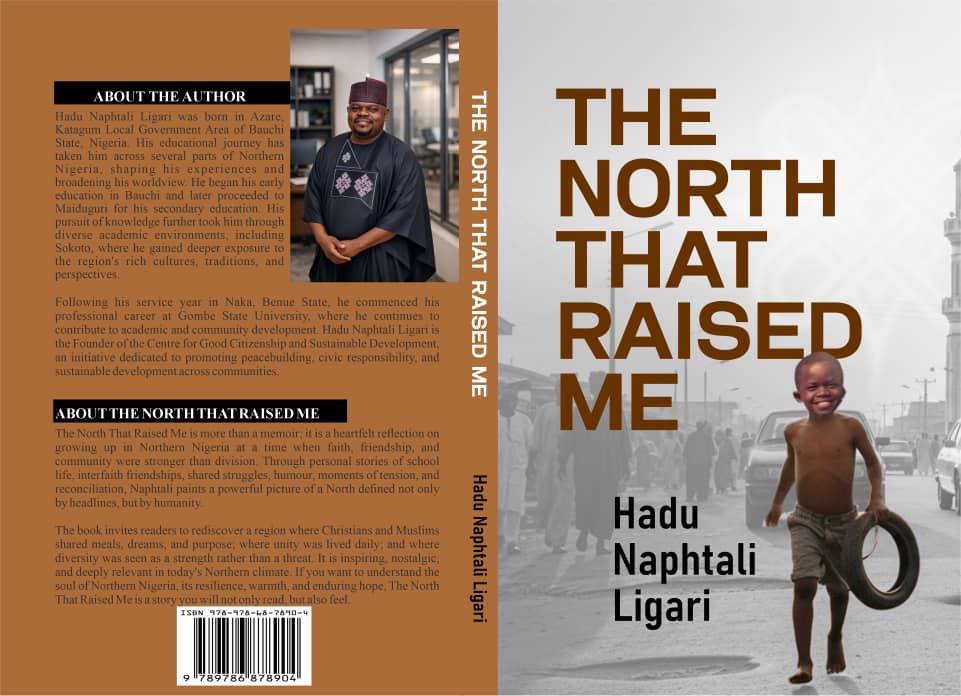
Books occasionally entertain, some educate, and a few challenge the reader to rethink deeply held assumptions. The North That Raised Me by Hadu Naphtali Ligari belongs firmly in the third category. It is not merely a memoir, nor simply a historical account. It is an emotional and reflective narrative that seeks to preserve the memory of a Northern Nigeria where humanity often transcended religious, ethnic, and cultural differences.
From the opening pages, Ligari makes it clear that this is not a conventional autobiography. Instead, he invites readers into his personal journey to illuminate broader questions about identity, faith, community, and the changing character of Northern Nigeria. He also cautions readers against judging the book before reading it in its entirety, describing it as “faction”—a blend of factual experiences and fictionalized storytelling grounded in real events.
The opening chapters are among the book’s most compelling. Through the remarkable account of his birth, the author recounts how a Muslim imam, Mallam Nasiru, placed humanity above religious differences by taking extraordinary responsibility for the life of his Christian neighbour’s wife during a medical emergency. The story is emotionally powerful not simply because of its dramatic events, but because it portrays compassion as stronger than prejudice and neighbourliness as more important than religious identity.
Equally captivating are the author’s childhood memories of Muslim and Christian families living as one extended community. Children played together, shared meals, learned from one another, and even unintentionally imitated aspects of each other’s religious practices without fear or hostility. These stories serve not merely as nostalgic recollections but as evidence supporting the author’s larger argument that peaceful coexistence once formed an ordinary part of Northern life.
The central thesis of The North That Raised Me is clear: Northern Nigeria was never defined solely by religion or ethnicity but by a culture of mutual respect, communal responsibility, and shared humanity. The author argues that many of today’s divisions emerged as those values gradually weakened. Whether every reader agrees with this assessment or not, the book succeeds in provoking thoughtful reflection about what has changed and why.
One of the greatest strengths of the book is its storytelling. Ligari writes with sincerity, allowing personal experiences to serve as windows through which readers can examine broader societal questions. His narrative style is simple yet evocative, making complex issues accessible to a broad audience.
Another notable strength is the author’s willingness to challenge both Christians and Muslims alike. Rather than glorifying one faith while condemning the other, he consistently calls both communities back to the values of compassion, justice, truthfulness, and respect for human dignity. This balanced approach strengthens the credibility of his message and reflects his stated intention of encouraging honest reflection rather than division.
Like every important work, however, the book invites discussion. Much of its analysis is drawn from personal experience and memory rather than systematic historical research. Readers seeking an academic history of Northern Nigeria may therefore need to distinguish between autobiographical reflection and broader historical generalization. Nevertheless, memoirs derive their value precisely from lived experience, and this book does not attempt to disguise its deeply personal perspective.
Perhaps the book’s greatest achievement lies in reminding readers that peaceful coexistence is not built by government policies alone but by ordinary people who choose respect over suspicion, dialogue over hostility, and shared humanity over division. The relationships portrayed between families, neighbours, and communities demonstrate how trust is cultivated through countless everyday acts of kindness.
As someone who has closely followed discussions on Northern identity, national unity, leadership, and interfaith relations, I found The North That Raised Me to be both timely and thought-provoking. It challenges readers to ask difficult questions: Have we lost something valuable in our pursuit of political, ethnic, and religious identities? Can we rebuild the culture of trust that once characterized many Northern communities? And what responsibility does each generation bear in preserving the values that unite rather than divide?
Ultimately, this book is less about longing for the past than about recovering principles that remain relevant today. Its message is not that the past was perfect, but that there were enduring values worth preserving—values of neighbourliness, empathy, hospitality, courage, and mutual respect.
I recommend The North That Raised Me to policymakers, traditional rulers, religious leaders, educators, students, and every Nigerian interested in understanding the human dimensions of our shared history. Whether one agrees with every conclusion or not, the book stimulates meaningful conversation about coexistence, identity, and nation-building.
In an era increasingly shaped by polarization, Hadu Naphtali Ligari has offered readers an invitation to remember, to reflect, and above all, to rediscover our common humanity. That, in itself, makes The North That Raised Me an important contribution to contemporary Nigerian literature.
Reviewed by:
Ibrahim Bunu
Email: ibrahimbunu2520@gmail.com